Archive for the ‘Ancient Asia’ Category
By: The Scribe on March, 2013
Want to know an ancient Chinese secret? Shhh… come closer… good. That rice you’re having for dinner? The sticky rice that’s easy to pick up with your chopsticks? It’s both tasty and practical! If you can’t finish what’s on your plate, no problem! We’ll just make it into a nice paste, and…
Well, the rest is ancient history.
 Turns out scientists have discovered the secret behind a super-strong ancient Chinese mortar that was used to build city walls and buildings that could withstand earthquakes. Sticky rice, or the “sweet rice” that’s a mainstay in traditional Asian dishes, was developed into a “sticky rice mortar” about 1,500 years ago by mixing rice with slaked lime.
Slaked lime isn’t a piece of citrus fruit—it’s actually limestone that’s been heated to a very high temperature and then exposed to water. Sticky rice mortar is thought to have therefore been the world’s first composite mortar using organic and inorganic materials.
Sticky rice mortar just so happened to be more resistant to water than mortar made with pure lime, and thus was used to construct things like city walls, pagodas, buildings, and tombs—some of which have survived to today! Despite disturbances from things like modern construction and earthquakes, some of the sticky rice mortar structures have stayed strong over a thousand years later.

For example, a section of tomb from the Ming Dynasty (1368-1644) is so strong that even modern bulldozers have been unable to destroy or move it.
To get scientific about it, the complex carbohydrate found in sticky rice called “amylopectin” is the secret ingredient that gives the mortar its incredible strength. It’s also thought that the mortar actually gets stronger over time—yes, even over a thousand years later—because the chemical reaction simply continues to occur.
As a result, sticky rice mortar has been used for modern-day restoration work on ancient Chinese structures, such as the conservation project at 800-year-old Shouchang Bride in eastern China.

By: The Scribe on December, 2012
Okay, okay, so it didn’t melt Santa’s workshop. Don’t worry, kids, he’s safe. But 74,000 years ago, a volcanic eruption on Sumatra Island that was 5,000 times larger than the Mount St. Helens blast in 1980 caused acid to rain on both the north and south poles!

As for the supervolcano’s lava, there was enough spewed forth to create two Mount Everests—yes, two.
For years, scientists have debated whether the massive amount of ash and gas that this eruption sent shooting into the atmosphere was responsible for cooling the planet, sending sulphuric acid raining on the poles, and causing severe devastation for early mankind—not to mention whether those effects have lasted.
Previous studies have suggested that the Toba volcano caused a 1000-year ice age, with only ten thousand humans surviving… while another study located evidence that suggested humans were having a lovely time living and thriving in India not long after the eruption. Which one is correct?
Turns out a new study that looked at ice cores from acid rain-tainted areas in Greenland and Antarctica suggests that despite the magnitude of the blast, it might not have been so bad after all. The Antarctic core actually shows traces of a warming event not long after the supervolcano’s eruption, happening around the same time as a cooling signal that was found in the Greenland cores.
What does this mean? “That means there’s no long-term global cooling caused by the eruption. There may have been a shorter [global] cooling of a duration of maybe 10 or 20 years, like we see for more recent volcanoes,” said Anders Svensson, co-author of the new study on the Toba eruption. Considering that these more recent volcanoes are not nearly as powerful as what happened to Sumatra’s Toba, this is significant.
Toba didn’t cause long-term cooling, and it seems that humans thrived on, regardless of the circumstances caused by the eruption—which is remarkable, because the volcano’s fallout is thought to have had environmental impact as far away as India!
While scientists are still learning more about what happened during and after the eruption through ongoing analysis of the ice core data, you can read more from the Toba volcano study in the journal Climate of the Past.

By: The Scribe on April, 2012
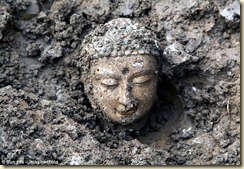 How’d you like to be the archaeologist responsible for finding over 3,000 Buddha heads & statues on your excavation? Or part of the team that has to put the thousands of broken ones back together?
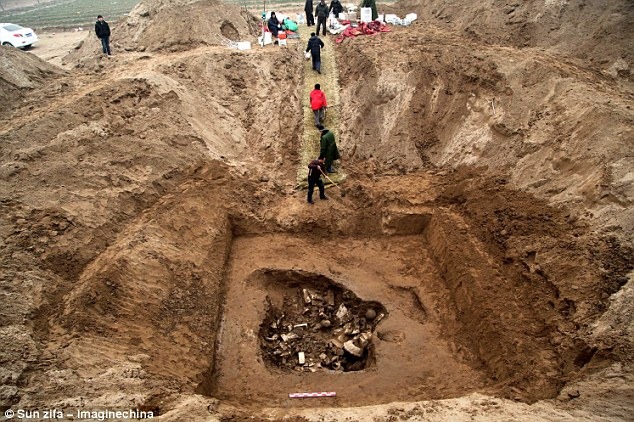
As daunting as the task sounds, this discovery in Handan, China, is so exciting that doubtless the archaeological team from the Chinese Academy of Social Sciences doesn’t mind one bit. The discovery of the Buddha statues is thought to be the largest since 1949, when the People’s Republic of China was founded.
While many of the statues are broken, the majority are made from limestone and white marble, range from eight inches to several feet long, and are believed to be around 1,500 years old, dating back to 534-577 A.D. (Northern Qi / Eastern Wei Dynasties). They were found outside of the ancient capital city Ye, and one early theory is that the statues were buried after the fall of the Northern Qi dynasty, during a period where the rulers attempted to purge Buddhism from the country.
 But rough treatment of Buddhist art wasn’t completely typical of the period, as other sites appear to contain respectful statue burials. Katherine Tsiang, director of the Center for the Art of East Asia (University of Chicago), commented that “it may have been that some of the ruins and broken sculptures from the past were gathered from old temple sites and buried in a pit… in other sites, there are inscriptions that suggest that old damaged sculptures were not just dumped in a pit, but respectfully buried in an orderly way.”
By: The Scribe on June, 2011
Turkey is home to some of the most interesting archaeological digs around. One of the most intriguing would have to be the underground city at Derinkuyu. Of all of the underground cities found in Turkey, the Derinkuyu underground city is the largest.
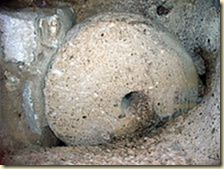 It is unknown exactly why the city was constructed. Archaeologists have found evidence that the city could be sealed off from the inside by means of a series of large stone doors. The stone doors are approximately one meter to a meter and a half in height. They are between 30 and 50 cms thick and weigh between 200 and 500kg. Each of the 11 floors in the city could also be closed off independently of one another.
The city was large enough to comfortably house between 35,000 and 50,000 people. The complex contains wine presses, oil presses, storage rooms, refectories, chapels and even stables. It is believed that the city was built between the 8th and 7th centuries BCE. The people that were believed to have built the underground city were known as the Phrygians. The kingdom of Phrygia was located the west central part of Anatolia. This is part of modern-day Turkey.
The Phrygian kingdom was attacked by many enemies. In approximately 690 BCE they were overwhelmed by Cimmerian invaders from Iran and were also conquered by invaders from the kingdom of Lydia. It finally became part of the Roman Empire and all traces of its language had vanished by the 7th century CE.
The Phrygians had a fairly advanced culture for the Bronze Age. Their music influenced some styles of Ancient Greek music and Midas, the king with the golden touch was mentioned as being a Phrygian. Some of the musical instruments that were used to play ancient music were also created b y the Phrygians.
It is unknown why Derinkuyu was created. The huge stone doors and access to water may 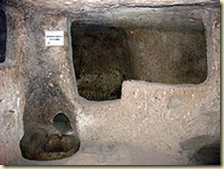 have meant that it was designed to be a stronghold should the Phrygians be attacked. The presence of churches and other religious buildings also suggested that the complex may have been used for religious purposes. Only about ten percent of the stronghold has been excavated and so scientists are still learning more about the structure as they go along. It is believed that while the city may have been started in the 8th to 7th centuries BCE it may have been expanded and enlarged during the Byzantine era. There is some evidence that suggests this work may have been performed during the 5th and 10th centuries CE. This was a time when the city was used more frequently as a means of taking refuge and for religious purposes.
Derinkuyu is only one of several underground cities that have been unearthed in Turkey. Many are located in the same province as Derinkuyu. It is believed that these other underground structures may have been created by ancient Christians as a place where they could retreat to in order to escape being persecuted. Derinkuyu is actually connected to some of these other underground cities through a series of tunnels.
Previous page | Next page