Archive for the ‘Ancient East’ Category
By: The Scribe on November, 2013
It’s not every day that one discovers a secret monastery hidden underneath a historic tomb site… but that’s exactly what has happened in the Linzin Hill graveyard in Amarapura Township, Mandalay Division.
Archaeologists were excavating the tomb of King Uthumphon, who was brought as a prisoner of war to Mandalay Division in the 18th century, after being captured by Hsinbyushin, the third king of Burma’s Konbaung Dynasty.

In 1767, Hsinbyushin invaded Thailand’s ancient capital, Ayutthaya, and brought as many captured people back to his own capital, Ava, as possible for his army to move. The Thai king was among these people, and lived in monkhood until he died in captivity.
King Uthumphon’s life in monkhood during his captivity certainly helps to explain the monastery building hidden beneath his tomb, although archaeologists still aren’t certain whether the King actually lived there or if it was a home for other abbots.
It’s entirely possible that abbots lived there during King Bodawpaya’s reign between 1782-1819, or the building could be much, much older.
While there is still much excavation work to be done, plans are underway for a museum around Linzin Hill, and hopefully future work will shed addition light on the existence of this secret monastery underneath a king’s tomb!

By: The Scribe on January, 2011
The battle of Thermopylae saw 300 Spartans hold back a massive Persian army. But who were the soldiers that faced off against King Leonidas and why were they called The Immortals when they were so obviously mortal? Why were they so feared by the enemies that they went up against?
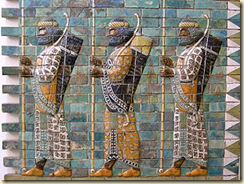 The information that exists about The Immortals is somewhat sparse. It is known that they were troops that fought for the Achaemenid Empire which ws in power in Persia from 550 BCE to 330 BCE. Persia was a true force to be reckoned with. Although the Persians were nomadic originally, they settled on a plateau in southwest Iran. From there, they expanded outward until finally, under the leadership of Cyrus the Great, the empire stretched from the Indus Valley (the eastern boundary of the empire) to the northeastern border of Greece. During its growth, the Persian Empire managed to absorb Egypt, Macedon and Thrace and had absorbed the Median, Lydian and Babylonian Empires.
It is known that these were the elite troops of the Persian Empire. They had several different functions besides taking on Spartans. One was to act as heavy infantry while on duty with the standing army and the other was to act as part of the Imperial Guard.
Because the unit was expected to act as infantry in the standing army they were outfitted as such. The Immortals carried shields and weapons such as spears, swords, bows and arrows and daggers. These allowed them to be very versatile in combat. They wore scale armor which was topped by rich clothing. The Immortals were elite troops. Because of this they were often showered with gold and this showed clearly in the clothing they wore and the equipment that they travelled with. Unlike other troops, the Immortals were allowed to bring women and servants with them. These non-combatants travelled in covered wagons and were dressed very elaborately. The Immortals even received special food that was not given to the remainder of the army.
The uniform of the Immortals was made up of an embroidered, sleeved tunic, scale mail and trousers. They wore tiaras and soft felt caps on their heads. They were armed with short spears, short swords and bows and arrows. In addition to their scale mail shirts they were protected by a wicker shield that each man carried.
Much of the information we have on this unit comes from the writings of Herodotus, a Greek historian who lived from 484 BCE to 425 BCE. He stated that the Immortals always numbered ten thousand men and that any time there was a vacancy (whether due to illness or death) it was instantly filled. The unit was exclusive and soldiers had to apply to join it. They were only accepted if they were of Persian, Elamite or Median ethnicity.
In addition to the battle of Thermopylae, the Immortals also participated in other battles. In 547, they participated in the conquest of the Neo-Babylonian Empire by Cyrus the great and took part in the Egyptian campaign mounted by Cambyses in 525 BCE. In 520 BCE and 513 BCE, the Immortals also took part in fighting in Scythia under Darius the Great.
By: The Scribe on December, 2010
Most ancient buildings were constructed in essentially the same way. Blocks or bricks of hardened clay, mud or stone were fitted together to form walls. These blocks were held together using some form of mortar- a substance which would harden and keep the blocks immobilized so that they could withstand the weather and wear and tear of everyday life. They were built by many different cultures with varying degrees of skill. Some had blocks that were fitted together so tightly that it was difficult to slip a piece of paper between them and they may have appeared to be made from a single piece of stone.
Al Khazneh was built very differently. This is a building found in the Jordanian city of Petra. It has beautiful soaring lines and an intricate façade that begs the question of how it could be created from individual bricks or blocks. The fact is- it wasn’t. This beautiful building is a true marvel as it was carved from a rose colored sandstone rock face.
The city where Al Khazneh is located is a bit of a mystery as well. Petra was believed to have been founded around the 6th century BCE and it is located in the country of Jordan, where it is one of the country’s major tourist attractions. Originally it served as a center of the Nabataean caravan trade routes. It was built within rock cuts and was incredibly easy to defend. To reach the city from the east, for example, it is necessary to travel through a deep rock cleft. The area formed a sort of natural oasis and water was plentiful. The Nabataeans were able to create dams and reservoirs so they could channel and store the water in the area, making it a refuge that was also incredibly hospitable.
Because much of the city is carved from rock it is no wonder that the Nabataeans were known for their carving ability. Al Khazneh is considered to be the pinnacle of their carving, however. They removed the rock by exploiting its natural fissure lines and were able to recycle the stone that had been cut away for other buildings. The façade of the building has columns and is designed with many familiar elements of Western architecture. The Nabataeans had contact with other cultures such as the Greeks due to their active participation in trading items such as frankincense, myrrh and other luxury items. At its height, the Nabataean empire reached as far north as Damascus and as far south as Hegra.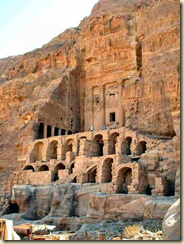
Although Al Khazneh is thousands of years old it continues to attract attention even now. The building has been used as a backdrop for several movies. Two of the most famous include Indiana Jones and the Last Crusade, and Transformers; and Transformers:Revenge of the Fallen. While the purpose of Al Khazneh varies depending on which film you are watching the original purpose for this unique and beautiful building is still a mystery.
By: The Scribe on November, 2007

Tigranes seemed to be set: he had an enormous amount of territory, vast armies at his disposal, and more than enough resources to boot. What could possibly go wrong? Of course, there was one thing he hadn’t counted on – the return of troublesome in-laws. Indeed, his father-in-law Mithridates IV managed to find refuge in Armenian lands after his peace treaty with Rome, and had been hiding out there ever since.
It was inevitable that Tigranes would eventually have his own conflict with the Romans – the two greatest powers in the world had to come to a head one way or another, since there was only so far either of them could expand before running into each other. The Roman general Lucullus was in control of the army now, and it just so happened that he knew where Mithridates IV was hiding. Rome demanded that Mithridates IV be expelled from Armenia, but naturally, Tigranes simply couldn’t give up his ally and father-in-law.
So, Tigranes went to battle with Rome in 69 BC because his father-in-law needed a place to stay. The battle was held at the city of Tigranocerta in Armenia, and though by all rights it should have been an easy victory, some of the non-Armenian guards betrayed Tigranes in the midst of battle by opening the city gates to the Romans – which forced Tigranes to redirect 6000 of his cavalrymen into the city in order to rescue his wives, children, and other assets. As a result, Tigranes officially lost the battle.
Not one to be shafted from victory, Tigranes and Mithridates regrouped and met Lucullus at the city of Artaxata the following year. The Armenian and Pontic forces were 70,000 strong, and cut a devastating swath through the Roman legions – so bad were the losses that between 68 and 67 BC, Lucullus’ troops staged three mutinies! Finally, Lucullus realized he was fighting a losing battle, and moved the fight in a different direction – instead of continuing to fight on the rough terrain of Northern Armenia, he moved south to plunder lands held by Tigranes’ brother.
Even so, Lucullus’ plan was a failure, and he was not able to defeat or capture either Tigranes or Mithridates. Disgusted in his performance, he was recalled by Rome and replaced with a new general: Pompey the Great. Meanwhile, Mithridates was able to return to Pontus with an army of 8,000 men, and Tigranes proceeded to recover much of his former territory. However, in the process, he fought and defeated his younger son who had accepted an army from Parthia – forcing the man to seek protection under the newest Roman general.
With his lands recovered and fully believing himself secured against Rome, Tigranes’ confidence would become his downfall. In 66 BC, Pompey advanced into Armenia with the younger son of Tigranes allied at his side. Realizing his mistake, Tigranes the Great – now nearly 75 years old – surrendered to Rome. To Rome’s credit, Pompey actually treated Tigranes with great dignity and generosity, allowing the former ‘king of kings’ to retain some portions of his empire in exchange for only 6,000 talents of silver. As for the unfaithful son, both Tigranes and Pompey agreed to send him back to Rome as a prisoner.
And so, until his death in 55 BC, Tigranes the Great – held in great respect by Rome for his military skills and vast territorial accomplishments – was thus allowed to rule Armenia as a Roman ally.
Want to read more?


Tomorrow: More Ancient Standard
Next page


