Archive for the ‘Ancient Mediterranean’ Category
By: The Scribe on August, 2007

The ancient town of Tiberias is located on the western shore of the Sea of Galilee in Israel, and is perhaps most famous for its prominent place in Jewish history – even though its origins are situated in Rome, since it was built by around 20 AD by Herod Antipas, son of Herod the Great, and named after the Roman Emperor Tiberius.
Recent excavations in Tiberias have exposed finds that date to the town’s founding during the 1st century, as well as a Byzantine church from sometime between the 4th and 5th centuries AD. The mosaics that were uncovered in this church are incredibly detailed and extremely colorful, and are decorated with geometric patterns of shapes and crosses.
In addition, there are three inscriptions written in ancient Greek that appear to be dedications – part of one of the inscriptions begins: “Our Lord, protect the soul of your servant…”. Another mosaic has a prominent medallion in the center with a large cross inside and the Greek letters alpha and omega, which was a typical Byzantine monogram for the name of Jesus.
Since this is the oldest church to be discovered in Tiberias thus far, it is interesting to see that the buildings which surrounded the church in ancient times were far from religious – they were typical public buildings, including a bathhouse, some shops, and a basilica. What is more, the church was built right in the center of the city, which falls contrary to the previous notion about Christian and Jewish relations at the time.
It was originally theorized that the Jewish leadership at Tiberias prohibited Christians from establishing their own places of prayer in the middle of the town, instead claiming this area for exclusively Jewish religious needs. The position of this church now disproves the theory conclusively – apparently town planning and Christian-Jewish relationships at Tiberas during the Byzantine era were not as straightforward as previously thought.
Although the exact date of the church’s construction is not yet known, there was a decree issued in 427 AD that prohibited the placement of crosses in mosaic floor designs, after it was decided that stepping on a sacred symbol was not appropriate. Since there are a large number of crosses in the mosaic designs from this church, at the very least, it was constructed before the ban was put into place.
Want to read more?

Tomorrow: Extreme home makeover…in ancient Egypt!

By: The Scribe on July, 2007

Around six million years ago, something rather drastic happened: the world lost an ocean. Fortunately, it’s returned since then, but during the Messinian Salinity Crisis, there was no Mediterranean Sea. Instead, there was a bit of a wading pool… or possibly even completely dry land.
During the Messinian period of the Miocene epoch, it seems that what is now known as the Strait of Gibraltar actually closed up, disallowing the flow of water from the Atlantic and resulting in the Mediterranean seabed simply evaporating – in some places up to 3 miles below sea level. As this occurred, there were also some cases of extreme erosion, creating several enormous canyons in and around the coastline, after which the evaporation procedure left behind deposits of evaporite mineral sediments.
It was during some routine geological work in the Mediterranean that geologists found evidence for this ancient desiccation of the sea, as they found mineral deposits that only form when large amounts of isolated salt water evaporate over time. Combined with layers of marine fossils, which indicats repeated periods of drying and flooding, as well as now submerged canyons that are cut into the sides of the sea basin, geologists realized there was enough evidence to confidently assert that, for some period of time, there was no Mediterranean sea.
During the period of dehydration, earth’s sea levels rose by 10 meters – if this happened today, many of the world’s major cities and landforms would be completely submerged! The global climate was also changed during this time, causing almost the entire Mediterranean basin to become a wasteland devoid of plant and animal life, and at 3 meters below sea level inside the basin, the temperature would have been almost 50 degrees hotter at the bottom than the temperature at sea level. With that kind of heat in and around the basin, added to the increased salinity of the area, the great civilizations of Egypt, Greece, Rome, and any other known Mediterranean culture could not have developed – unless the sea was refilled.
Eventually, the Strait of Gibraltar opened again, allowing water from the Atlantic to once again refill the Mediterranean basin, but not until the earth’s oceans had already been permanently altered by the loss – the freezing point of the ocean had been raised, and the average salinity of seawater significantly reduced. Even today, the salinity of the Mediterranean is higher than the North Atlantic, and thus it continues to have a higher rate of evaporation.
Want to read more?


Tomorrow: Iranian Salt Men.
By: The Scribe on June, 2007

Sometime between 1800 and 1200 BC, a group of settlers arrived on the island of Sardinia in the Mediterranean, and proceeded to build over 30,000 stone towers across the landscape. Although only around 8,000 of these structures survive to date, it appears that the network of towers – called Nuraghe – was constructed so that each tower had a line of visibility to the next, forming a strategic chain of visual communication.
Nuraghe were built in a beehive or truncated cone shape, and relied on the weight of the stones – instead of a typical building foundation – to keep the structures in place. Standing up to 20 meters in height, it remains unknown as to what exactly these structures were used for. Suggestions have been made, such as: chieftain dwellings, religious structures, military strongholds, or place of assembly for local governors. While all ideas are certainly credible, it should be considered that the Nuraghe are all placed in strategic locations across the island – not only did each tower have visual contact with its neighbor, but they were also placed along important passages on the island.
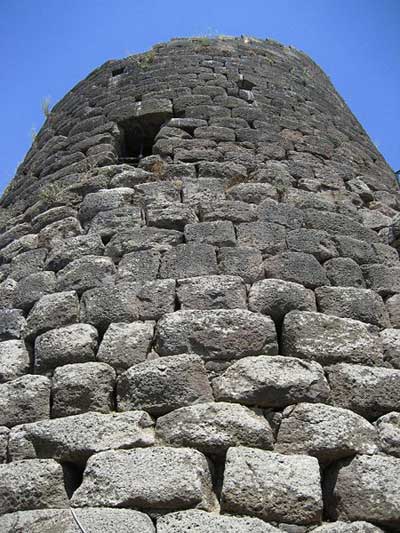
The most important Nuraghe in Sardinia is at the site of Barumini, where an entire complex was constructed about 1500 BC around a three-story tower. Now considered a UNESCO World Heritage Site, Barumini was once a fortified village with a number of smaller Nuraghe centered around the three-story one, containing many corridors as well as a cache of small, bronze statues.
Although little is known about the so-called “Nuragici people”, they left behind some other small pieces of art, such as stone carvings and statues of female goddesses, and bronze representations of chieftains, hunting men, warriors and animals.
It is also speculated that the Nuragici had contact with the Mycenaean and Phoenician cultures during the height of their cultural development, which may have had some influence on Nuragici art and architecture. The Mycenaeans, renowned for their megalithic defensive architecture, may have provided inspiration for the strategically located, giant Nuraghe towers, while Phoenician skill at bronzeworking may have influenced the Nuragici’s use of bronze for their artistic statues.
Want to read more?

Tomorrow: Down with Dowsing
By: The Scribe on April, 2007
 In the 7th century BC, Greek colonists arrived on the Libyan coast and established the city of Cyrene. The Greek scientist Theophrastus (ca. 370-288 BC) wrote a detailed account of the expedition, explaining how not long after the colonists’ arrival, they discovered a plant called ‘silphium’. The city would soon come to depend on this plant for its high trade value, and its existence was crucial for the Cyrenian economy.
Generally considered to be an extinct “giant fennel”, the plant was valued both for its use in seasoning foods, as well as for its unique ability to affect cures for a number of ailments. Cooking aside, sap from the silphium plant was used to treat everything from coughs, fever, indigestion, to sore throat, aches, warts, and more. What it was most valued for, however, was its use as an herbal contraceptive.
It is thought that the plant may have been active in the prevention or termination of pregnancy. The Roman physician Soranus, also known as the most famous gynecologist of the ancient world, wrote in a medical treatise that women should drink about the size of a chick pea’s worth of silphium juice, mixed with water, once a month. He claimed that this “not only prevents conception, but also destroys anything existing.”
While silphium was eventually harvested to extinction, there were also several other plants in antiquity purported to have prophylactic abilities: Queen Anne’s lace blocked a woman’s internal cycle, while even in modern times, pennyroyal contains a substance that can terminate both human and animal pregnancies.
Although much of the information from antiquity concerning contraceptive herbs and medicinal remedies for pregnancies has been lost, one thing remains clear: women in and around ancient Greece and Rome definitely had a great deal of control over their reproductive decisions.
Want to read more?


Tomorrow: Woman beating prince.
Previous page | Next page
