Archive for the ‘Ancient North America’ Category
By: The Scribe on June, 2013
 The next time you’re craving a chocolate fix, remember—it’s only human! Humans have been yearning for the bittersweet treat for hundreds (maybe thousands?) of years… and a recent discovery at a settlement in Utah may have set the “chocolate in America” date back by 200 years!
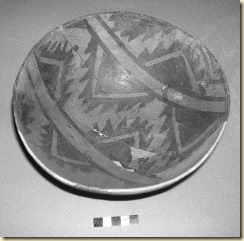
The site, which dates back to the 8th century and is known as Alkali Ridge, contains the oldest known traces of chocolate found in the USA. Dr. Dorothy Washburn, a researcher from the Museum of Archaeology and Anthropology at the University of Pennsylvania, studied residue from 18 pottery vessels taken from the site in the 1930s, and found that 13 of the vessels contained traces of cacao (more commonly known as “cocoa”).
The jars, bowls, and pitchers contained evidence of theobromine, which is a chemical compound found in chocolate (yep, that’s the one that’s safe for humans, toxic for dogs!). The only other North American plant that’s known to contain the substance is a toxic holly plan, occasionally used by Midwestern cultures to induce “ritual vomiting.”
Critics who cite that it might have been the holly in the jars are mistaken, according to Washburn. “The only conclusion can be that it’s cacao,” she says, because cacao was known to have been a staple of life in Mesoamerica—and the holly only grows in the Southeastern USA.
And as for how cacao made its way to the Southwest in Utah? Well, that’s another mystery. It’s possible that it arrived through trade routes… or, even more likely, through the movement of people from one place to another.
 During this period, it’s possible that people living in Mesoamerica were making their way up to the American Southwest, using trade routes to migrate and find new places to live. Today, it’s not unusual for people to do that same thing—immigrate from Central America to the Southwestern United States. Maybe they just arrived earlier than we’d thought!
The pottery that the traces of cacao were found in is another clue as to what the plant was doing in Utah—the pottery isn’t at all like what was the typical local pottery of the time, indicating that different people were living alongside the Pueblo culture of the area and continuing to create their own traditional pottery and pot designs.
During the 8th century, Mesoamerica was in the midst of an upheaval—by the year 900 A.D., many Mayan city states had collapsed, and people were on the move… and Washburn believes some of them ended up at this little site in Utah.
(More research on this find has been published in the Journal of Archaeological Science.)

By: The Scribe on June, 2013
Deep in the Canadian North… in a frigid town called Timmins, where even polar bears fear to tread… there’s been–
Editor: Wait, wait. Hold up. What do you mean, “deep in the Canadian North?” You mean Timmins, Ontario, home of Canadian country pop sensation Shania Twain?
 Umm… yes.
Editor: That’s what I thought. Please continue.
Right. Ahem.
So, as we were saying, in a small town in northeastern Ontario where it’s not quite as cold as some people would like to believe (you have to go much further north for that), a team from the University of Toronto made a rather incredible discovery.
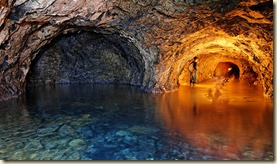
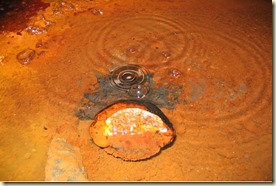
Inside boreholes in the Timmins Mine, about 2.4 kilometers below ground level, the team collected samples of ancient water that is estimated to be between 1.1 and 2.6 billion years old.
Yes, that’s as old as the rocks in the mine! When the surrounding rocks formed, that depth of 2.4 kilometers down? Would have been ocean floor. That means folks who walk around in the Timmins Mine in those boreholes are walking on 2.6 billion-year-old seafloor.
The team who collected the samples found that the water contained rich amounts of dissolved gases, such as methane and hydrogen. These gases can provide energy for microbes that tend to be found around hydrothermal deep-ocean vents.
Barbara Sherwood Lollard, an Earth Scientist and co-author of the water study, says that a find like this “shows us that there’s been very little mixing between this water and the surface water; what we want to do … is see if we can narrow that [age range] down.”
By measuring the concentrations of other rare gases in the water—neon, helium, argon, and xenon—the team was able to make its estimation of the water’s age, ie. how long it had been trapped underground, and whether it had interacted with any other water or if it remained isolated all that time.
 The next step to this find is in testing the water for microbes—yes, living microbes that might be billions of years old! Some ancient microbes can survive for that long without access to sunlight, and can reveal new information about the development of life on Earth.
This ancient water provides the necessary evidence to prove that pockets of water can exist in isolation under the Earth’s crust for billions of years—and may have implications for the possibility of life on other planets!
Geochemist Steven Shirey has weighed in with his thoughts on the study, saying that “if you think that you can have microbial life throughout the entire crust of the Earth, then all of a sudden it becomes very possible that life could live on other planets under the right condition.”
Considering that there’s known to be warm rock under the cold surface of Mars, it’s possible that water may still exist… and perhaps some ancient Martian microbes?
(Editor: Hmm… The Ancient Standard: Mars Edition… that sounds pretty good…!)
By: The Scribe on June, 2013
 Everyone has that friend… you know who it is… the one who shows up late, but gets really excited about arriving and expects everyone else to get excited too? Well, it may be that Christopher Columbus was one of those friends.
Except with, you know, arriving on “newly discovered lands” and all that.
Christopher Columbus has long been known for being the “discoverer of the New World”, crossing the vast waters between Spain and the Caribbean in 1492—and of course, finally setting foot in America. Which he thought was India. Chris was definitely a special guy.
But here’s the thing—a British adventurer, a former Royal Navy officer named Philip Beale, believes that Columbus may not have been the first to set foot in the Americas. His theory is that the Phoenicians actually reached the New World a staggering 2,000 years before Columbus even knew what a boat was!
Beale said, “of all the ancient civilizations, they were the greatest seafarers—Lebanon had cedar trees perfect for building strong boats, they were the first to use iron nails, and they had knowledge of astronomy and currents.”
The theory is based on the writings of the ancient Greek historian Herodotus, who wrote that the Phoenicians circumnavigated Africa in 600 B.C.
And whether this theory is true or not, it is known definitively that Columbus wasn’t the first man on the scene—Viking settlements in Newfoundland place the New World’s discovery at least at 900 A.D. That makes Chris the second arrival at best… but possibly the third.
Will it ever be known for sure whether the Phoenicians made it to the Americas? Probably not. A number of artifacts that were thought to be of Phoenician origin, discovered on American soil, turned out to be forgeries.
Still, the incredible sailing abilities of the Phoenicians make it worth considering… did they discover America?
By: The Scribe on May, 2013
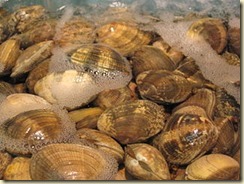 Now, that’s a gardening exhibit you won’t see every day… clam gardens?!
But that’s what researchers are calling the ancient food storage system found on Russell Island’s beach in British Columbia. The clam gardens were discovered six years ago, and University of Victoria students are still helping to sift gravel, sand, and shells to figure out the origins and purpose of the gardens.
The clam gardens aren’t gardens in the traditional sense of the word—ie. where you’d find an abundance of plant life—but rather they’re locations where clams are able to grow naturally, abundantly, and where the environment in those locations can be manipulated to increase clam production. Sort of like feeding compost to a backyard garden to help it grow.
It’s thought that the clam gardens are at least 1,000 years old, but possibly older. The gardens look like small fields constructed on the beach at low tide (a necessity!), with rock walls surrounding the locations. The walls would have helped provide a barrier to stop seaweed and predators from getting inside the garden and damaging or disturbing the growing clams.
And just like a backyard gardener does when taking care of his or her plants, whoever tended the clam garden would have needed to till the sand (so to speak) to keep the oxygen flowing.
Who built the clam gardens is another question entirely. A thousand years ago, an aboriginal community lived on the island, so it’s possible that the clams were used for both food and trade—but that said, clam gardens are a new(ish) discovery for Canadian archaeologists, with the first one discovered only as recently as 1995.
Inevitably, there’s still much to be learned about these ancient clam gardens, and it’s possible that there are many more out there still to be discovered.
Next page
 The next time you’re craving a chocolate fix, remember—it’s only human! Humans have been yearning for the bittersweet treat for hundreds (maybe thousands?) of years… and a recent discovery at a settlement in Utah may have set the “chocolate in America” date back by 200 years!
 During this period, it’s possible that people living in Mesoamerica were making their way up to the American Southwest, using trade routes to migrate and find new places to live. Today, it’s not unusual for people to do that same thing—immigrate from Central America to the Southwestern United States. Maybe they just arrived earlier than we’d thought!


