Archive for the ‘Ancient Scandinavia’ Category
By: The Scribe on January, 2008

The earliest form of alternate transportation for humans wasn’t the wheel after all – it was something much simpler, and much less time-consuming to build… not to mention convenient for winter! That’s right: northern Europeans invented ice skates around 3000 BC, which would have assisted humans in saving energy on their daily travels – not to mention help them move from one place to another much more quickly!
The first skates were made of animal bones in southern Finland, where the extremely high density of lakes would have resulted in a rather treacherous landscape for humans trying to cross frozen bodies of water on foot. And so, someone devised the brilliant idea of trimming down horse and cow bones, piercing them at either end, and strapping them onto one’s feet with leather thongs.
Unlike the skates known to Olympic athletes and minor hockey players today, these ancient skates actually were not used on their own, but were complemented by a long stick that was used at the same time. Skaters would strap the skates to their feet, straddle the stick, and pole themselves along the ice – think of cross-country skiing, except with only one pole and on skates instead of skis.
The thing is, skating is an awfully strange activity to have developed as a hobby – it seems like a much more practical idea to have come from humans living in the frozen lands of northern Europe, where surviving was a priority and winters were incredibly harsh. Ice skates would then allow hunters to find food with less energy expenditure, which meant that less food needed to be consumed to survive – which tends to be a bonus under extreme winter conditions.
Although experiments in reconstructing the ancient skates showed that a person would have moved quite slowly while using them – around 2.5 miles per hour – the energy expenditure in using the skates on Finland’s nearly 60,000 frozen lakes would have reduced a human’s energy requirements by around 10%.
Talk about a legacy in human history!
Want to read more?


Tomorrow: More Ancient Standard

By: The Scribe on October, 2007
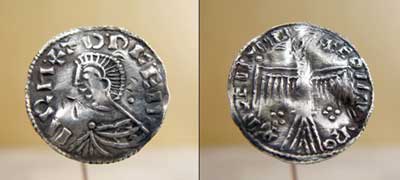
Once upon a time, a local Swedish gardener was minding his own business, tending his vegetable patch on the island of Gotland, when all of a sudden… he realized it wasn’t a rutabaga he pulled out of the ground, but a hoard of Viking treasure! Indeed, he had found a treasure trove of silver coins from Europe, Central Asia, and the Middle East, all dating to around 970-1030 AD.
The garden trove yielded 69 coins, and the cache as a whole has been identified as a Viking “safety-deposit”, which was not unusual – Vikings and Anglo-Saxons would bury their stash of loot somewhere in the ground, with every intention of returning for the money in the future when it was needed.
In addition to coins from Eastern Europe and beyond, there were several extremely rare Viking coins in the cache, which were likely paid to the owner as protection or plunder money, also known as ‘danegeld’. Danegeld was paid to Viking groups by regional rulers, in order to bribe them out of attacking their cities or towns – which was an easy way for the Vikings to make some extra cash for little work! The rare coins were minted for a regional Swedish king named Olof Skotkonung, who was actually the first king to mint coins in Sweden. He had probably learned the trade from England.
Many other coins in the horde were copies of English coins made by Ethelred II, who was the British monarch between 978 and 1016. He was often referred to as “Ethelred the Unready”, since he lacked reliable counsel and greatly preferred the option of paying massive amounts of “tribute” cash to the Vikings, rather than face them in armed conflict.
As for the Asian coins found in the treasure trove, they would have come from the Vikings’ transactions while moving along their extensive trade route – often, Viking ships would travel all the way along the Russian rivers into the Middle East! And since Gotland in Swedenwas situated right in the middle of the Viking routes – between eastern and western Europe – it was a natural stopping point for Vikings to stash their cash before continuing onward in their travels and trade.
In total, the area of Gotland has actually yielded between 700-800 Viking treasure hoards, with the majority of the coins originating from the Middle East. Many of the coins in this and other caches also show evidence of ‘pecking’, which results from someone poking at the surface of a coin with a knife, in order to determine whether or not it the coin is real silver or a lead counterfeit.
Want to read more?


Tomorrow: Soggy Rice in Stone Age China
By: The Scribe on September, 2007
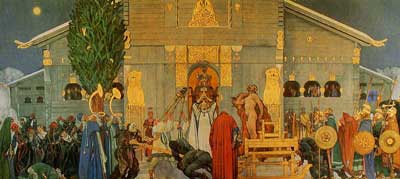
No, it’s not a splash of spilled ink… the ancient Norse blot was actually a pagan sacrifice to the Norse gods and the Elves, held at several times throughout the year. The sacrifice typically took the form of a sacramental feast or meal, and the sacrificial victims tended to be pigs and horses. The meat from these festivals was then boiled in enormous cooking pots heated by stones, and the blood from the animals was sprinkled on the community’s statues of their gods, on the walls, and on the people, as it was believed to hold special magical powers.
The word “blota”, from which the sacrificial festival took its name, means “to worship with sacrifice” in Old Norse, and the people would gather around the boiling pots of meat as it cooked, believing they were having a meal with the Elves! They also passed around a drink that was blessed and considered sacred, each person taking a drink as the cup came into their hands. Typically, the drink would be either beer or mead, while the high-class nobility often imported wine just for the occasion!
Several blots were held throughout the year, one in October and then later on, one in December called “The Great Midwinter Blot.” Interestingly enough, the tradition of eating ham at the December blot has continued, as it still tends to be the main course at Christmas feasts in Scandinavian countries. Around April, a third ‘summer’ blot was held in honor of the god Odin, celebrating the beginning of the season of war and Viking raid expeditions.
Blots were actually held in their own little blot buildings called ‘hovs’, however most hovs were destroyed or built over during Christianization of the area – namely, medieval churches were built overtop these spots in an effort to redeem the land. Several laws were also put into place that forbade various forms of pagan worship, but the traditions were so ingrained into the local culture that elements of the rituals have survived until today, such as the Christmas tradition.
Each Scandinavian country had their own variations on each blot throughout the year, though the basic concept remained the same: kill a pig, have dinner with elves!
Want to read more?


Tomorrow: more Ancient Standard!
By: The Scribe on August, 2007
 In the summer of 2007, a student in western Finland working on an archaeological dig came across an interesting find – it was a lump of birch bark tar from about 6,000 years ago! Based upon the time period that it was from, as well as the appearance of the lump of hardened substance, it didn’t take long to deduce that it was, in fact, a piece of ancient chewing gum.
It is known that during the Neolithic period, humans used birch bark tar as an antiseptic to treat mouth sores like gum infections, or even for household tasks such as repairing a pot. Birch bark tar in particular contains something called “phenols”, which are antiseptic compounds that help to treat infections naturally.
Chewing sugar-free gum – whether it is modern gum or ancient birch bark tar – also helps to stimulate the production of saliva in the mouth, which works as a preventative method against tooth decay.
In the case of this ancient piece of birch bark tar, there are tooth marks remaining on the piece of gum that confirm it was in someone’s mouth thousands of years ago! Interestingly enough, an amber ring and a slate arrowhead were also found near the ancient treat.
Even if they weren’t necessarily aware of the gum’s medicinal properties, it appears that humans of all millennia have enjoyed popping a tasty, chewable treat into their mouths… perhaps they even had their own troubles with scraping used gum off of sandals.
Want to read more?


Tomorrow: Eagle vs. Shark? Forget it…Griffins vs. Deer!
Previous page | Next page
