Archive for the ‘Ancient Scandinavia’ Category
By: The Scribe on August, 2007
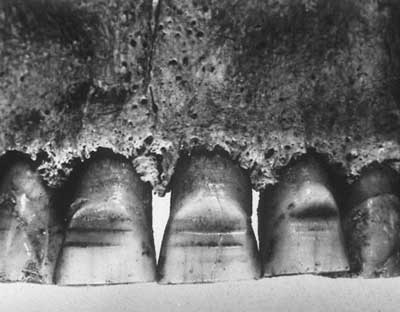
As fierce and merciless as their reputation may have been, one thing is now clear: the Vikings took pride in their outward appearance. In fact, they were so concerned with looking good that they actually did something that might be considered strange to those who were not part Viking culture – they filed their teeth.
A study of 557 Viking skeletons revealed that 24 of the bodies’ mouths had deep, horizontal grooves across their set of upper front teeth. Although other cultures around the world were known to have practiced dental modification in ancient times, this is the first known occurrence of it on human skeletons from this part of Europe.
It is an interesting find, because Vikings have typically been known for their seafaring abilities and violent church and monastery raids in ancient Britain and France. Facial decoration simply does not seem to conform to the habits of gold and silver acquisition that the Vikings practiced – however, it is entirely likely that they picked up on the idea from another foreign culture.
Since the Vikings were expert seafarers, it is possible that they learned of dental modification after coming into contact with some West African cultures during one of their voyages across the Mediterranean, or perhaps even as far away as North America – the only other known place where horizontal tooth marks occur is in the Great Lakes region and several other adjoining American states.
The actual tooth markings appeared to cut quite deeply into the enamel, and the markings tended to happen either in pairs or sets of three. The consistency of the markings also rules out any suggestion of this occurring through natural wear or using the teeth as a tool – the depth of filing and the placement on the teeth indicate that the grooves are decorative and were probably done by a very skilled hand.
Why these Vikings chose to file their teeth remains a mystery, however the most likely explanation is that it was representative of an achievement. It could have been a way to socially identity certain individuals of marked status, and if filled in with colored pigment – which Vikings often used to color their faces or tattoo their own skin – they would have looked even more terrifying to the villagers they were raiding.
On the other hand, there is evidence that most Vikings spent time combing their hair and ironing their clothes with hot rocks – so perhaps filing one’s teeth was an expensive way of making oneself more aesthetically pleasing… a kind of Viking answer to modern plastic surgery.
Want to read more?


Tomorrow: Mega volcano eruption? No problem!

By: The Scribe on July, 2007
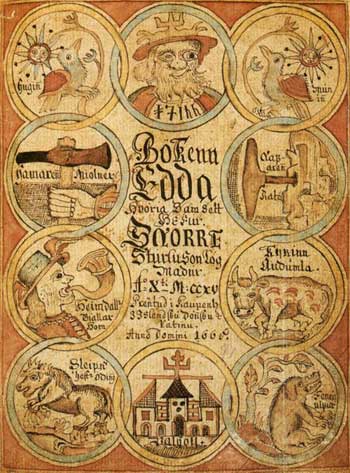
During the Viking Age in Scandinavia, there was a group of poets who performed their poetry in the courts of Viking leaders and kings – this so-called courtly poetry, more commonly known as Old Norse poetry, would be performed in solo by a poet called a skald.
Each skald tended to emphasize the deeds of his king in his poetry, and the constructed poems tended to be subject to rather intense technical demands. These complicated forms of verse were comparable to those of Welsh bards, and in the same manner, the topics of poetry were rather limited to testimonials and memorials of a king’s or well-known aristocrat’s battles and deeds. In fact, it wasn’t unusual for a Viking king himself to take an interest in poetry, and many kings actually became their own skalds! For this reason, the majority of skaldic poetry that survives today can be attributed to specific authors and kings.
As time moved on, the 10th century began to see an increase in syncretizing of pagan and Christian themes, and by the 11th century, skaldic poetry had become extinct in a Christianized Scandinavia. Icelandic skalds continued to practice well into the 13th century however, which gave many of the poets time to write down their own compositions as well as traditional poems that might have otherwise been lost. One skaldic poet even compiled a manual called the Prose Edda, hoping to preserve an understanding of this poetic art for the future.
To make matters a little more interesting, skalds also tended to compose other pieces of poetry that weren’t necessarily meant for recitation in the court. They were known to have composed satire, and on rare occasions, they constructed erotic verses called ‘mansongr’. Unfortunately for the skalds, the writing of mansongr was forbidden in many Norse jurisdictions under penalty of death.
Why? Not because of any moral objections, but because leaders were afraid of the poems’ potential for magical ensnarement! Erotic and love poetry often contained magical charms in several verses, and on other occasions, love poetry was seen as a smear on a woman’s reputation – thus potentially harming her family’s reputation as well.
Want to read more?


Tomorrow: To kill a Mayan scribe…
By: The Scribe on June, 2007

What are these stones, and why do they seem to be named after canned preserves? The truth is, they’re actually named after the town of Jelling in Denmark, and currently rest in one of Jelling’s churchyards between two large, earthen burial mounds.
These enormous rune stones were carved in the 10th century, during the transition period between traditional Norse paganism and Denmark’s Christianization. Due to the lack of written history for most of Scandinavia’s past, the few inscriptions found on these stones are quite valuable for their historic worth.
The smaller – and older – of the two stones was set up by King Gorm the Old, the last ‘pagan’ king of Denmark, as a memorial for his wife, Queen Thyre. The larger stone was erected by Harold Bluetooth in memory of his own parents, King Gorm and Queen Thyre.
The Jelling stones have a strong association with the establishment of Denmark as a nation, a notion which may have originally come from the inscriptions. The older rune stone reads: “King Gorm made this monument in memory of Thyvre, his wife, Denmark’s salvation”.
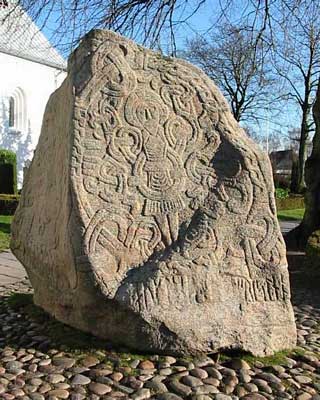
The Bluetooth inscription says:
“King Haraldr ordered this monument made in memory of Gormr, his father, and in memory of Thyvre, his mother; that Haraldr who won for himself all of Denmark and Norway and made the Danes Christian.”
This stone also has an image of Christ on one side, and a picture of a lion wrapped in a serpent on the other.
Want to read more?


Tomorrow: More fascinating stuff!
By: The Scribe on April, 2007
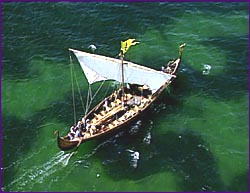 Before the heyday of the compass, the Vikings of Scandinavia traversed the seas in their Norse ships, relying on sundials to help navigate the open waters… but what did they do on cloudy days?
Researchers in the past have suggested that Vikings may have used rock crystals known as ‘sunstones’ to assist in navigation during overcast conditions. Although there is no official archaeological evidence to support this theory, in early 2007 a team sailing the Arctic Ocean aboard the Swedish icebreaker Oden found that sunstones could indeed “light the way” in foggy or cloudy conditions.
Although the concept of a ‘sunstone’ is known only from an ancient Viking legend, the theory on its usefulness for navigation was first put forth by Danish archaeologist Thorkild Ramskou in 1966.
These rock crystals work as natural polarizing filters, changing brightness and color as they detect the angle of sunlight. Using these changes, Vikings could have determined which angle the light was coming from, and thus determined the sun’s orientation.
Since there is no concrete evidence of these sunstones, the matter is still under dispute. However, with recent studies confirming the reliability of sunstones for navigation in overcast conditions, it does not seem implausible that the Vikings could have made use of such technology for nautical purposes.
Want to read more?


Tomorrow: Swimming in…..the forest?
Previous page
