Archive for the ‘Ancient South America’ Category
By: The Scribe on August, 2013
 The ancient Incan ritual of capacocha is known by historians and archaeologists as an event which culminated with human sacrifices—and the 500-year-old bodies of several young child sacrifice victims were found a number of years ago near the summit of Volcan Llullaillaco in Argentina.
As study continues on the bodies, these three ridiculously well-preserved victims have revealed some previously unknown details about the ritual sacrifice, as well as put a human face on our historical understanding of the event. One of the Inca mummies was a 13-year old girl, with the other two a little younger at the time of their deaths.
The ceremonial processes to ready these children for the sacrificial event took place over the course of a year, and a biochemical analysis of the “Llullaillaco Maiden’s” hair showed scientists what she ate and drank for the final two years of her life.
The markers in her hair showed that her consumption of coca and alcohol (chicha, the maize-brewed beverage) increased at approximately a year before her death—likely when she was selected as a sacrificial victim.
Forensic and archaeological sciences expert Andrew Wilson of the University of Bradford commented that “we suspect the Maiden was one of the acllas, or chosen women, selected around the time of puberty to live away from her familiar society under the guidance of priestesses.”
 Notable was the Maiden’s consumption of coca, a hallucinogenic substance, which increased at 12 months before death and then again at the 6 month point. She used a significant amount of coca during those final 6 months, but it was the alcohol consumption which really spiked in the final weeks before death.
“We’re probably talking about the last six to eight weeks … that she’s either compliant in taking this or is being made to ingest such a large quantity of alcohol … the coca and chicha alcohol, might be used in almost a controlling way in the final buildup to the culmination of this capacocha rite and her sacrifice.”
On the day of sacrifice, the drugs and alcohol may have made her docile, or perhaps “put her in a stupor” or left her barely conscious. The Maiden’s relaxed, seated position—and the presence of chewed coca leaves in her mouth—support the theories.
And while prior discoveries of victims in this particular sacrificial ritual have shown evidence of violence—ie. cranial trauma—it appears that these three young children were allowed to slip away in death quietly. For those who are reading this and shuddering at the notion of child sacrifice, that, at least, may be somewhat consoling.

By: The Scribe on July, 2013
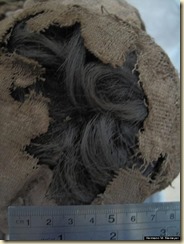 According to a study by the University of Chile in Santiago, the hair of mummies from the site of San Pedro de Atacama in Chile has revealed that the ancient people living here between 100 B.C. and 1450 A.D. had a tough time kicking their nicotine habit.
Popular theories on the people in this region, prior to the study, centered around a short-stinted use of tobacco that led to a greater use of snuffed hallucinogens—but it looks like this new finding refutes that theory rather soundly.
The hair of the mummies showed that nicotine consumption was all-encompassing in terms of the population, with no variation according to wealth or social status. Everyone smoked!
The hair samples came from 56 mummies that were excellently preserved due to the dryness of the soil and high soil salinity in the Atacama Desert. Various objects were buried with the mummies—jewelry, weapons, ceramics, textiles, metals, and various snuffing paraphernalia such as tubes and mortars—and these objects provided researchers with information on the social standing & wealth of each individual.
Nicotine was found in the hair of 35 mummies whose ages at burial ranged from young to old, and the traces of nicotine were unrelated to the snuffing paraphernalia also found buried within the tombs.
While there’s not a whole lot to say about the find as of yet, preliminary thoughts on the unexpected “everyone smoked!” discovery seem to simply be that this pre-Hispanic society wasn’t stratified by the use of nicotine—everyone used it, regardless of social standing, for hundreds of years.
More results on the mummies will be published this October in the Journal of Archaeological Science.
By: The Scribe on April, 2013
 It’s exciting for an archaeologist to find a tomb filled with ancient remains… but it’s even more exciting to discover that beneath that tomb is another tomb!
In 2011, archaeologists in Peru were thrilled to find a tomb in the Lambayeque region containing a pre-Incan priestess and eight other bodies, but as the dig continued, the team found what they’re calling a “basement tomb.” The contents of the tomb are slowly revealing new things about the religious and political structure of the area.
The basement tomb contained four preserved bodies of “waterlogged human remains,” and it’s thought that the tomb was actually created with the intention of flooding. The bodies were stacked inside the tomb, with one particular elite individual decorated with shell and pearl beads, face covered with a copper sheet and wearing a spool-shaped earring bearing a wave design.
These indicators of status seem to denote that the three additional bodies in the tomb were intended to accompany the elite individual into the afterlife.
But the weirdest part is that the basement tomb was intentionally dug beneath the water table—in a region frequently subject to draught in ancient times. Notably, the tomb is part of ceremonial complex that archaeologists are suspecting was used for a cult that worshipped water.
Why would the ancient priests want a tomb to flood? Dig leader Wester La Torre has said that perhaps they thought this would ensure the region’s agricultural fertility for the year ahead—and while the tomb is technically pre-Inca, it may have been a precursor to later beliefs: “The Inca believed that the dead became a seed, which sprouted new life, the way that this was buried suggests the same process of fertilization, in which the seed, the person, is reborn.”
 And while the dig team hasn’t yet identified whether the elite individual is male or female, it’s possible that person had something to do with the priestess discovered buried overhead in 2011.
Of course, there are dissenters who point out that there’s no reasonable way to know where the water table was 800 years ago. But regardless of whether the tomb flooded or not, both the burials are important additions to the historical record of a lesser-known period of world history in the region.
By: The Scribe on January, 2012
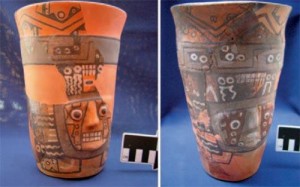
Peruvian Drinking Vessel (credit: Michael Moseley et al)
Binge drinking and arson—a crime of modern invention? Not entirely.
The Wari people of Cerro Baúl were drinking and burning things with enthusiasm in 1000 A.D., around the same time that they abandoned the town and other sites of cultural significance. Of course, the drinking and burning business isn’t as simple as it sounds—in fact, the Wari engaged in ritual binge drinking and ritual brewery burning.
It’s probably a good thing that today’s drunks don’t wander around towns burning down the breweries that produce their favorite grain-based beverages, but at Cerro Baúl, destroying their brewery was a necessary ceremonial component in the abandonment of the town.
According to the archeological evidence, there were 28 leaders who sat together in the brewery drinking pepper-spiced corn beer, a beverage very similar to chicha, a corn-based beer brewed by the Inca in modern-day Peru. After consuming copious amounts of alcohol, the Wari leaders—who were undoubtedly very much “in the bag” by this point, as it were—enthusiastically smashed their drinking vessels, preceded by setting fire to any and all surrounding flammable material. This had the consequence of leaving only the sections of stone wall standing, though these too collapsed over time.

Brewery at Cerro Baul field image (Photo by Patrick Ryan Williams, courtesy of The Field Museum)
While one might be tempted to protest that perhaps they merely had a sip or two before engaging in ritual vandalism, there is archaeological proof that indeed, the Wari leaders got rip-roaring drunk first. The remains of Cerro Baúl’s brewery revealed a capacity of around 1,800 litres per batch, with women doing the brewing. Fermentation followed, and finally the drink was spiced with pepper-tree seeds—a version of the drink reserved for nobles among the Wari.

Brewery at Cerro Baul
Based on the mug fragments, it has been determined that 12 of the participants were ‘lesser nobles’, because their drinking vessels held a smaller amount of liquid (355ml), and another four of the participants may have been senior officials or much higher on the social ladder, as their mugs contained much more elaborate iconography and held nearly 2L of beer.
And drinking wasn’t all they did—the spread was something worthy of a modern Super Bowl party, with the archaeological record showing remains of llama, deer, and a variety of fish.
Of course, the question remains: Why have a feast, get slobbering drunk, and then torch the place?
While the answer isn’t certain, it turns out that settling a town on top of a 600-meter mesa doesn’t make the best place to live. It takes a lot of time and effort to haul resources up the side of a mountain, which may have resulted in someone realizing the impracticality of building a city where no one could get to it. Good for defenses, bad for… everything else.
The ritual destruction, however, was likely a mechanism to preserve the purity of their historical living spaces—torching the brewery and subsequently other important buildings such as the temple and palace meant no one else could re-use the buildings for their own purposes or defile their sacred spaces.
And to finish the job? The Wari smashed their mugs in the fire. Of course the real question that follows is: With half the town on fire, where did they go to sleep it off?
Next page
 The ancient Incan ritual of capacocha is known by historians and archaeologists as an event which culminated with human sacrifices—and the 500-year-old bodies of several young child sacrifice victims were found a number of years ago near the summit of Volcan Llullaillaco in Argentina.
 Notable was the Maiden’s consumption of coca, a hallucinogenic substance, which increased at 12 months before death and then again at the 6 month point. She used a significant amount of coca during those final 6 months, but it was the alcohol consumption which really spiked in the final weeks before death.


