Archive for May, 2007
By: The Scribe on May, 2007

The second wonder of the ancient world, in chronological order, is the Hanging Gardens of Babylon. Believed to have been built around 600 BC by King Nebuchadnezzar II, there is actually little to no archaeological evidence for the existence of these gardens – instead, knowledge of the gardens comes from Greek historians such as Strabo and Diodorus Siculus.
These Greek historians lived several hundred years after the gardens were supposedly built, and it is quite odd that there are no Babylonian records that mention the gardens – however, there are tablets from Nineveh that describe gardens at that city, and so it is possible that ancient Greek travelers merely had their information a little jumbled when they returned home to recount tales of their travels!
The commonly understood story of the gardens is that Nebuchadnezzar II constructed them for his wife, a Mede, who was homesick for the lush trees and flowers of her homeland. The garden supposedly had a wide variety fruits and plants from across the ancient world, waterfalls, exotic animals, and other plants drooping from the palace terraces, to give the garden its appearance of ‘hanging’.
The major problem with the gardens’ existence is simple enough to conceive of: how were the gardens watered? How could enough water for entire terraces of plants possibly be transported to the roofs of buildings and palaces in order to keep the plant life thriving? And how is it possible that the water’s run-off wouldn’t cause the entire palace to weaken and collapse from water damage?
Diodorus Siculus attempted to explain the watering issue in his writings:
“the approach to the Garden sloped like a hillside and the several parts of the structure rose from one another tier on tier… on all this, the earth had been piled… and was thickly planted with trees of every kind that, by their great size and other charm, gave pleasure to the beholder… The water machines [raised] the water in great abundance from the river, although no one outside could see it.”
Conveniently concealed water-transportation mechanisms? The Babylonians were spectacular engineers, and thus it is a plausible suggestion. Presumably, some sort of complementary drainage system would have been implemented as well, possibly making use of terracotta pipes on each terrace level so that the roofs would not weaken and collapse.
Want to read more?


Tomorrow: Temple of Artemis

By: The Scribe on May, 2007
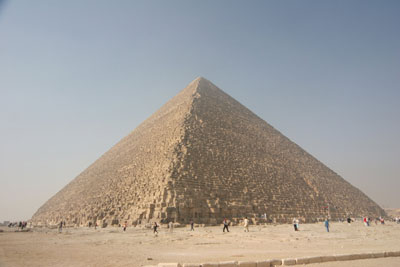
The oldest of the three pyramids at Giza, the Great Pyramid is the oldest and the only remaining monument of the Seven Wonders of the Ancient World. Constructed over what is believed to have been 20 years, the Great Pyramid was built as a resting place for the Pharaoh Khufu after his death.
Additional structures were built around the pyramid as part of a mortuary complex for the Pharaoh’s entire household, including several smaller pyramids, several temples, and a causeway leading down to the Nile. Near the complex was a small town for the workers, which included such facilities as a beer factory, bakeries, and metal-working production centers. Evidently, the Pharaoh spared no expense in ensuring his afterlife was as well-equipped as conceivably possible.
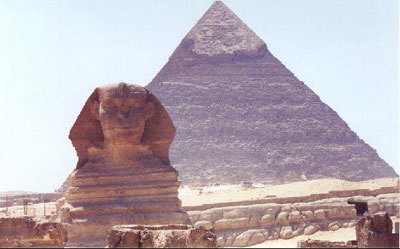
Recent evidence concerning the Great Pyramid’s construction suggests that previous assertions claiming the pyramid was built by slave labor are wrong. Instead, the workforce was paid, and would have included skilled craftsmen and an administrative body to ensure the project ran smoothly.
It is estimated that approximately 2 million blocks of stone, each weighing over 2 tons, were used to build the pyramid. The blocks were made of limestone, basalt and granite, with the outer casing consisting of white, highly polished, limestone slabs. The monument would have been extremely bright in the desert sun, however only several of these casing stones remain on the Great Pyramid today.
The inside of the pyramid consists of a large network of passages and chambers, and although the passages themselves were not carved with relief, a significant amount of graffiti was left behind on many of the blocks by the workers! The main burial chamber also has two small passages dubbed “air shafts” that ascend out of the Pyramid and are aimed directly at two stars in the Orion constellation; it is believed that these were intended as air shafts for the Pharaoh’s spirit to escape its entombment.
Want to read more?


Tomorrow: The Hanging Gardens
By: The Scribe on May, 2007
 The first reference to a list of wonders of the world appears in the writings of Herodotus, a Greek historian from the 5th century BC, but it was not until several decades later that other historians would actually write about the greatest monuments of the world at that time.
In the 2nd century BC, the ancient Greek writer and poet Antipater of Sidon compiled a list of the Seven Wonders of the World in a poem, written around 140 BC; both Antipater’s poem and another list, titled De septem orbis spactaculis – traditionally and incorrectly attributed to the Greek engineer Philo of Byzantium – are considered to be authoritative sources on the physical descriptions of the ancient monuments. The author of De septem remains unknown, as well as the date of composition: it could date anywhere from around 200 BC to as late as the 5th C AD.
The Chief Librarian of the ancient Library at Alexandria in Egypt, Callimachus of Cyrene, wrote a treatise named “A Collection of Wonders Around the World”, however – like thousands of other documents – all that survives is the title, as it was lost in the destruction of the Alexandria Library.
A final list of the seven ancient wonders was compiled during the Middle Ages, at which point many of the monuments had already disappeared. Notably, since the list originated out of early Greek travelogues, all the sites that were included in the list came from locations that were easily accessible by Greek tourists. This is why many sites in the Near East or even further down the Nile in Egypt were seemingly overlooked – they simply were not easily accessed by Greek travelers.
What is different, however, is that Antipater’s original list did not include the Pharos of Alexandria, but instead listed the Ishtar Gate in Babylon. Somehow in the finalization of the list, this monument was changed, though it may have been included in other documents now lost. Of the seven ancient wonders, it is notable that only one has survived into present day: the Great Pyramid of Giza. Five other wonders were destroyed by natural disasters, and the last monument was the victim of deliberate arson.
It may be surprising for many to learn that most of the Seven Wonders did not co-exist – they were simply recognized by ancient writers as incredible feats of human ability. So, for the next seven days, the Ancient Standard is going to take you on a tour of these seven ancient wonders…!
Want to read more?
Tomorrow: The Pyramid (of course)
By: The Scribe on May, 2007
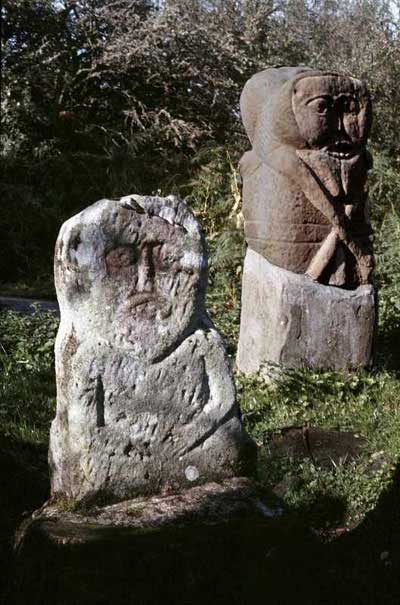
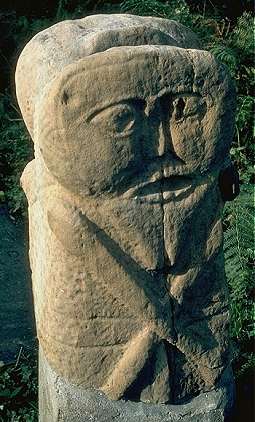 In Caldragh Cemetery on Boa Island, in the Irish county of Fermanagh, there stands two stone statues of unique variety, which may date as early as the 8th century AD. Famously used as the ‘token’ monument for Irish guidebooks, these examples of Celtic art are little understood.
The larger statue of the two is a double-sided figure of two people in a squatting pose – and perhaps not surprisingly, one is male, while the other is female. Carved back-to-back, the male figure is identified by his genitalia depicted underneath crossed arms, while the female side has simply been depicted with a protruding tongue. Both statues have large, bulbous eyes, and it appears that the male is holding an object in his right hand. Between the heads is a carved zig-zag pattern, thought to represent hair, and each figure seems to be wearing a belt around their waist.
The larger figure has often been referred to as a Janus statue, however it should be clarified that ‘Janus’, in this context, is simply used in its literal Latin form meaning ‘two-faced’, and does not refer to the Roman god Janus. Precisely what this statue was meant to represent remains unclear, though since it dates from the pre-Christian period on Ireland, it likely held great meaning for the local pagan religion.
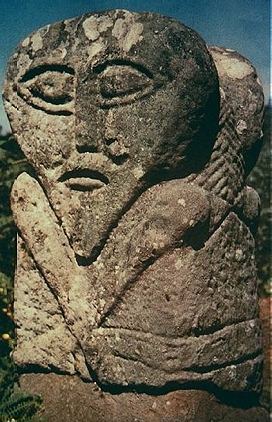
The smaller statue is not native to the cemetery, and was imported from nearby Lustymore Island; weathering on the statue has made it difficult to precisely identify its gender. The carvings on this statue are not very deep, and it also appears to be holding something. The arms rest on the figure’s lap, while the protruding tongue may indicate that this figure is, in fact, female. There are comparable figures to this one elsewhere on nearby islands, however the purpose or significance of this figure is unknown as well.
Want to read more?


Tomorrow: A brand new series of posts on the 7 wonders of the ancient world!
Previous page | Next page
