Archive for May, 2007
By: The Scribe on May, 2007
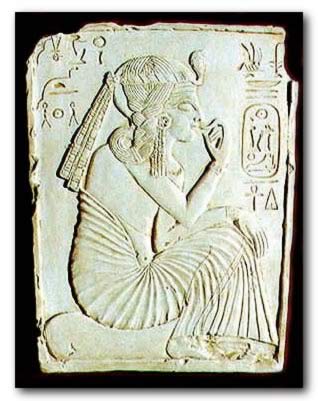 Like many people today, the ancient Egyptians were extremely concerned about outward appearance – and in particular, about their hair. From simple styling to elaborate wigs, most Egyptians spared no expense to ensure that their hair was perfect.
In order to avoid the problems of head lice, both Egyptian men and women often shaved their heads – this also made it far easier for a wig to sit on the head comfortably. Of course, not all people would do this, and there are tomb paintings and statues where an artist has actually shown little bits of a person’s natural hair peeking out from behind a wig! Priests were required to shave their heads and bodies of all hair – and would do so about every three days – in order to remain ritually clean.
In most cases, it appears that men’s wigs were actually more elaborate than those of women, who typically used wigs or hair extensions to make their natural hair more luxurious, or to fill out their own hair as it began to thin with age. In order to look more natural on the head, Egyptian wigs and extensions were almost always made with human hair, either bought or traded at the market, or from the shaved locks of the wearer.

False braids and curls were among the most popular hairstyles of ancient Egypt, and both wigs and extensions could be attached right to the wearer’s own hair with various knots or weaves; for those who had shaved their heads, a small amount of beeswax and resin would be applied onto the scalp to hold the wig in place. To gain fullness in the hair, as seen in Egyptian wall paintings, the wigs often had an internal layer of padding, made of date-palm or other vegetable fibers.

The ancient Egyptians, it seems, had such an adversity to grey hair, that they would even dye the hair of corpses after death. Using vegetable henna, the hair would be dyed a dark brown or auburn color; in some cases, the dead were even provided with an extra set of hair extensions in their grave – just in case they needed their hair done in the afterlife.
Want to read more?


Tomorrow: Faces of Boa

By: The Scribe on May, 2007
 Every year on February 15th, the ancient Romans celebrated the Lupercalia festival in honor of the she-wolf who suckled their founders – twin brothers Romulus and Remus – when they were infants. The festival was meant to purify the city and ensure fertility… however, the rituals involved were perhaps some of the strangest traditions ever practiced in ancient Rome. Oddly enough, by the time the festival was at the height of its popularity in the 1st century BC, the Romans had forgotten most of the festival’s origins, even to which gods it was originally dedicated.
The religious ceremonies of the Lupercalia were directed by the Luperci, or “brothers of the wolf”, and began at a cave on Rome’s Palatine Hill – where Romulus and Remus were believed to have lived with the she-wolf as children. These male priests were responsible for the ritual sacrifices of two male goats and a dog, after which two young Luperci would be led toward the altar to have their foreheads ‘anointed’ with the sacrificial blood.

The priests wiped the blood off their knives with a piece of wool soaked in milk before smearing it on the mens’ foreheads, after which these young Luperci were expected to laugh and rejoice. Some studies have speculated that the ritual blood-smearing was a remnant from another ancient ritual originally practiced at the festival, but long forgotten: human sacrifice.
After the sacrifice came a feast for all the participants, after which the priests would cut thongs from the skin of the sacrificed goats and dress themselves in the rest of the skin. Then, the priests would run around the boundaries of the city holding the leather thongs and whipping people with them – in fact, young women would line up along the city limits and bare their flesh praying to be whipped, as this ‘ritual whipping’ was believed to bring fertility and ease the pain of childbirth.

This festival was so popular that it continued to be celebrated long after the Christianization of the Roman empire, until 494 AD when the Pope shifted the festival’s focus and refashioned it as the “Feast of the Purification of the Virgin Mary.”
Want to read more?


Tomorrow: Having a good hair day, in ancient Egypt
By: The Scribe on May, 2007
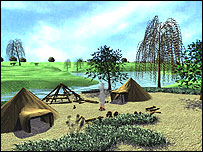 Researchers from the University of Birmingham have recently made the astonishing discovery of what may be an entire, prehistoric “lost country”, hidden underneath the UK’s North Sea. It appears that at the end of the last ice age, over 8000 years ago, rising water levels literally swallowed what may amount to an area of around 23,000 square kilometers – an area that is currently a part of the North Sea’s seabed.
The research team believes that this find could serve as a warning for the devastating impact of climate change on human populations, since these people would have lost their land as the rising water levels crept across the low-lying plains. Although the majority of the landscape’s change would have been gradual, some warmer years likely saw a rapid shift in the amount of land available to these people – a terrifying concept for hunter-gatherer populations that relied on their land to survive.
Professor Vince Gaffney, chair in Landscape Archaeology and Geomatics at the University, has surmised that as early as 10,000 BC, hunter-gatherers were living on the land in the middle of North Sea, but it was only 4000 years later – by 6000 BC – that Britain had fully become an island. Global temperatures and water levels rose, forcing people off the land and onto higher ground, namely the area that is modern-day Britain.
“It would be a mistake to think that these people were unsophisticated or without culture,” said Gaffney, “they would have had names for the rivers and hills and spiritual associations – it would have been a catastrophic loss.” Prehistoric groups often lived together in family units, and based on the previous evidence from other prehistoric groups in Britain, these people probably lived in small, thatched huts and hunted animals such as deer and rabbit for food.
University of Birmingham researchers are currently attempting to map the physical features of the seabed’s geological landscape, in hopes that it will shed further light on the specific locations of these underwater sites that might yield further evidence for how these people lived – and also hopefully avoid further destruction of the sites. Quoted as being the “best preserved prehistoric landscape in Europe”, it is likely that underwater excavations will be mounted in the future, to try and learn more about the people that lived in this enormous stretch of lost world.
Want to read more?


Tomorrow: Whipping = fertility??
By: The Scribe on May, 2007
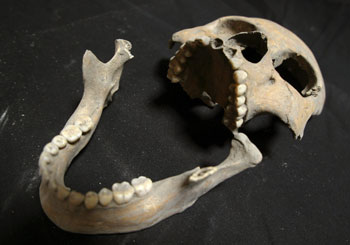 In April 2007, archaeologists uncovered the buried bones of 24 Pre-Columbian Mexican children – members of the ancient Toltec people who lived in Mexico from the 10th to 12th centuries AD. The bones were dug up at the ancient Toltec capital of Tula, and markings on the bones indicated that the children had been decapitated in a group and then buried together. Initial speculation is that this find may be evidence for child sacrifice among the Toltecs.
The Toltec civilization is best known for its fifteen-foot high stone warrior figures, though little about these people can currently be stated with certainty, because the Aztecs later plundered the ruins of Tula for building materials. Much of the historical evidence that might have otherwise survived was destroyed, causing historians to rely mostly on legends from other cultures to piece together Toltec history.
It is thought that the Toltec culture was highly militaristic, and much like the later Aztecs, used their military might to dominate the surrounding cultures. The Toltec architecture that remains has a very rough feel, and is characterized by snakes, skulls, and images of a reclining red jaguar, as well as their mysterious colossal statues.
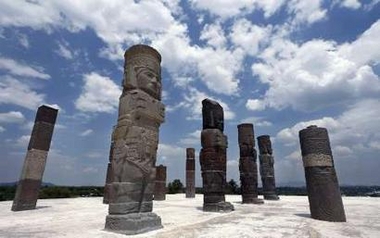
The Toltec empire lasted until the 12th century, when it was conquered and destroyed by other encroaching cultures such as the Chitimecs. The Toltecs that survived in the south would be assimilated with the Maya – the very people that had once been subjugated by the Toltecs themselves. Shortly after the fall of Toltec civilization, central Mexico entered a period of chaos and warfare, and no group would rise to domination for another 200 years. Not surprisingly, the group who eventually assumed control was that of the Aztecs.
Want to read more?


Tomorrow: The real “Lost World”
Previous page | Next page
