By: The Scribe on May, 2007
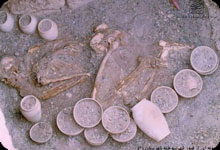 In January 2007, anthropologists conducted a paleo-pathological study on some skeletons from the “Burnt City” in Iran, and were able to determine that one of the individuals must have ridden a camel for an extended period in his lifetime. Indeed, it has been suggested that since this man must have lived most of his life on camelback – most likely from puberty until his death, around 40-45 years old – his occupation must have been that of a profession courier or messenger.
Evidence of long-term riding was found on the skeleton’s right leg bone, where the swelling indicated that he gathered the leg under himself while riding on a large animal, such as a camel or ox. It is known that draft animals were used in the Burnt City around this time to transfer goods, however folding one leg while riding is something done only when riding a camel over long distances.
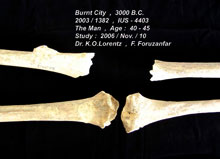
While excavating burials at the Burnt City in 2004, archaeologists noticed that the man’s skeleton had evidence of a bone lesion on the right thighbone. Since the 2007 analysis of the skeleton revealed his likely occupation as a professional courier, additional paleo-pathological analyses have been scheduled for the remaining skeletons unearthed in the 2004 excavation season. These analyses are expected to unravel some of the mysteries surrounding the commonly practiced occupations of the Burnt City’s inhabitants in the 3rd and 2nd millennia BC.
Want to read more?


Tomorrow: Embryo burials

By: The Scribe on May, 2007

A burial near the “Burnt City” in ancient Persia has yielded a 5,000 year old artificial eye from the skeleton of a 25-30 year old female. During her life, she stood around 6 feet tall, which would have made her head and shoulders above most other women during this time. Skeletal analysis revealed that she possessed a sharp jaw line and a high, sloping forehead; evidence from eyelid tissues left on the artificial eye give evidence of her dark skin and thus, she was likely of Arabian background.
Although excavators first thought it was possible that the eye was placed on the body at burial, forensic examination showed an imprint that was caused on her left eye socket by prolonged contact with the golden eye.
While the eye was not intended to imitate a real eye, even the most delicate eye capillaries were drawn on the eyeball using gold wires less than half a millimeter thick. Other lines around the engraved pupil form a diamond, and two holes were drilled on the sides of the eyeball through which thread could be strung to hold it in the woman’s eye socket. Though obviously not a real eye, the gold coating on the eye would have caused it to shine brightly – and when combined with her startling height, the woman would have been highly effective at convincing others of her supernatural powers, such as those of a soothsayer or an oracle.
The grave also contained an ornate bronze hand mirror, which gives further weight to the idea of this woman’s role as a prophetess. It is possible that she visited the “Burnt City” with a caravan, as it was a busy and wealthy trade city during the time of her death ca. 2900 BC.
Want to read more?


Tomorrow: Fedex camel delivery
By: The Scribe on May, 2007
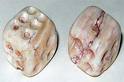 Excavations at the “Burnt City” in Iran yielded what is considered to be the world’s oldest backgammon game, along with two dice and 60 game pieces to play with!
This 5,000 year old game is about 100-200 years older than a backgammon board found in Mesopotamia, which suggests that the people living at this city created the game and then introduced it to other people. Trade relationships between cities would have made it easy for merchants to introduce the game to others, perhaps playing a game over drinks; even kings might have taken in a game with visiting nobles over peace negotiations.
Backgammon, which combines luck and strategy, is still played often in this region of Iran today. The board which was uncovered during excavations looks remarkably like modern boards: it is rectangular, made of imported ebony from India, and features an engraved serpent which coils around itself 20 times. These highly artistic coils produce the 20 slots needed in the game, and although the board material had been imported, the game pieces were made of common stones quarried around the city.
The game pieces, found inside a terracotta vessel near the board, were made of stones such as turquoise and agate. Though the game is not conventionally played with 60 pieces – each player traditionally has 15 pieces to start with, needing only 30 pieces in total – it certainly does not seem unusual that those who played the game on a regular basis would need extra pieces, as small checkers are easily dropped or misplaced, or perhaps there was originally a second board included with this set that has simply been lost.
Want to read more?


Tomorrow: The first fake eye?
