The False Princess: A Stranger Arrives – Part 1/7 (1791-1865)
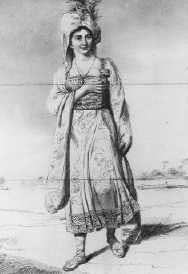 It was in April of 1817 that a cobbler in Gloucestershire, England, came across a disoriented young woman, dressed in exotic clothes – and she was speaking a language that no one in the town could understand. The cobbler brought the young woman back to his home, where his wife could tend to her and decide what to do. She certainly didn’t seem to belong to a local community – her thick, black hair, dark eyes, and black turban seemed to suggest she was a foreign beggar, at best.
After allowing the woman to sleep for awhile, the cobber’s wife decided to take her to the Overseer of the Poor, whose job was to arrest anyone begging, making trouble, or running rogue across the countryside – and then either place them in jail, a workhouse, or ship them off to Australia in chains. However, the Overseer was just as stupefied by the woman as the cobbler had been, and instead decided to pass her off to the county Magistrate, Samuel Worrall, since the Magistrate and his wife had a Greek servant who spoke several European languages.
Unfortunately, neither the Worralls nor their servant could understand what the girl was saying, although Mrs. Worrall became fascinated by her looks and exotic appearance. The Magistrate tried to follow protocol: he took a suspicious view, and tried to ask her if she had any papers. Seeming to understand, the woman emptied her pockets, which contained only a few halfpennies and a fake sixpence – which, under normal circumstances, would mean the death sentence for carrying around counterfeit currency.
The only other thing the girl had with her was a bar of soap, pinned inside her clothes on a piece of linen. Uncertain of what to do, the Worralls finally realized that if she was indeed a beggar or foreign slave, her hands would tell the truth – but when they examined her hands and fingers, they were soft and clean, which were certainly not a sign of hard work. Thinking it would probably be in her best interest to stay the night at a village inn, the Worralls sent the woman downtown with two of their servants.
Upon arriving at the inn, the woman noticed a picture of a pineapple on the wall, and began to gesture excitedly, saying “Anana!”, attempting to convey that this fruit was from her own country. Since ‘anana’ was the word typically used for pineapple in several European languages, the landlady offered her some, as well as a plate of dinner. However, the woman refused and instead insisted on drinking a cup of tea – and would only drink this after holding a hand over her eyes and repeating a prayer. Then before she would drink another cup, she insisted on washing the little cup herself and then repeating the hand-over-eyes and prayer ritual.
Fascinated by the woman, the inn’s landlady agreed to allow the stranger to stay for the night, but when she was shown her room, she didn’t seem to understand what the bed was for. Instead, she lay down on the floor, and would not get into the bed until the landlady’s daughter physically showed her that the bed was more comfortable than sleeping on the floor. Consenting to use the bed, the woman kneeled, said some prayers, and then went to sleep. The next morning, Mrs. Worrall could not contain her curiosity, and decided that the girl must come back home with her for awhile…
…to be continued…
Want to read more?
Caraboo: The Servant Girl Princess : The Real Story of the Grand Hoax

Tomorrow: Part 2!