Archive for October, 2007
By: The Scribe on October, 2007
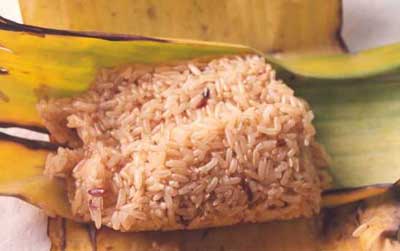
Once thought to be merely an ancient legend, it turns out that several thousand years ago, the Chinese were using sticky rice to cement their walls. Indeed, this glutinous ‘rice porridge’ was the best kind of mortar additive available, surviving until today in the remnants of plaster on ancient Chinese bricks.
It was during a round of maintenance work on the ancient wall of Xi’an that workers found that the plaster on many bricks was extremely difficult to remove – and since the task was much more difficult than it should have been, the substance was tested. Infrared analysis then revealed that the mortar had a molecule structure nearly identical to that of glutinous or “sticky” rice.
In fact, the use of rice as mortar may be the real reason that many ancient Chinese structures are still standing! The wall of Xi’an was built in the early years of the Ming Dynasty that spanned from 1368-1644 AD, and still remains standing at approximately 12 meters high.
While the claim that construction workers used sticky rice to build the Great Wall of China had previously been discounted as a myth, it turns out that there may have been truth to the legend after all.
Think about it: workers wouldn’t have to stop for lunch, they could just snack while they were working…!
Want to read more?

Tomorrow: More Ancient Standard!

By: The Scribe on October, 2007
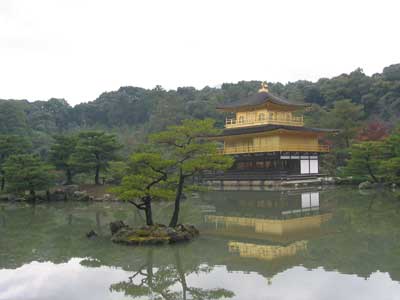
During the pre-Meiji era in ancient Japan, the term “Kugyo” was used to refer to a group of the most powerful men of influence in the court of the Emperor. The group typically contained only three or four men at one time, and each came from a background of extensive experience that had brought them to this ‘pinnacle’ of his entire life’s work. They were also hereditary courtiers, and each held one of four specific offices.
The Sadaijin was the “Minister of the Left”, and as the Senior Minister of the State, he oversaw all the branches of the state and had the Udaijin as deputy. Within the State Department – or, Daijo-kan – his position was second in power and influence to the Great Minister of the Realm. For centuries, the position was most commonly held by a member of the Fujiwara family, in order to justify the influence the family held in Japan.
The Udaijin was “Minister of the Right”, and he helped the Sadaijin to oversee all the branches of the Daijo-kan.
The Naidaijin was the “Inner Minister” or “Minister of the Center”, with the rank and role of this position varying over time. He was essentially responsible for internal affairs and making sure they were kept in order.
The Dainagon position was created in order to assist the Sadaijin and the Udaijin with their affairs, although by the 17th century, the position had been modified to give primary assistance to the Nadaiji. This was done in order to ensure that there was another person ready to replace the main court officials, should something happen to one of them.
Although the Kugyo had a large amount of power and responsibility during the early pre-Meiji eras, they gradually lost power as the Fujiwara family came to dominate Japanese politics in the 10th and 11th centuries. By the 12th century, the group was nearly powerless – and it certainly didn’t help that the warrior clan Minamoto seized control of the country through the aristocratic courts.
Regardless, the Kugyo continued to function as a figurehead group inside the palace walls for centuries to follow.
Want to read more?


Tomorrow: More Ancient Standard
By: The Scribe on October, 2007
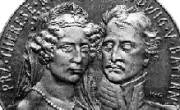 On October 12th, 1810, the Crown Prince Ludwig of Bavaria married Princess Therese of Saxony-Hildburghausen – and to commemorate the event, the citizens of Munich were invited to the front gates of the city to celebrate and join in the festivities. Food, drink, and horse races marked the day as one to be remembered… literally! The wedding celebration was such an enormous success – and the people enjoyed themselves so much – that the decision was made to repeat the festival every year, eventually giving rise to the Oktoberfest tradition.
The second year of Oktoberfest, in 1811, marked the addition of an Agricultural Show, which was created to boost awareness and publicity of Bavarian agriculture. There was little else to do at the early Oktoberfests – other than watch the horse races, look at agriculture, and drink – but in 1818, two swings and a carousel were added! Small beer stands were also becoming more prevalent, meaning that more people could afford to join in the festivities at a lower cost.
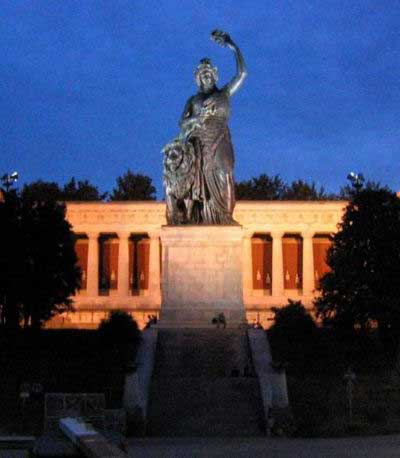
The first Oktoberfest parade took place in 1835, with the intention of honoring the original wedding that inspired the festival. It took awhile to catch on, however, as the concept of an annual parade didn’t really sink in until 1850. It was also in 1850 that the Statue of Bavaria was commissioned to watch over the festivities.
Over the next several decades, Oktoberfest would continue almost uninterrupted, but in 1854 and 1873, the festival was cancelled due to cholera outbreaks. There were also no festivities in 1866 while Bavaria fought in the Austro-Prussian War, and again in 1870 during the Franco-Prussian War. However, by 1880, there were over 400 tents and booths at the Munich festival – and in 1881, Oktoberfest attendees could purchase bratwursts at small food stands!
It was in 1892 that beer was first served in glass mugs, and by 1896, the small beer stands were so numerous that they had to be replaced by beer tents! Breweries began to sponsor the event, and large halls were set up and decorated by more affluent members of the local community. In 1910, Oktoberfest celebrated its 100th anniversary… and will mark its 200th anniversary in just a few years!
Want to read more?


Tomorrow: The Powerful Kugyo of Japan
By: The Scribe on October, 2007
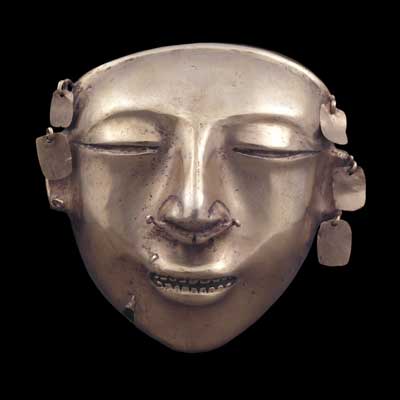
If there is one highly notable thing about ancient South America, it’s that the continent was home to many, many indigenous cultures – all of which developed independently of each other, becoming specialists in various, distinct areas. One of these lesser known cultures, but certainly not any less talented, was the Quimbaya civilization of Colombia.
The Quimbaya were noted for their incredible talent in goldworking, which was revealed through their highly technical accuracy and exquisitely detailed designs. Their gold pieces also have a very distinct hue and shine, which comes from the inclusion of 30% copper with the gold, creating an alloy known as “tumbaga”.
The favored subjects of Quimbaya gold art pieces were men and women in sitting positions, almost always with closed eyes and rather placid expressions. Gold funerary masks were also created with the same general expression on the face, and these were often placed inside the sarcophagus of a deceased individual – gold was believed to have been a sacred thing, and very useful for achieving safe passage into the afterlife.
The Quimbaya generally lived around the Cauca River in Colombia, and although it is believed that they probably settled there sometime in the first century AD, the culture did not really reach its height until the 4th to 7th centuries. Then during the 10th century, the Quimbaya disappeared as mysteriously as they had appeared… leaving behind purely archaeological evidence of a civilization with advanced cultural development, a structured chiefdom, and groups of people dedicated to specialized trades, such as pottery, goldwork, trade relations, the military, and religious duties.
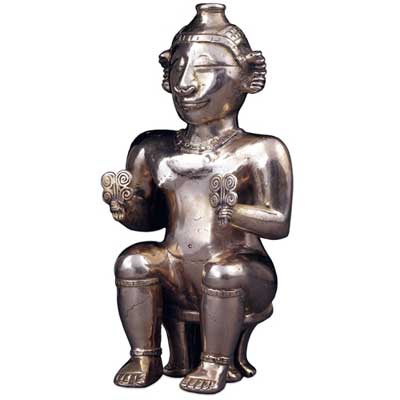
Beyond this, little else is known – except for one thing: the Quimbaya were drug addicts. Many of their gold figurines have flasks around the neck, or are even flasks themselves, and held a substance called lime. Lime was chewed together with coca leaves in order to release their “active stimulant” – and anyone who knows even a bit of plant biology will probably recall that coca leaf is the raw material used to manufacture a more commonly known drug: cocaine.
Of course, the Quimbaya believed that this stimulant helped them to bring about a state of clear and contemplative thinking, and may have been an important part of the culture’s religious beliefs – the drug was probably used during fertility rituals, in order to commune with ancestral spirits and ensure the continued regeneration of essential plant and animal life in their land. Why would this be the case? There are actually several present-day people groups in Colombia, such as the Kogi, who utilize coca for a very similar purpose!
Want to read more?


Tomorrow: More Ancient Goodness!
Previous page | Next page
