Archive for 2007
By: The Scribe on October, 2007
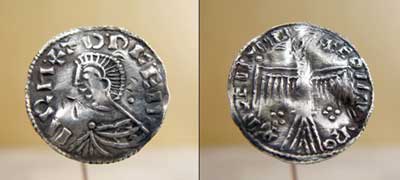
Once upon a time, a local Swedish gardener was minding his own business, tending his vegetable patch on the island of Gotland, when all of a sudden… he realized it wasn’t a rutabaga he pulled out of the ground, but a hoard of Viking treasure! Indeed, he had found a treasure trove of silver coins from Europe, Central Asia, and the Middle East, all dating to around 970-1030 AD.
The garden trove yielded 69 coins, and the cache as a whole has been identified as a Viking “safety-deposit”, which was not unusual – Vikings and Anglo-Saxons would bury their stash of loot somewhere in the ground, with every intention of returning for the money in the future when it was needed.
In addition to coins from Eastern Europe and beyond, there were several extremely rare Viking coins in the cache, which were likely paid to the owner as protection or plunder money, also known as ‘danegeld’. Danegeld was paid to Viking groups by regional rulers, in order to bribe them out of attacking their cities or towns – which was an easy way for the Vikings to make some extra cash for little work! The rare coins were minted for a regional Swedish king named Olof Skotkonung, who was actually the first king to mint coins in Sweden. He had probably learned the trade from England.
Many other coins in the horde were copies of English coins made by Ethelred II, who was the British monarch between 978 and 1016. He was often referred to as “Ethelred the Unready”, since he lacked reliable counsel and greatly preferred the option of paying massive amounts of “tribute” cash to the Vikings, rather than face them in armed conflict.
As for the Asian coins found in the treasure trove, they would have come from the Vikings’ transactions while moving along their extensive trade route – often, Viking ships would travel all the way along the Russian rivers into the Middle East! And since Gotland in Swedenwas situated right in the middle of the Viking routes – between eastern and western Europe – it was a natural stopping point for Vikings to stash their cash before continuing onward in their travels and trade.
In total, the area of Gotland has actually yielded between 700-800 Viking treasure hoards, with the majority of the coins originating from the Middle East. Many of the coins in this and other caches also show evidence of ‘pecking’, which results from someone poking at the surface of a coin with a knife, in order to determine whether or not it the coin is real silver or a lead counterfeit.
Want to read more?


Tomorrow: Soggy Rice in Stone Age China

By: The Scribe on October, 2007
 The Eye of Horus is a symbol from ancient Egypt, typically associated with protection and royal power from the Egyptian deities Ra and Horus. The Egyptian word for the symbol was ‘wadjet’, which sprung from its early associations with one of Egypt’s earliest deities, Wadjet. Over time, Wadjet the goddess was assimilated into the personas of other Egyptian goddesses, including Hathor, Bast, and Mut.
As Wadjet’s symbol, the Eye was said to see everything – which may be where the first concept of a supernatural ‘all-seeing eye’ arose – however, as Wadjet’s importance in the Egyptian pantheon diminished, the Eye began to be frequently represented as a trait of the goddess Hathor.
In Egyptian mythology, Hathor was the wife of the god Ra, and became the mother of the god Horus. As the story goes, one of Horus’ eyes was damaged when he fought with his uncle Set, who had murdered the god Osiris and tried to seize the Egyptian throne. As a result, Horus’ eye, its injury, and eventual restoration caused the Eye of Horus symbol to become an important image in representing the concept of renewal and rebirth after death.
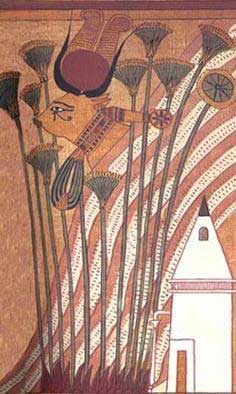
Horus himself was an Egyptian sky god, depicted most often as a falcon. The Eye of Horus is thus shaped much like a peregrine falcon’s eye and markings, including a ‘teardrop’ mark that is often found under the bird’s eye. Since the ancient Egyptians believed that the Eye of Horus was powerful enough to assist an individual in his rebirth after death, amulets and images of the Eye were often included in burial wrappings – in fact, an Eye of Horus was found under the twelfth layer of wrappings on the mummy of King Tutankhamun.
In ancient Egyptian mathematics during the Old Kingdom, the Eye of Horus could also represent a rounded off number one, but would later shift in meaning as the Egyptians developed a higher understanding of complex math.
Want to read more?


Tomorrow: A 1000-year-old Viking treasure trove
By: The Scribe on September, 2007
 In a quarry near Peterborough, England, archaeologists uncovered the skeleton of a tiny baby that was born around 3,500 years ago. The discovery came about 2 months after the same team found the remains of a Bronze Age man about 50 meters away, which leads workers to believe that they have located an ancient cemetery in this area.
The baby’s body was found near the center of Bronze Age burial mound at a place called Pode Hole. The discovery came as quite a surprise, because although work has been ongoing at this site for almost 8 years, very little has been revealed about the ancient people who lived in the area. Now, with two bodies found in two months, archaeologists can say that the people who lived here seemed to have created a vibrant agricultural landscape, complete with a communal burial ground.
The skeleton of the baby was found lying inside a small grave that had been lined with birch bark, and several small items had been placed alongside the body – namely, a fully intact pottery vessel with an offering inside of wheat or grain. The bones of the child were very soft and extremely fragile, leading excavators to believe that the baby may have been stillborn, or at the very least, less than a year old at the time of death.
The baby’s body and the artifacts are scheduled to undergo testing, in order to better determine things like the age, diet, and lifestyle of the people who lived in this area during the Bronze Age in England. Since two bodies in total have been uncovered in such a short period of time, it is likely that further excavation will be conducted here with the hope of finding additional burials that may yield more information about the area’s ancient community.
Want to read more?


Tomorrow: More Ancient Standard
By: The Scribe on September, 2007
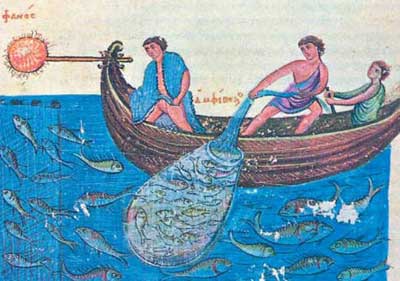
Fishing gear found in a shipwreck from the 7th century AD, off the coast of Dor in Israel – a location west of Galilee – suggests that fishermen in this area tended to work the night shift… and did so far more often than anyone had previously believed.
Among other things, the shipwreck yielded something called a ‘fire basket’, which is the first evidence in the ancient eastern Mediterranean for a practice known as fire fishing. Although several ancient images and writings had suggested that people in this area practiced fire fishing, there had previously been no evidence for its actual use.

Fire baskets were mounted onto the end of fishing boats by being placed on the end of giant lantern-like devices, which kept the fire suspended overtop the water. The light from the fire would then attract fish to the boat, and the fishermen would be able to see the fish in the water far more easily than they could without a fire illuminating the surface.
The fishermen would then be able to easily spear the fish or other creatures that swam near the boat, or they could throw their nets into a spot in the water where the most fish congregated. In fact, this practice may date back to around 400 BC, when the ancient Greek philosopher Plato wrote about a similar practice that involved striking at fish from above the water.

This evidence, combined with some pieces of ancient art and Plato’s writings, suggest that fire fishing was very important in the ancient Mediterranean, and was likely practiced throughout New Testament times and well into the Byzantine era.
Other finds from the 7th C shipwreck included: an iron five-pronged fishing spear; a pile of rectangular, lead fishing net sinkers that would have been used to weight down nets; a bronze weight in the shape of a woman; and a tubular, iron “sounding lead”. The sounding lead was perhaps the most intriguing of the additional finds, since these were actually metal bobs used to measure water depth.
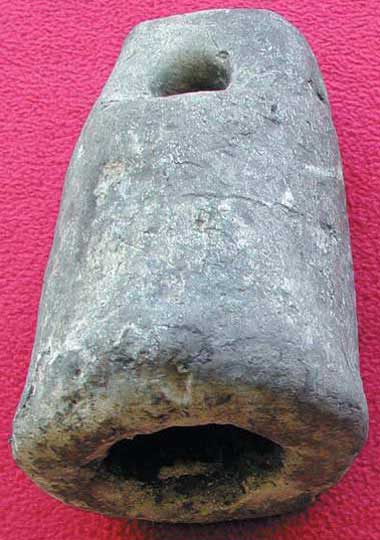
What the ancient fishermen would have done with the sounding lead was: fill the hollow middle of the lead with tallow, attach the lead bob to a sounding line, and then throw the line and lead over the side of their boat. The length of the line, combined with the amount of debris stuck to the tallow, would then indicate a depth measurement to the fishermen. This information could then be used to return to a specific fishing ground – particularly at night or during low visibility, when a sounding lead functioned as a vital navigational aid.
Want to read more?


Tomorrow: 3500 year old baby!
Previous page | Next page
