Archive for 2007
By: The Scribe on September, 2007
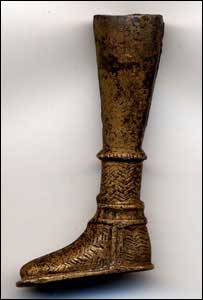 It is no secret that the Roman Empire once controlled more territory than any other empire in history – and it now appears that perhaps the secret to Roman success has been revealed! No, it wasn’t impeccable strategy, courageous generals, or unparallel war tactics… instead, the success of the Roman armies hinged on one crucial element: they always had warm toes.
Indeed, if there is one thing that’s important when it comes to war, it’s the comfort of the soldiers – after all, if you’re freezing cold, how can you possibly swing your sword at full strength? So, it appears that the Roman armies who went northward to conquer England took all necessary precautions to ensure that they were properly equipped for battle – including bringing along some very heavy woolen socks.
This is now known because one of the artifacts found at an excavation in Durham, England, was a highly unusual Roman razor handle: it was 5 centimeters high, made of copper alloy, and was shaped like a human leg and foot. The very unusual part is that the foot is wearing a common soldier’s sandal – but it also has a thick, woolly sock on at the same time! Socks and sandals together in Roman times? Clearly, comfort came before fashion on the northern frontier.
However, whether it was fashionable among the ranks to wear socks and sandals or whether the soldiers were simply protecting themselves against the harsh cold of the British north, there is one piece of evidence from another archaeological site that suggests Roman soldiers took their foot care very seriously – a letter was once found at the Roman fort of Vindolanda near Hadrian’s wall, in which a soldier actually wrote home to ask for… more socks!
Turns out socks are a handy gift after all…
Want to read more?


Tomorrow: Egyptian hieratic script

By: The Scribe on September, 2007

In the ancient wilderness of China, India and Vietnam, there once existed a very special monkey… actually, he wasn’t a monkey at all, but a giant, 10-foot-tall ape called Gigantopithecus. Coming in at 2 to 3 times bigger than any modern gorilla, the Gigantopithecus was the largest ape to ever have existed – and for some reason, it died out rather suddenly about 100,000 years ago.
As terrifying as it might have been to meet this giant primate on a stroll through the forest, early humans wouldn’t have needed to fear the ape for anything other than its size – all indications are that the Gigantopithecus species subsisted on mostly bamboo, with seasonal plants to supplement its diet! Researchers know this to be the case because, while fossil evidence for these enormous apes is scarce, plenty of huge molars have been found that are nearly one square inch in size.
In total, palaeoanthropologists have three mandibles, or jaw bones, of the giant apes, as well as hundreds of teeth. Based on its size, Gigantopithecus would have weighed at least half a ton – which seems to suggest that the extinction of the species must have come as a result of climate change, and not from being hunted by other animals. These primates were, quite simply, too big to fear threats from predators!

One theory is that Gigantopithecus was a victim of a bamboo crisis, since bamboo crops tend to go through cycles of growth – every twenty to sixty years, bamboo forests tend to experience a shift and die out before regaining crop strength. It is possible that competition with the area’s pandas and other bamboo-eating creatures may have simply caused the short straw to be drawn by these apes.
As one might expect, Cryptozoologists maintain that one Gigantopithecus species – there are three distinctly known species in total – did not die out, and instead managed to survive by adapting to its environment… and which is now known by the more popular names of ‘Bigfoot’ and ‘Yeti’!
Want to read more?


Tomorrow: More Ancient Standard
By: The Scribe on September, 2007

It seems that 55 million years ago, some ancient British bogs had a serious case of indigestion. All across the countryside, bogs were releasing large belches of methane gas, which is a greenhouse gas now known to be more powerful than carbon dioxide – and as a result, the bogs probably contributed on a large scale of a period of global warming.
How can modern wetlands reveal clues about global warming from 55 million years ago? Researchers were able to take sediment cores from deep inside several wetland areas in Kent, and measure the internal chemistry of the ancient layers. The organic compound levels that were produced by bacteria were then used to estimate the ancient levels of methane-consuming microbes that lived in the bogs.
The results of the study showed that there were significantly more methane-eating microbes in Kentish wetlands around 55 million years ago than at any other period, and for this to have happened, there must have been an awful lot of methane emissions coming from the bogs themselves. Based on what is already known about ancient climate in this area, the region probably first began to warm up, causing plant material to decay much more rapidly than usual – which, as a result, triggered the increased methane levels and “burps” from Kent’s wetlands.
If Britain’s other wetlands had a similar response to the ones studied from Kent… well, the result would have been catastrophic, with enormous amounts of methane gas being released into the atmosphere, thus causing a rapid acceleration of the global warming process.
Essentially, burping bogs were one of the main factors for a severe period of global warming… and although scientists hope that there is not a repeat of this ancient catastrophe in the future, it might not hurt to invest in a few extra bottles of Febreze, just in case…
Want to read more?


Tomorrow: Giant Apes.
By: The Scribe on September, 2007

It appears that the ancient inhabitants of a cave in southern Mexico weren’t very good about cleaning up after themselves in the kitchen – in 1966, an archaeologist working around the Mexican town of Mitla stumbled across the remains of about 122 ancient chili peppers! The pepper pieces were distributed between two caves, and represent at least ten different varieties of chili peppers.
Analysis of the chili pepper remains showed that some of the ancient fruits had actually been kept fresh while others were dried and stored – much in the same way a person could purchase dried chili pepper flakes in a grocery store today. The likely explanation is that the inhabitants here would chop up the fresh peppers and use them for salsa or as a meal garnish, while the dried pieces were probably thrown into a sauce or stew.
If this sounds oddly familiar, it’s because it is – further investigation into the caves also revealed the ancient remains of beans, corns, and squash, all staples in the diet of modern Mexicans today! However, the evidence certainly seems to lean toward the idea that today’s Mexicans borrowed their culinary traditions from the ancient Zapotec Indians, who lived in the area between 600 and 1521 AD.
But why would anyone store their food supplies in a cave, and was anyone actually cooking there? Considering the known locations of Zapotec settlements in the area, the caves were probably used by Zapotec hunters as night shelters – if they’d gone too far from their village on a hunt to be able to return safely in the same day, they could stay in the cave, eat a meal, and rest before continuing their journey in the morning.

There also may have been crop fields nearby, which would have made the caves very handy for temporary crop storage, before transporting them to the village. Since the caves are about 1,900 meters above sea level, this would have made them ideal for crop storage – at this elevation, the harvested crops wouldn’t be threatened by flooding.
Although it remains to be seen whether the kinds of chili peppers found here are similar to modern species or if they are remnants of now-extinct varieties, the fact remains that the culinary heritage of southern Mexico has a much richer and distinct history than anyone had previously suspected.
Want to read more?


Tomorrow: Stinky global warming!
Previous page | Next page
