Archive for 2007
By: The Scribe on December, 2007
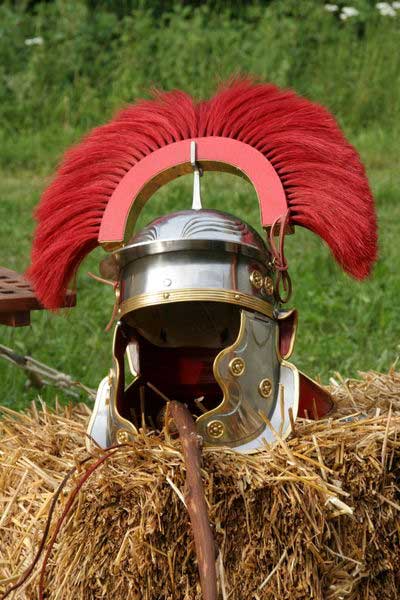
Archaeologists working near the town of Xanten – an area of land which was a part of the Rhine riverbed for nearly 1,500 years – were thrilled to find an iron legionnaire’s helmet that had once been worn by a Roman soldier… and they were even more ecstatic to realize that the helmet held trace elements of glue on its exterior!
When researchers were handling the helmet for restoration purposes, they removed a tiny sample of metal with an extremely fine saw – not an unusual practice, since restorers need samples of ancient items in order to make sure the restorative chemical won’t damage the artifact – and were shocked to see that the tool’s heat was causing little silver laurel leaves that decorated the helmet to peel off, leaving threads of glue behind.
It seems that since the helmet was on the riverbed for such a long time, the glue was spared exposure to potentially destructive atmospheric elements, thus allowing it to maintain its adhesive power for over two thousand years.
Examination of other Roman artifacts since this discovery revealed that there are plenty of additional items – such as ancient battle masks – that have trace remains of silver decoration like the helmet’s laurel leaves, and it is likely that they were held on with glue in the same way. Unfortunately, a close look at many of the items has shown that they are too far in their deterioration to yield evidence of glue. However, it seems that the Romans preferred to glue on their decoration to battle armor, rather than go through the hassle of soldering on each and every small piece.
A chemical analysis of the ancient Roman glue has determined that it was made of beef tallow, pitch, and bitumen – but as of yet, researchers haven’t been able to exactly reproduce the adhesive, and are beginning to think that something like sand, soot or sawdust might have been added in order to complete the recipe.
Researchers are hopeful that they’ll be able to fully recreate the Roman glue soon – after all, if the Roman stuff can still stick after 2,000 years, it’ll easily surpass any of its modern competitors!
Want to read more?


Tomorrow: More Ancient Standard!

By: The Scribe on December, 2007

In ancient times, the Kingdom of Mali was one of the wealthiest ancient Empires around – after all, it was the source of nearly half the world’s gold. Not surprisingly, this industrious Empire also had its own system of religious beliefs and customs, which included the production of complementary artifacts for those beliefs.
However, archaeologists also suspected that a little more than just plain sculpting went into many African artifacts, such as those from Mali – and so three analytical tests were done on seven Bamana and Dogon sculptures.
The results of the tests revealed that the beautiful, shiny patina on the outside of Malian works of art was created by a secret ingredient: blood. The ‘chemical fingerprint’ of blood showed up on each of the statues, confirming suspicions that these ritual statues were likely used for ceremonies that involved animal sacrifices, which may have made the statues representative of an animal’s death.
Want to read more?


Tomorrow: 2,000 year-old glue sticks!
By: The Scribe on November, 2007
![A glass jar with the ashes of a baby was found at the Syrian site of Palmyra, a trading and caravan center in the ancient Near East.]](http://ancientstandard.com/images2/palmyra-syria.jpg "A glass jar with the ashes of a baby was found at the Syrian site of Palmyra, a trading and caravan center in the ancient Near East.]")
Amongst the ruins of the ancient Syrian site of Palmyra, archaeologists came across an ancient glass jar which held some rather curious contents: the ashes of a baby. This kind of item had never been found before, and the discovery indicates that there were different funerary practices at this important city than had been previously assumed.
The jar was found in an ancient cemetery inside of the city, and the diameter measured approximately 24cm x 18cm (9.5in x 7in) – with the cremated remains resting inside. Other items found within the cemetery were things like small pieces of furniture, lamps, pottery, and even small, glass vials that mourners could place their tears inside and then leave the vials at the gravesite.
While further studies on the baby’s remains are pending, it would be very important to learn about new funerary practices at Palmyra. The city is located about 240 kilometers away from the Syrian capital, Damascus, and rose to prominence through its location along the primary caravan route through Mesopotamia. Traders and travelers from all across the world came through Palmyra, and the city later became the center of an Arab client state to the Roman Empire.
Since cremation of infant remains had not otherwise been known to exist as a regular funerary practice in Palmyra, it is possible that the child belonged to someone moving through the city and who simply felt the need to conform to their own traditions – or perhaps this new method of burial developed under Roman rule, which means that other jars of baby ashes might turn up once the cemetery is more fully excavated.
Want to read more?


Tomorrow: Ancient Blood Sculptures
By: The Scribe on November, 2007
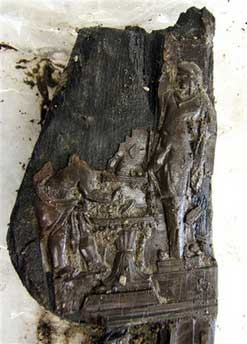
For the first time in history, pieces have been found of an ancient Roman throne – a throne that was buried in 79 AD, after the eruption of Vesuvius covered the city of Herculaneum with lava and ash, killing thousands of people. As one of the three cities that was destroyed in the eruption – the others being Pompeii and Stabiae – Herculaneum was closest to the volcano’s base and would have been the first to be destroyed.
The ancient wooden throne was decorated with bas-reliefs in ivory that depicted several ancient gods, which spanned across the entire chair. Two legs and a portion of the throne’s back makes up the most of the remains, and were located very near to the Villa dei Papyri, which is believed to have been the home of Julius Caesar’s father-in-law during the first century.
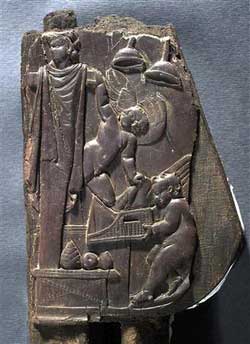
Prior to the discovery, Roman thrones were known only from artistic depictions – this throne is incredibly detailed in its own artwork, with images of Greek figures from myth shown in a Romanized style. The gods Attis and Dionysus are prominently featured, and other decorative features are made up of flowers, phalluses and pine cones – perhaps more than a little unusual for the modern eye.
The cult of Attis was prominent at Herculaneum during the 1st century AD, and since the god was associated with life, death, and rebirth, it is likely that the theme of the Roman throne was that of fertility – which explains the decorative features of choice.
While little is known as to how the throne would have been used – let alone whether the chair even belonged to the resident of the Villa dei Papyri – the cultic associations certainly point to it having belonged to someone who was prominently involved in Attis worship.
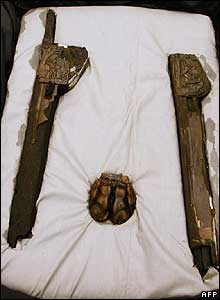
Either way, the survival of such a large portion of wooden furniture is rather astounding, though organic materials aren’t entirely unheard of in Pompeii or Herculaneum – the volcanic mud that came after the eruption did a very good job at preserving nearly everything, even food from the time of the eruption, in both cities.
Want to read more?


Tomorrow: Baby Cremation
Previous page | Next page
