Archive for 2007
By: The Scribe on November, 2007
 In a quarry about 200 miles east from Frankfurt, Germany, archaeologists discovered the fossilized claw of what would have been an 8-foot long sea scorpion during its lifetime approximately 390 million years ago. The claw was 46 centimeters long – nearly half a meter! – and it is fairly certain that the ancient creature would have spent its time paddling along in rivers or swamps.
That isn’t to say that it couldn’t walk on land. According to the Biology Letters journal which published the report on the claw, the ‘Jaekelopterus rhenaniae’ probably only lived in water because it was easier to get around that way, considering the construction of its body – an arthropod of this size probably had some trouble walking effectively on land.
Considering the size of the claw and its resultant comparison – the sea scorpion would have been larger than a human being – researchers are now more convinced than ever that creatures such as spiders, crabs, insects, and other living things that are tiny in today’s modern world were much, much larger in the past. At the very least, this ancient sea scorpion exceeds the record for known arthropods by nearly a half meter.
These ancient sea scorpions existed during a time in the history of earth when the atmosphere’s oxygen levels were significantly higher than they are today – and some scientists believe that as a result, this helped creatures such as the giant arthropod and other invertebrates to develop super-sized bodies.

However, over time as vertebrate predators made their way into the main sphere, larger creatures such as these would have been seen as prey – for plenty of predators, bigger prey is better, which likely resulted in all the larger creatures being killed off first, and the smaller specimens surviving. By the time humans came on the scene, these large creatures had been dwindled down to a much smaller size, which continued until there were only the tiny specimens that are known today.
Although the fossilized claw of this sea scorpion dates to approximately 390 million years old, it is believed that the species actually made its land debut approximately 450 million years ago.
Want to read more?


Tomorrow: More Ancient Standard

By: The Scribe on November, 2007
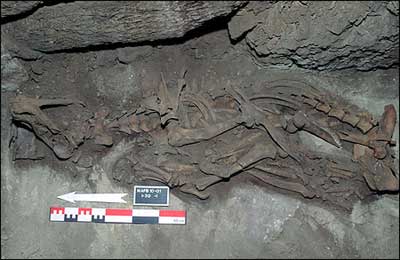
It’s no secret that the ancient Egyptians mummified cats, monkeys, small crocodiles, even things like snakes and birds… but what about larger animals? Say, for example… a lion? Well, it turns out that not only were lions considered sacred in ancient Egypt, but the ancient records that talked about breeding and burying sacred lions weren’t exaggerating! Although no one had previously found a specimen to verify the written record, excavations from a tomb in 2001 certainly changed all that.
A mummified lion – actually one of the largest lions known to the scientific community, and obviously very old when it died in captivity – was found inside the tomb of a woman named Maia, who was the wet nurse to the famed King Tutankhamun. The nurse was buried around 1430 BC at Saqqara in northern Egypt, and was evidently held in very high regard by the royal family.
Analysis on the bones and the teeth of the lion revealed its old age, and that the lion was a captive in the royal household. The association between lions and royalty – particularly the Pharaoh – was nearly as well known as the association between kings and falcons, and plenty of Egyptologists believe that there were probably special animal precincts and sacred cemeteries at various locations in Egypt devoted to the breeding, care, and eventual buried of sacred animals such as lions.
Although none of these ‘sacred lion precincts’ have been found, the ancient Egyptians certainly had a history of setting aside specific areas for animals – for example, the city of Crocodilopolis was specifically devoted to crocodiles and contained a sacred pond for the animals.
The lion inside the Saqqara tomb was found stretched out on a rock, with the body oriented eastward and the head pointing north. Most of the wrappings had been lost, but the positioning and the surrounding context revealed its mummification had been complete at the time of burial – and in terms of the scientific community, the bones represent those of the largest male lion to ever be recorded.
Want to read more?


Tomorrow: Giant Scorpions!
By: The Scribe on November, 2007

At the site of Phum Snay in northwestern Cambodia, archaeologists uncovered a group of 35 skeletons, believed to date between the first and fifth centuries AD. The unusual aspect of the burial, however, was that five of the skeletons were females – and all of them were buried together with bronze or steel swords and helmet-like objects.
In an era and location where women were supposed to have played a more ‘traditional’ role in society – these were villages of fishermen and rice-farmers, where women tended the household and were responsible for mending clothes, caring for children, and food preparation – finding battle objects with female bodies was quite surprising.
The burials seem to suggest that this area of Cambodia was a place where female warriors played an active role in the society – and the find-spots of the skeletons in prominent locations within the tomb also indicates that these women were held in high regard, at least to some degree.
Of course, before any theories can be made absolute, it is probably best to wait until more investigation is done on the women’s bones – if the skeletons show signs of cut marks and other battle-related damages or injuries, then it is likely that the theory of Cambodia’s version of ‘Amazon’ warriors may actually ring true.
Want to read more?


Tomorrow: Mummy Lion
By: The Scribe on November, 2007
 Although Julian the Apostate `did everything he could to try and elevate paganism again in the eyes of the general populace, the Christian churches continued to have a high degree of influence because of their public charities. Christian charities were beneficial to all citizens of Rome, and the Emperor found this to be greatly disconcerting – they fed both Christian and pagan poor, welcomed everyone with open arms, and were compassionate toward the less fortunate, whereas the pagan priests were moreso preoccupied with neglecting the poor, a fact which certainly didn’t escape Julian’s attention.
In an effort to fight back, Julian envisioned a philanthropic system for the Roman Empire that would reduce pagan reliance on Christian charitable organizations, but it wasn’t as well received by pagan priests and followers as he would have liked – instead, he watched as contempt grew for the old gods. His plan was designed to ensure that all aspects of citizenry were connected through varying levels of society, all the way up to the consolidated figure of power in the Emperor, who was the “final provider” for all his peoples’ needs. Christian charity simply didn’t fit into this hierarchy.
On a trip through Jerusalem in 363 AD, Julian made a brief stop at the ruins of the Second Temple. Naturally, since he was committed to elevating any other religion over Christianity, he decreed that the Temple was to be rebuilt – however, a series of disasters struck during the initial phases of the project, and thus the rebuilding efforts were abandoned. It also didn’t help that the Jews were rather ambivalent toward the idea in the first place.
It was on that same trip that Julian moved to engage the Sassanid Empire of Persia, in hope that he would be able to take back the cities under Sassanid rule that his cousin – Constantius II – had been unable to regain. He was encouraged to move forward with the campaign after receiving an oracle from the Sibylline books, and entered Persia with 90,000 men. A skilled military leader, Julian easily conquered several smaller cities and decimated the initial waves of troops, but even after winning the Battle of Ctesiphon in front of the capital city, he was unable to enter and gain control of the city itself.
Julian decided to lead his army back to the safety of the Roman border, at least until reinforcements arrived. They were pursued during the retreat and engaged by Sassanid troops, and it was during one of these battles that Julian received a spear wound that pierced through the bottom of his liver and intestines. Although the wound itself wasn’t initially fatal, his personal physician Oribasius of Pergamum was unable to treat it successfully. He likely tried to irrigate it with red wine and also suture the intestine, but it was to no avail – Julian the Apostate died on June 23, 363 AD.
Although it is unknown whether the tale is pure myth or an actual battle report, the traditional story goes that as Julian lay on his deathbed, his dying words were: “Vicisti, Galilee”- which translates as “you have won, Galilean” – a supposed resignation from the last pagan Emperor that Christianity had won out as the state religion of Rome.
Want to read more?


Tomorrow: Cambodian Warrior Princess
Previous page | Next page
