Archive for 2007
By: The Scribe on March, 2007
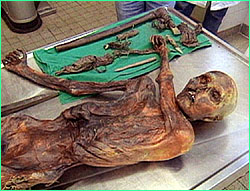 Although it was originally believed that Otzi the Iceman, Europe’s oldest known mummy, was ritually sacrificed by his people to appease the gods, further forensic analysis on the body has revealed that, in fact, ‘Frozen Fritz’ may have been the victim of an ancient murder!
A small tear on Otzi’s coat matched the shape of an arrowhead found lodged in his shoulder, suggesting that he may have bled to death after a confrontation with another individual, possibly from a competing tribe. However, Professor Annaluisa Pedrotti, from Trento University in Italy believes otherwise – according to her research, the type of arrowhead found in Otzi’s shoulder is known only from a very specific area in the southern part of the alps, suggesting that the attacker may have actually been one of his own people.
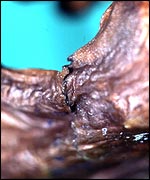 In addition, research done on the body in 2002 revealed a deep wound on Otzi’s right hand – cut down to the bone. Because his gear was found neatly arranged in the ice nearby, it appears that Otzi may have sat down to rest after the conflict and, weakened by blood loss, died shortly thereafter.
Unfortunately for Otzi, even if he had been able to avoid his fatal confrontation, he would have likely died in the near future regardless. At 46 years old, ‘Frozen Fritz’ already suffered from intestinal cancer as well as an intestinal parasite known as whipworm. It is thought that perhaps the 52 tattoos found all over his body – consisting of various lines and dots – were the results of a type of acupuncture, perhaps in an attempt to alleviate his suffering.
Tomorrow: Otzi’s Curse…?

By: The Scribe on March, 2007
 It seems that Europe’s oldest known mummy – Otzi the Iceman, or ‘Frozen Fritz’ – was so well preserved during his 5,300 year frozen stay inside an Alpine glacier, that scientists were able to analyze the contents of his stomach and determine exactly what Fritz ate for a final meal!
Evidence from his intestinal tract revealed that shortly before his death, Fritz probably ate venison and ibex meat, an unusually rich meal for a people who normally ate very small amounts of meat from rabbit, rat or squirrel. In fact, evidence shows that he ate two meals on his journey up the slopes: for his first meal, Fritz dined on the ibex meat as well as cereals and plants, and for his second – before his death at 3,200 metres above sea level – an unusual amount of deer.
Before the latest evidence, there were speculations that Otzi had been killed as a part of some ritual sacrifice, which may have explained why the diet of his final days was superior to that of the typical hominids of the time… however, it is now known that Otzi’s death was, perhaps, not of his own accord…
 Want to read more?

 Tomorrow: Frozen Fritz’s fatal confrontation…!
By: The Scribe on March, 2007

Although the ancient footwear you see here may look uncomfortable, the truth is that these shoes were designed to outlast a near infinite amount of stress and wear – in fact, the ancient Europeans used these shoes to hike up the treacherous pathways of the Austrian alps… even past elevations of 10,500 feet.Europe’s oldest known mummy, Otzi the Iceman (or more affectionately known as ‘
Frozen Fritz’), was discovered in a glacier of the Otztal Alps between the Austrian and Italian border, and was quite literally still wearing his shoes.
These wide, waterproof shoes seem to have been designed specifically for walking across snow, and though some have speculated that they may have been used as the tops of snowshoes, this remains under debate. The outer layer of the shoes was made of deer and bearskin, while inside was sewn a tree-bark netting. To keep the feet warm, grass was placed around the foot, forming a kind of ‘ancient sock’. In fact, these shoes were even recreated and tested by a Czech shoe expert named Petr Hlavacek, who hiked up to 8,200 feet – more than 25 miles in frigid, mountainous Alpine conditions – and only stopped due to personal reasons of recent surgery! In fact, the shoes functioned so well – and so much better than modern outdoor footwear – that these 5,300 year old pieces of footwear are now being studied for commercial production.
Want to read more?


Tomorrow: The Iceman’s intestines reveal his final meal!
By: The Scribe on March, 2007
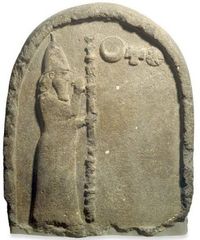 The last king of Babylon, Nabonidus was a monarch who truly wished that he had been born into another family – he simply was not interested in the job. Passionate about the ancient history of his own time, Nabonidus had a reign characterized by a lack of interest in the politics of his own kingdom, as well as the rejection of the traditional Neo-Babylonian religious practices.
A scholar and a recluse, Nabonidus decided that instead of worshiping Marduk, he would build a temple to the moon god Sin, and give his mother and daughter the jobs of temple priestesses… after which he went into self-imposed exile at the Oasis of Tema in the Arabian desert, making himself absent for about 10 years from the city he was supposed to be ruling!
According to writings in the Dead Sea scrolls, the accounts in the Hebrew scriptures which suggest that the previous king of Babylon, Nebuchadnezzar, was mentally unstable, may have in fact been referring to Nabonidus, whose reign followed that of Nebuchadnezzar. In the Hebrew scriptures, the tale talks of the king “imagining he was a goat” and that he “ate grass with the cattle”, after being cursed by God for not following Him. However, this may have been a reflection of Nabonidus’ refusal to conform to the traditional Babylonian religious practices, and perhaps somewhat reflective of his demeanor after his rather lengthy seclusion in the middle of the desert – alone… in the sun… – for so many years…
Indeed, upon hearing reports of the Persian army encroaching upon Babylon, Nabonidus returned to the city, but it was too late. Babylon was sacked and conquered in 539 BC by the Persians and their famed leader, Cyrus the Great.
Want to read more?

Tomorrow: All about Otzi
Previous page | Next page
