Author Archive
By: The Scribe on September, 2007

It appears that the ancient inhabitants of a cave in southern Mexico weren’t very good about cleaning up after themselves in the kitchen – in 1966, an archaeologist working around the Mexican town of Mitla stumbled across the remains of about 122 ancient chili peppers! The pepper pieces were distributed between two caves, and represent at least ten different varieties of chili peppers.
Analysis of the chili pepper remains showed that some of the ancient fruits had actually been kept fresh while others were dried and stored – much in the same way a person could purchase dried chili pepper flakes in a grocery store today. The likely explanation is that the inhabitants here would chop up the fresh peppers and use them for salsa or as a meal garnish, while the dried pieces were probably thrown into a sauce or stew.
If this sounds oddly familiar, it’s because it is – further investigation into the caves also revealed the ancient remains of beans, corns, and squash, all staples in the diet of modern Mexicans today! However, the evidence certainly seems to lean toward the idea that today’s Mexicans borrowed their culinary traditions from the ancient Zapotec Indians, who lived in the area between 600 and 1521 AD.
But why would anyone store their food supplies in a cave, and was anyone actually cooking there? Considering the known locations of Zapotec settlements in the area, the caves were probably used by Zapotec hunters as night shelters – if they’d gone too far from their village on a hunt to be able to return safely in the same day, they could stay in the cave, eat a meal, and rest before continuing their journey in the morning.

There also may have been crop fields nearby, which would have made the caves very handy for temporary crop storage, before transporting them to the village. Since the caves are about 1,900 meters above sea level, this would have made them ideal for crop storage – at this elevation, the harvested crops wouldn’t be threatened by flooding.
Although it remains to be seen whether the kinds of chili peppers found here are similar to modern species or if they are remnants of now-extinct varieties, the fact remains that the culinary heritage of southern Mexico has a much richer and distinct history than anyone had previously suspected.
Want to read more?


Tomorrow: Stinky global warming!

By: The Scribe on September, 2007
 Whether you call her Pscipolnitsa, Poluudnica, Psezpolnica, Polednice, Polednica, Poludnitsa or – mercifully – Lady Midday, ancient Slavic mythology suggests that you really don’t want to meet this woman on a hot day. In fact, Lady Midday is a noon demon, which is just one more reason why staying indoors at the hottest part of the day is always a good idea…
According to Slavic mythology, Lady Midday (or Pscipolnitsa, ad infinitum…) had a tendency of appearing to people in the middle of hot, summer days, showing herself as either an old hag, a 12-year-old girl, or a stunningly beautiful young woman. The lady would stop people as they walked through the countryside’s fields or while they were working, and would ask them difficult questions or perhaps simply engage them in conversation… and as harmless as it sounds, she apparently had a bit of a temper. If a person failed to answer her question, or if they attempted to change the subject, well… Lady Midday would cut off their head, or alternately, strike them with madness.
Theoretically, workers could see Lady Midday as she approached, since she tended to take the form of a dust cloud before becoming corporeal – and she would often carry a scythe or a pair of large shears in her hands. According to mythology, she was also quite efficient at scaring away small children who might be up to trouble around valuable crops.
Slavic artists often pictured Lady Midday as a young woman dressed in white, roaming around the edges of crop fields – however, it is useful to keep in mind that she was only seen during the hottest part of the day… namely, she was a personification of sunstroke, and was a useful tool in teaching workers about the dangers of working through the noon heat. What better reason to take a lunch break?
Want to read more?


Tomorrow: Red Hot Ancient Chili Peppers
By: The Scribe on September, 2007
 Though the Inca are typically remembered for their complex societies and large-scale warfare, there’s something that often gets overlooked in the history books: women’s fashion! And yet, quite often, it’s the metal accessories from clothing and adornments that last in the historical record. Certainly, they’re nice to look at, but these kinds of artifacts also explain just a little bit more about how ancient societies functioned on a day-to-day level, and what was important to them.
“Tupus”, or long shawl pins, were a staple of women’s fashion during the Incan Empire. These long pins, created out of silver, bone, copper alloy, or even bronze, were used every day by women to pin their garments together or to help close the wrappings used as burial shrouds during funerary preparations.
Many, many tupus were discovered at Machu Picchu over the years of excavation, and it seems to be that, much like modern feminine ornamentation, tupus did not conform to a standard design or size. Instead, tupus like the one pictured above had a much higher value than a plain, silver tupu that might only have a small, curved flange on the top. After all, a bone-carved shawl pin would have to be hand-made – whereas the silver pins pictured below were cast in mass quantities and would have cost far less to purchase.

And yet, some women seem to have thought that even a hand-carved shawl pin wasn’t enough for them, and instead decided they needed… foreign imports! The image below is an example of a tupu that has a highly unusual shape, when compared to the other pins found around Machu Picchu – not to mention that it has three openings in the middle of the pin, which were likely created during the casting process. The unusual shape, combined with the odd décor, suggests that this pin was probably made outside of the region and later imported into the area for trade!

Want to read more?


Tomorrow: Sun-stroke really IS fatal.
By: The Scribe on September, 2007
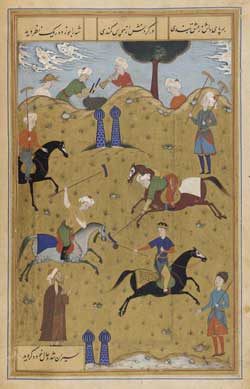 Although its origins and history are somewhat obscure, polo seems to have appeared in Persia around 2500 years ago, making it possibly the oldest known team sport in world history – not to mention being a sport that has typically always been restricted to the more privileged classes of society!
Owning a horse has historically been considered a bit of a status symbol, and in polo, all team members must have their own, well-trained beast, in order to participate. The sketchy historical records suggest that polo was initially developed by competing tribes in Central Asia, and was quickly adopted as a training program for Kings’ cavalry and other elite troop guards – these “training” matches could actually have up to 100 mounted men per side, creating a true sense of replica warfare.
As use of the sport progressed, it appears that the noble families began to participate, eventually adopting polo as their own Persian National sport, played only by the nobility. Both women and men participated in matches, and there is even one documented record from the 6th century AD of a Persian queen and her waiting ladies having challenged the Persian King Khosrow II Parviz and his men to a friendly, family game!
Indeed, ancient Persian art and literature give detailed accounts of polo games played in the royal courts, including many references in an epic poem, Shahnameh (The Epic of Kings), from the 9th century by the Iranian poet and historian Ferdowsi, where he discusses various matches held in tournament format. He also makes mention of another Persian prince from the early Persian empire, who apparently learned how to play polo sometime during the 4th century AD, when he was just seven years old.
It wasn’t until the 10th century that an Iranian king actually recorded some of the sport’s general and more important rules, in particular pointing out the potential dangers of playing in a match – and as the centuries progressed, a 13th century Iranian poet even used polo as a basis for one of his love stories!
As the Persian nobles continued to invite other royal families from various countries to play in their tournaments, the popularity of the sport grew and spread rapidly across the East – in fact, there was even a stone tablet next to a polo field along the famous Chinese silk road, reading: “Let other people play at other things. The King of Games is still the Game of Kings.” Coats of arms for the Chinese royal families soon included a polo stick, and it is well know that polo was an important part of royal family life during the reign of Ming-Hung, a time that is often referred to as the Golden Age of Chinese classical culture.

Naturally, not everyone was a good sport when playing these ancient polo matches. Although a 9th century Iranian historian had written instructions concerning how players should behave on the field – such as, “a player should strictly avoid using strong language and should be patient and temperate”, and “if a polo stick breaks during a game, it is a sign of inefficiency” – this apparently didn’t stop the Chinese Emperor Tai-Tsu in 910 AD from beheading all the players in a polo match that he had been watching, simply due to the fact that one of his own favorite players had been unfortunate enough to be killed during the game.
Brutality aside, the game continued to spread, with the Japanese learning the game from Chinese diplomats, and the Arab world picking up on the sport during their conquest of Iran in the 7th century. The polo stick actually became an important heraldic symbol in Islamic courts, and Polo Masters were a common addition to a ruling Caliph’s entourage!
Even with its spreading Eastern popularity, the game didn’t actually make it to the West until the Byzantine period. The ruler of Constantinople during the 12th century tried to encourage the sport’s growth, and his own successor even played until his arm and leg were crushed during a particularly rough match.
Polo continued to spread in this way, moving from royal household to royal household in various Eastern countries – and it wasn’t until sometime during the 18th century that the Western world learned of the existence of the sport, eventually refining the game into what is known today as the ‘modern’ version of polo.
Want to read more?


Tomorrow: What the heck are Tupus?
Previous page | Next page
