Archive for the ‘Ancient Europe’ Category
By: The Scribe on January, 2008
For the first time since its discovery, Britain’s very own underwater “Atlantis” is likely to finally be revealed and examined. The town under investigation is the lost city of Dunwich, located off the coast of Suffolk.
This ancient British town was considered lost until the 1970s, when marine archaeologist Stuart Bacon located the city’s debris underwater. Since that time, dives have been conducted on the site, but it wasn’t until recently that high-tech underwater cameras were developed that could massively improve researchers’ ability to take accurate images of the city as it sits on the seafloor.
An expedition is planned for 2008 that will make use of the latest sonar, scanning equipment, and underwater cameras, in order to build an accurate picture of what the ancient sunken city looked like before it was submerged. Currently, the city lies between 3 and 15 meters below the surface.
About 1,500 years ago, Dunwich was the capital of East Anglia – and at this point, divers have found three churches and one chapel, though the silt levels in the water are so high that visibility for the sunken city is no more than a few centimeters.
 During the city’s height, it was a prosperous seaport that specialized in the wool and grain trade, boasting a population of around 3,000 people. Historical texts from the time have identified that the city had about eight churches, three chapels, two hospitals, and five houses for various religious orders – though it is likely that there were even more churches at the city during its most prosperous period, considering the size of the population.
The decline of the city began in 1286 AD, when the East Anglian coast was hit by a sea surge that began to erode the coastline. Since Dunwich literally sat right on the coast, the city was gradually claimed by the sea as the coastline eroded over a period of time. According to ancient reports, after the storm of 1286 had swept away a large part of the town, the residents banded together to try and save the harbor – but in 1328, a second storm destroyed it and the entirety of a neighboring village a little way up the coast.
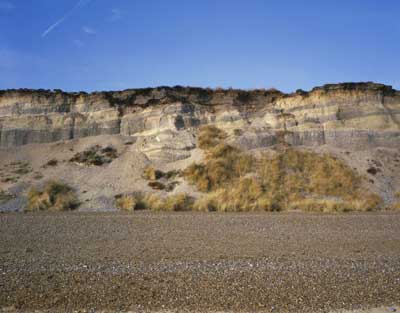
In 1347, another storm swept around 400 houses into the sea, and longshore drift set in to reduce the city to what is visible today; the Dunwich buildings that currently sit on cliffs were once at least a mile inland. According to local legend, there are certain tides where a person can stand on the shore and hear church bells underneath the waves.
Want to read more?


Tomorrow: More Ancient Standard

By: The Scribe on January, 2008

Many pieces of ancient art have little information known about them, other than the context of where they were found and the approximate time period they were from. However, this should not discount their value as incredibly important testaments to human creativity in history. Whether appreciated for their historic value or their artistic merit alone, one would be doing a great disservice to their ancient creators if one was to ignore these tangible objects of the human past.
One of these ancient pieces of art that little is know about is the Venus van Mierlo. This little engraving was found on a piece of sandstone in the Netherlands, at a site called Geldrop-Mierlo in North Brabant province. The image engraved on the stone is of a girl who appears to be dancing – her legs and arms swing out in motion, and she is wearing a low, hip-hugging garment.
Called the ‘Venus of Mierlo’ as a bit of a joke – a testament to the ancient Greek goddess Venus, though the Greeks certainly established their gods thousands of years after this little engraving would have been made – the cultural and religious significance of the piece is completely unknown.
The site where it was found is believed to have been occupied by reindeer hunters, and it is entirely possible that the image of this dancing girl had something to do with their religious notions about the hunt… or, perhaps someone simply was bored and drew a picture on the stone.
Want to read more?


Tomorrow: A brief history of Tae Kwon Do
By: The Scribe on January, 2008

Ah, for the good old days when meat-eating fungi ravaged the earth, eating tiny animals…
Actually, that’s a pretty frightening thought… which is why scientists were shocked – but also somewhat relieved – to find remnants of a carnivorous fungus trapped inside a piece of one hundred million-year-old amber.
The amber was found in a quarry in southwestern France, but the first noticeable thing about the amber was that there were a number of tiny worms trapped inside it. These worms are called ‘nematodes’, and the fungus actually trapped the worms inside of sticky loops before descending on them… and eating the worms.
Analysis of the meat-eating fungus shows that this ‘micropredator’ had developed this complex trapping and eating process about 145 million years ago, during the Cretaceous period. The fungus itself was made up of branching protrusions, also called ‘hyphae’, that had small rings around them that were coated with particles. These particles would have produced a sticky, sap-like resin that trapped their prey – in this case, the nematode worms.
Once the fungus trapped a worm inside its sticky loops, additional hyphae called ‘infestation hyphae’ would have pierced the worm and begun digesting its flesh.
The only problem with this piece of amber is that none of the worms were actually found inside the amber still trapped in the hyphae rings, leading some scientists to suggest that this trapping method is pure speculation. However, some modern trapping fungi have similar methods for capturing their prey, which is what led scientists to their conclusions.
While the carnivorous fungi cannot be assigned as relative to any of today’s modern meat-eating fungal species, it seems that trapping devices on fungus evolved independently on multiple occasions over the course of Earth’s history. Modern carnivorous fungi are known to use such trapping methods as adhesive knobs, projections, and constricting rings to catch their prey.
Want to read more?


Tomorrow: More Ancient Standard
By: The Scribe on December, 2007

It was around 26,000 years ago that the people living in ancient Southwest France decided that they had a favorite food – very favorite, for that matter. Prior to this discovery, the people had occasionally treated themselves to a hearty dinner of reindeer meat… but they began to ask themselves, why only occasionally? And with a large supply of reindeer to be found in the area – not to mention how tasty they were – why not eat them on a more regular basis?
In fact, so many ancient reindeer bones were found in this area of Europe that the people even began to use the bones to do things like carve calendars into them, use the bones as counting devices, and fashion them into ornamental pieces.
Two recent studies on the consumption of reindeer in ancient times analyzed bone remains from rock shelters and limestone caves, in order to learn things like: how the meat was butchered, information about the reindeer population, and how far the hunters had to travel in order to find the reindeer. The remains showed that around 64,000 years ago, the humans living in these caves had to travel a significant distance to hunt reindeer, and would then only bring back the best cuts of meat to their community.
Over time, the population of reindeer increased at a significant rate – which meant the hunters didn’t have to go far at all to find a good source of nutritious meat. Eventually, 90% of the human populations’ meat came from reindeer, and nearly all parts of the animal were being eaten – and the remaining parts used to create other items.
Talk about a reason for getting coal in your stocking…
Want to read more?


Tomorrow: More Ancient Standard!
Previous page | Next page
