By: The Scribe on April, 2007
 Although it may look like just a piece of sculpture, this dog’s head is actually a drinking cup from 5th century Athens. It is thought to have been created by the Brygos Painter, who has over 200 pots and cups attributed to him in museums worldwide.
This drinking cup, or ‘rhyton’, was made with very close attention to detail: tiny whiskers are incised on the dog’s snout, and visible tendons bulge on the throat. The red band around the neck represents a collar, and on the rim of the cup is a painted scene from Greek mythology of pygmies battling cranes.
The rhyton probably belonged to a high-class Greek citizen, since dogs in ancient Greece were mostly kept as hunting companions. The cup itself would have likely been used to drink wine at men’s drinking parties, called ‘symposiums’. When the cup was empty, it would be turned upside-down to show the dog’s head, displaying the craftsmanship and allowing the vessel to have two functions: for practical use as a cup, and for aesthetic use as a piece of art.
Want to read more?


Tomorrow: 9000 year old wine, was that a good year?

By: The Scribe on March, 2007
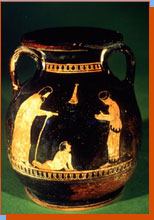 Hippocrates, a doctor in ancient Greece who has often been referred to as “the father of medicine”, after his death left a great deal of writings concerning women’s health, including the procedures and complications arising from an unwanted pregnancy.
Abortion in ancient Greece was not common, simply for the fact that it was highly unlikely that the mother would survive the abortive procedure – it is estimated that about one in ten women would live through an abortion. Indeed, speculation on the methods of abortion are numerous: pressure on the woman’s stomach, riding in a cart on bumpy roads, herbal supplements, or the most dangerous method – inserting a sharp knife or rod into the womb, killing the baby immediately.
Although infanticide was technically legal, a more acceptable recourse was to simply expose the baby at birth. Exposure was more common for female children; the child would generally be wrapped up and placed somewhere outside of the city, perhaps in a field or even in a back alley. Though this would typically result in the child’s death through exposure to the elements, anyone who found an exposed child was permitted to keep it and raise it as their own, though in many cases these children would be raised as slaves. Of course, there was always the option of making some money off the birth – even a noble-born child could be sold into slavery at any time.
Want to read more?


Tomorrow: All about Angkor Wat!
By: The Scribe on March, 2007

The first Olympic Games were held in 776 BC in Olympia, Greece. Many events that are known from our modern Olympic games were first described in the famous Greek poem The Iliad. Held every four years in ancient Greece during July or August, a truce was called between anyone at war within the country for about a month before and after the games, to ensure the athletes and spectators could travel safely to the event.
Athletes were unpaid and trained year-round for the events in which they planned to compete. Notably, all athletes in the Greek world trained and competed in the nude! Although the Greek ideal was to gain honor through winning in the games, the victor would be crowned with an olive wreath immediately after his event, and his name recorded in stone – second and third place prizes did not exist. On the final day of the competition, victors from many events received a large amphora of olive oil, which could be valued up to five years’ worth of pay.
Much like modern Olympic victors who gain sponsorships and advertising stints after their events, ancient Greek athletes were often given financial compensation by their hometowns upon their victories; in some cases a statue of the athlete would be erected in the center of town, idolizing and making the athlete into a famous, hometown hero.
The ancient Olympics included many events which are still held in today’s modern games: discus, javelin, jumping events, footrace, wrestling, and boxing. Chariot races were also quite popular.
Want to read more?


Tomorrow: The Mayan Military
