Archive for the ‘Ancient South America’ Category
By: The Scribe on October, 2007
When the Spanish colonialists arrived in Peru, many Chachapoyas saw this as their opportunity to escape subjugation from the Inca. Fed up with the harsh treatment and continual suppression of their culture, they allowed and even helped the Spanish to move into Cochebamba, looting local villages as they advanced through the Incan Empire.
Since they were a military culture, the Inca were not about to roll over and let the Spaniards take their land without a fight. The Inca leader Manco Yupanqui attempted to enlist groups of Chachapoyas to help, but they remained loyal to the Spanish and refused to defect… and yet by 1547, more Spanish soldiers arrived in the area, eventually taking over the city of Chachapoyas and removing any last vestiges of Chachapoyas independence.
The Cloud Warriors found themselves relocated into Spanish-style settlements and towns, forced to convert to the Spanish way of life and religion. Within 200 years after the Spanish arrival on Peruvian shores, the population of indigenous peoples in the Chachapoyas region was reduced by 90%. Attrition, poverty, and disease all contributed to the decline of the Chachapoyas culture and people, even after their help with Spanish advancement against the Inca.
Although the modern city of Chachapoyas still stands as a remnant of the ancient people, their culture and lineage has all but disappeared. Fortunately, their elaborate burials along the sides of cliffs have deterred looters to an extent, preserving their material culture enough for history to remember them as they were. Their monumental fortress of Kuelap also still stands, containing more than 400 buildings on the interior – it has even been referred to as the ‘Machu Picchu of the North’. However, keeping with the Chachapoyas tradition of setting themselves up on terraced slopes and cliff-side areas, Kuelap’s remote location often deters visitors from making their way to the site.
Want to read more?


Tomorrow: More Ancient Standard

By: The Scribe on October, 2007

Chachapoyas Material Culture
Although the Chachapoyas never reached the same level of technology in their material culture as other Peruvian cultures like the Moche or Nazca, they created simple and functional pieces of art that reflected what was important to them. Remnants of textile fabrics have shown that the Cloud Warriors preferred to dye their clothes red, and in some cases, painted decorations of birds or people would be added to larger, more elaborate pieces.
Many small, ceramic pitchers were recovered with cordoned motifs, while interior walls of domestic and public buildings were frequently painted – one building even depicted a story, with each wall representing a different stage in a ritual dance where couples held hands.
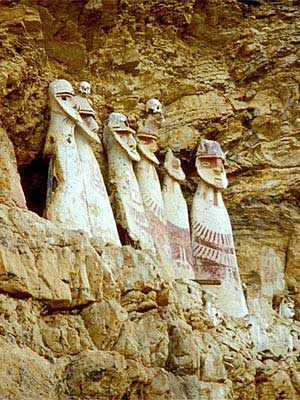
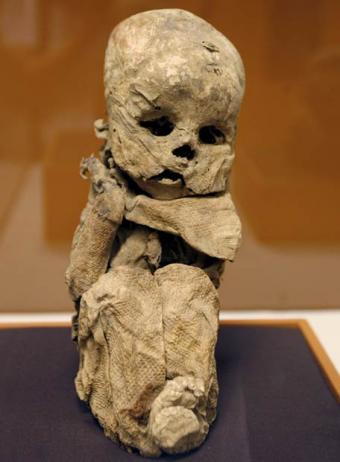
Funerary tradition could be conducted in one of two ways: a burial might take place in a cave located at the highest point of a precipice, with the mummified body placed inside a vertical sarcophagus, or it might involve the construction of mausoleums that looked like miniature houses, located inside of caves along the side of a cliff.
The Rise and Fall of the Cloud Warriors
While the archaeological evidence suggests that there were people living in the Amazonian Andes as early as 200 AD, the Chachapoyas probably didn’t arrive until the 9th century. The neighboring Wari culture may have influenced the rapid development of the major urban centers of the Cloud Warriors, mainly for defense purposes – and even if the Chachapoyas developed out of the Wari culture, it is likely that they would have been a group who split away due to irreconcilable differences.
The Kuelap citadel was likely the Cloud Warriors’ first line of defense against invading tribes, but in the 15th century, the Chachapoyas found themselves unable to stave off the Incan Empire – and were conquered by the ruler Tupac Inca Yupanqui! Although the might of the Inca quickly overpowered the Cloud Warriors, the people refused to go lightly – for decades afterward, the Inca found themselves troubled by rebellions and civil unrest. They attempted to quell the frequent rebellions by sending large groups of Chachapoyas into remote locations inside the empire… but as the Inca soon learned, this simply encouraged the Cloud Warriors to make more trouble.
When the Incan Empire inevitably broke out into civil war, the Chachapoyas were ready – they had formed an alliance with the Huascar, ruler of the southern capital, who warred against his brother Atahualpa of the northern capital, and many of them joined his army in hopes that winning would result in better treatment of their people. Unfortunately, the other side won – and many Chachapoyas were deported or executed for their alliance with the losing side.
However, this wasn’t the end for the Cloud Warriors – the Spanish colonialists had yet to arrive…
Want to read more?
Tomorrow: The conclusion!
By: The Scribe on October, 2007

The Chachapoyas people of ancient Peru, also known as the “Warriors of the Clouds”, was a culture belonging to the cloud forests of the Amazonas region. Although most of the information about these people is secondhand – since they didn’t develop a writing system of their own – there are many excavated archaeological sites that have yielded artifacts and architecture, which has assisted in the reconstruction of this group’s history.
The name ‘Chachapoyas’ was actually given to the group by the Inca, who conquered the Cloud Warriors in the 15th century – currently, no one knows what name the Chachapoyas used to refer to themselves. It is widely believed that the name ‘Chachapoyas’ is an Incan variant of the Quechua phrase ‘sacha puya’, which means ‘people of the clouds.’
The Origins of the Cloud Warriors
Second-hand accounts of the Chachapoyas by later Spanish conquistadors reveals that their skin was much lighter than that of other surrounding tribal groups, which may suggest that the culture did not originate in the Amazon region but that they were originally Andean. Their origins may also be revealed through their burial customs – such as burying their dead in anthropomorphic sarcophagi that wear wooden masks – which has also been seen in the Wari culture, a group whose civilization actually lasted four times longer than the Inca!
If they came from the Andes, the Chachapoyas probably expanded into the Amazonian area of the Andes for the purpose of expanding their agricultural territory, which is visible in land terracing spots throughout their known territory. As for what the land looked like, the Amazonian Andes is part of a tropical forest mountain range, and would have been covered in thick vegetation during the time of the Chachapoyas.
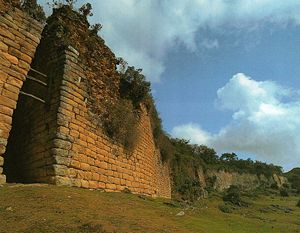
The architectural remains of the Cloud Warriors have shown that they preferred to live either on raised platforms built on sloped terraces, or inside of circular stone buildings, and often decorated the inside of their structures with symbolic images. They were also known to build monumental fortresses, such as the one found at Kuelap.
Want to read more?
Tomorrow: Part 2!
By: The Scribe on September, 2007
 Though the Inca are typically remembered for their complex societies and large-scale warfare, there’s something that often gets overlooked in the history books: women’s fashion! And yet, quite often, it’s the metal accessories from clothing and adornments that last in the historical record. Certainly, they’re nice to look at, but these kinds of artifacts also explain just a little bit more about how ancient societies functioned on a day-to-day level, and what was important to them.
“Tupus”, or long shawl pins, were a staple of women’s fashion during the Incan Empire. These long pins, created out of silver, bone, copper alloy, or even bronze, were used every day by women to pin their garments together or to help close the wrappings used as burial shrouds during funerary preparations.
Many, many tupus were discovered at Machu Picchu over the years of excavation, and it seems to be that, much like modern feminine ornamentation, tupus did not conform to a standard design or size. Instead, tupus like the one pictured above had a much higher value than a plain, silver tupu that might only have a small, curved flange on the top. After all, a bone-carved shawl pin would have to be hand-made – whereas the silver pins pictured below were cast in mass quantities and would have cost far less to purchase.

And yet, some women seem to have thought that even a hand-carved shawl pin wasn’t enough for them, and instead decided they needed… foreign imports! The image below is an example of a tupu that has a highly unusual shape, when compared to the other pins found around Machu Picchu – not to mention that it has three openings in the middle of the pin, which were likely created during the casting process. The unusual shape, combined with the odd décor, suggests that this pin was probably made outside of the region and later imported into the area for trade!

Want to read more?


Tomorrow: Sun-stroke really IS fatal.
Previous page | Next page
