Archive for the ‘Ancient South America’ Category
By: The Scribe on August, 2007

Though generally not considered a favorite food of children, it turns out that lima beans were once touted as a sacred, elite-only delicacy among the Moche civilization of northern Peru. Known for their lively painted and sculpted pottery vessels, many of the images they created were records of daily life – including important symbols and their favorite foods. Among these paintings are recognizable images of lima beans… and some are depicted in a rather interesting way.
At the Larco Museum in Lima, there is an extensive collection of Moche pottery that have lima bean designs, where some of the lima beans are actually anthropomorphic: the little beans have been given expressive faces, legs, feet, and in some cases appear to be representations of messengers or warriors. On some pots, there are symmetrical rows of lima beans that cover the entire surface of a pot, with distinctive speckles to show their specific genus.
Research into these pots, as well as the dieting habits of the ancient Moche people, give all indications that these lima beans were consumed primarily by the ruling elite, which would have placed them in a position of importance and prominence – and likely ensured their role in any number of religious rituals as well. Since cultures like the Moche tended to allow only the ruling elite as members of the community priesthood, there is a fair amount of certainty concerning lima beans’ ritual significance.
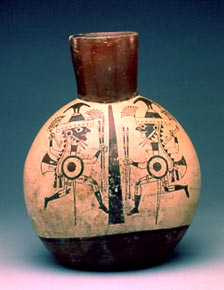
Other studies have focused on the lima bean’s role as a type of proto-script, meaning that many of the images of beans on Moche pottery actually held ideographic connotations – they were pictures that held distinctive ideas in their depiction. Thus, not only were lima beans consumed by the elite, but they also held symbolic meaning in their usage.
Lima beans have had a long history in South America, with remains of beans dating to around 6000 BC. While there are several different types of lima beans that grow across Central and South America, the Moche people would have consumed the denser variety of bean that is familiar in most grocery stores today.
Want to read more?

Tomorrow: Gold of the dead

By: The Scribe on July, 2007

Around 36 million years ago, giant penguins roamed the earth… or at least the tropics of Peru! Although scientists previously believed that penguins didn’t leave cold-weather areas like Antarctica and New Zealand for warmer areas until around 10 million years ago, the fossilized remains of two new penguin species have turned this theory completely around.
Both of the ancient penguins identified lived on the southern coast of Peru, not too far from each other – but the size of one of these penguins is where it really gets interesting. The Icadyptes salasi penguin stood around 5 feet tall, and had a long, protracted skull and an enormous spear-like beak around 7 inches long. Currently, the largest living penguins on earth are the Emperor penguins, who measure around 4 feet tall and have a much smaller beak.
The second species, Perudyptes devriesi, was around 2.5 or 3 feet tall – a size much closer to the living King penguins of today. Visible in the image below, both these penguin species stood much larger than the one species of penguin currently known to be living in Peru’s southern regions. The Icadyptes salasi also visibly dwarfs the second species whose fossils were found nearby!

As evidenced by the picture above, it is highly unusual for such large penguins to inhabit warm climates, but evidently both of these species thrived in the tropical environment! And although a 5 foot tall penguin would certainly be a force to reckon with, it is apparently only the third largest penguin known to have lived… evidently, 65 million years ago, penguins survived the mass extinction of the dinosaurs, living to grow into enormous sizes and later thrive off the coast of New Zealand at around 61 million years ago. Talk about a resilient creature…!
(Unfortunately, complete information on these even larger penguins is yet to be published…)
Want to read more?



Tomorrow: Fine dining in the stone age
By: The Scribe on June, 2007
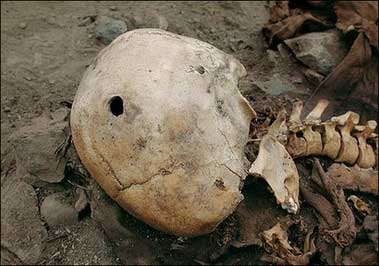
Near Lima, Peru, archaeologists believe they have discovered the first gunshot victim in the Western Hemisphere. In a shallow grave, surrounded by a large group of ancient Incan bones, the skull had an almost perfectly round hole, leading experts to wonder at first whether it had been made by a slingshot, spear, or some other circular weapon.
The Incans who died here, however, appear to have been killed rather violently – likely as a result of the Spanish Conquistadors, who battled against the Incan empire around 500 years ago. The shallow graves seem to suggest that the victims were buried in a hurry, which usually means that the burials were conducted during a time of conflict – in this case, possibly during a known uprising against the Spanish invaders in 1536.
In order to determine what made the hole in the one victim’s skull, forensic experts looked for a trace of metal around the wound, believing there was a very slim chance that any traces would remain after this long. However, against the odds, they found minute fragments of musket ball metal stuck inside the area surrounding the hole! Further examination revealed that the musket shot was less than an inch in diameter, and was powerful enough to enter the back of the victim’s skull and exit through the top of the head at an angle.
Since identifying this skeleton as the first gunshot victim in the Americas, two more gunshot victims have also been located among the bones, with further research on their conditions still to come!

As for the hastily buried bodies, their burials absolutely did not conform to the typical Incan burial customs: they were facing the wrong direction in the graves, they were wrapped only in a simple cloth, the graves were far too shallow, and there were no burial offerings – something absolutely unthinkable in many ancient burial rites. A closer look at the Incan mummies also revealed something more disturbing – many of the bodies seemed to have been hacked up and were missing limbs, there was evidence of impalement by iron weapons, and chunks of the bodies appeared to have been torn apart, in addition to the several bodies with gunshot wounds.
Although it is still not conclusively known what occurred here, the Incans buried here were clearly victims of some horrific and extremely violent acts. Hopefully, further forensic study on the bodies from these graves will help to shed some light exactly what happened at this site in Peru.
Want to read more?

Tomorrow: Scandalous Roman poetry!
By: The Scribe on June, 2007

A specialist by the name of David Johnson has done some work of his own on the Nazca lines, and has come up with a theory that is considered somewhat more plausible than some of the previously suggested ideas. Because the region is one of the driest in the world, the Nazca people actually created known underground waterways that made use of some of the excellent reservoirs located below the desert surface.
Through a somewhat controversial method known as dowsing, Johnson tracked the water tunnels, in order to determine whether the areas of the ground around the images contain water or not, and it is his belief that the pictures lie in correlation to water sources. The images were thus created as large-scale maps so that inhabitants of the area could find water, no matter where in the desert they were located. The glyphs themselves were then depictions of water gods, or religious figures that the Nazcans believed to represent each water source.
In 1985, archaeologist Johan Reinhard published a report using archaeological, topographical, ethnographic and historical data to demonstrate that Nazca religion and ritual was greatly centered around the worship of mountains and water sources. It was his belief that the figures were a part of Nazcan religious practices involving crop fertility and water provision, wherein the Nazca lines were used as sacred paths that led to places where each deity could be worshiped. The gods could see the images on the ground that honored them, and thus act benevolently toward the people, knowing they were being venerated. The various figures were thus symbolic of the gods and their attributes, though the specific meaning of each image has yet to be deciphered.
Reinhard’s theory built on the work of Johnson, and has since become the most accepted explanation for the Nazca lines, due to the ethnographic information that compared what archaeologists know of the ancient Nazca people with the modern religious habits and practices of some Andean cultures.

Although Reinhard’s theory is widely understood as the most logical explanation for the Nazca lines, they still present a fascinating visual wonder along the Peruvian coast, and will continue to serve as objects of wonder about this ancient culture and their curious but fascinating drawings on the desert floor.
Want to read more?


Tomorrow: Who’s up for a 2000 year old bowl of fruit salad?
Previous page | Next page
