By: The Scribe on April, 2007
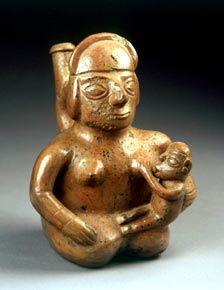 The Moche civilization occupied the coastline northern Peru for around 700 years, building large stepped platforms and creating elaborately painted murals depicting their gruesome traditions of ritual warfare. However, the Moche are best known for their advanced agricultural knowledge and complex ceramics and pottery.
Moche pottery is one of the most diverse types of pottery known from an ancient civilization, and many of their pieces were mass produced in molds. Despite this, there was a great variety in Moche pottery, which depicted everything the culture seemingly found important: vegetables, animals & birds, war, metalworking, weaving, and of course, sex. There were also many “portrait vases”, which were pottery vessels made to resemble a person’s head. The faces also depict a variety of emotions, such as anger, laughter, or deep thought.
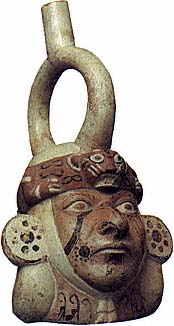
The pottery was made by applying clay figures onto the pottery before it dried (and thus before firing), a technique not frequently used due to the risk of explosion in the kiln – if there were any air pockets left between the pot and figure joints. The color of the pottery was fairly simple as well, mainly black, red, white, and cream.
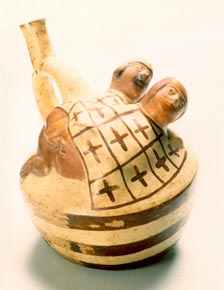
The erotic pottery of the Moche is highly varied, showing a great deal of creativity reminiscent of the Hindu Kama Sutra. What has fascinated scholars is the limited number of depictions of standard procreative copulation on these vessels; this is only ever depicted when the male is shown wearing ceremonial dress, the female’s hair is parted into two braids ending in snake’s heads, and the act is occurring within a ceremonial building with additional figures standing around to watch. While the exact meaning of such a depiction has not yet been established, it is clear that the Moche were not squeamish about their sexuality.

The Museo Larco in Lima, Peru, holds a large number of Moche pottery and artifacts, including a gallery of erotic pottery. Some images from this gallery are available online here.
Tomorrow: The Mega Temples of Malta

By: The Scribe on March, 2007

Located 250 metres north of Lima, Peru, the magical and religious centre of Chavin de Huantar was built in two phases: the Old Temple (ca. 900-500 BC) and the New Temple (ca. 500-200 BC).
Constructed 3,185 metres above sea level, Chavin de Huantar was built of stone blocks, with odd pyramid-shaped structures that have resulted in debate over whether the complex was meant to be used as a temple or a fortress.
The inside of Chavin de Huantar features a labyrinthine network of passageways, lit by carved ‘skylight’ openings overhead. One of the rooms also contained a five-meter high stone carving called the ‘Lanzon’, depicting contorted images of sacred deities and monsters.
Contemporary to the Olmecs in Mexico, the Chavin culture achieved an extremely high level of technology and skill in agriculture, art, architecture, and social organization – thereby allowing them to dominate a large portion of north and central Peru.
One of the most interesting aspects of the Chavin is the amount of religious artifacts that have been uncovered: a number of small mortars, bone tubes, and spoons were found at the temple, which may have been used to grind vilca, a hallucinogenic snuff. In addition, there are several examples of artwork that show figures with mucus streaming from their nostrils – a known side effect of hallucinogenic use – and holding ‘San Pedro’, a variety of hallucinogenic cactus!
Want to read more?


Tomorrow: Midget worship in ancient Egypt!?
By: The Scribe on March, 2007
 The Mayans were familiar with tactical warfare throughout their 2,000 year history, though unlike most ancient civilizations, the use of horses and chariots was not a part of Mayan military technique. Most Mayan weapons were items that could be used from a distance, that would allow soldiers to take advantage of the surrounding landscape’s natural forests for concealment.
Weapons used by the Mayans included: the bow and arrow, blowguns, spears, axes, knives with blades of volcanic glass , and spear-throwing slings called ‘atatls’.
Helmets were not common, and most armor was simply tight-woven cotton, with shields made of with animal skin, reed matting, or carved wood.
Barricades and trenches were popular devices in Mayan warfare, and armies had an elaborate signaling system using whistles and drums. Indeed, much of the Mayan system of warfare was based on the element of intimidation and surprise – the war chieftains are known from wall paintings to have dressed in elaborate animal-inspired robes and headdresses; painting one’s body with religious insignia was also common before battle.
Unfortunately for their enemies, the Mayans were keen on taking prisoners… for the express purpose of sacrificing them on a temple altar, in front of the entire tribe. The belief was that by eating the heart of an enemy warrior, you could gain a portion of that warrior’s strength.
Tomorrow: Abortion early in Greek history
