By: The Scribe on Monday, June 25, 2007

Contrary to popular belief, it appears that women had a very high presence in Roman military forts, living and working alongside the men even in wartimes. Although previously it was thought that the forts were exclusive to men, a number of objects and their distribution pattern throughout a number of Roman forts have begun to dispel that notion!
A typical Roman soldier was not legally allowed to have a wife, although commanding officers frequently had wives and children. The belief was that the only women in a Roman fort would have been these officers’ wives, and that any other women inside the forts were prostitutes or concubines – women who didn’t live there on a regular basis. However, it is likely that this concept was reinforced by male military historians in the 19th century, who believed that women were merely a distraction and a disruption to military life.
In direct contract to this outdated belief, over 30,000 objects such as hairpins, beads, perfume bottles, and spindle wheels have been found all across the fort buildings and in along their streets. These kinds of artifacts show that women played roles as craftspeople, traders, and shopkeepers, in order to keep the small town-like economy of the forts running smoothly. After all, if the men were expected to receive military training and work for the army all day – who would be left to negotiate shipments of food supplies and mend clothing?
Another intriguing piece of the puzzle comes in the form of 11 babies, buried underneath the barracks of one of the forts. Historians who still believe the forts were segregated have tried to explain this phenomenon as coincidence, claiming the babies’ remains were accidentally brought into the fort in shipments of soil and then laid down in the barracks’ foundations unawares, however that is highly unlikely – a coincidence of 11 burials transported from elsewhere is rather impossible.
According to archaeologists, tombstone inscriptions in and around the Roman forts detail how many soldiers left property to women upon their deaths, which is a very significant act for any Roman male, and not something he would have done for a concubine or prostitute. These Roman soldiers were forming long-term relationships with women while inside the forts, and though they may not have legally been allowed to wed, it appears that women still lived and worked alongside the soldiers as common-law wives, taking care of the soldiers and bearing their children.
Want to read more?


Tomorrow: All hail the god of…. lettuce?
By: The Scribe on Sunday, June 24, 2007
 According to recent studies, it appears that people in the Stone Age didn’t drink milk – at all. Although modern Europeans rely on milk as a part of their diet, ancient Europeans were only able to digest milk up until the end of childhood – after which their bodies simply weren’t able to process the lactose through their systems.
DNA analysis of Neolithic skeletons showed that there might be a reason why today’s Europeans have the highest percentage of lactose tolerance in the world, more precisely in Europeans from north and central regions. It turns out that before dairy farming, humans had no need to be able to digest milk during adulthood, and it was only after dairy animals were introduced in Europe around 8000 years ago that humans began to be able to drink milk without getting sick.
The truth is, most mammals lose the ability to produce lactase after childhood, an enzyme in the intestines that is needed to digest lactose – it turns out that humans who still produce lactase actually have genetic mutation that allows them to do so. Essentially, Neolithic humans were normal in their lactose intolerance – and most European and African humans are the weird ones with a genetic mutation that allows them to keep drinking milk.
Today, the only modern humans that can properly digest milk are those from European, African, and Middle Eastern descent – wherever prehistoric farming communities began to use dairy animals like cows, goats, and sheep in their farm habits. The mutation developed as milk began to be a regular staple in the diet, providing nutrients when other harvests were small, leaving the rest of the world behind in their ‘normalcy’.
So, although you may enjoy your ice cream today, if you’re ever given the opportunity to travel back in time to the Stone Age, leave the Yoplait behind – unless you really want to make your prehistoric ancestors ill.
Want to read more?


Tomorrow: Roman soldiers had to clear their rooms too.
By: The Scribe on Saturday, June 23, 2007
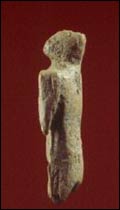 In a cave in southwestern Germany, three very small ivory figurines were discovered that seem to suggest Early Man wasn’t as artistically inept as once thought. These tiny figurines have been dated to around 30,000 years old, making them part of the period in time when scientists believe Neanderthals and Homo Sapiens lived as neighbors to each other.
All three of the figurines were less than 5 centimeters long, and are each very distinct forms: one is a bird that closely resembles a duck, one is a horse, and the third piece is a semi-human and semi-animal creature that appears to have the face of a lion and a man’s body.
Hailing from three additional sites not too far from Hohle Fels cave, where these figurines were discovered, archaeologists have a collection of 17 other artistic objects, including a rather complex musical pipe made of swan bone. These 20 objects in total, all from the Swabian Jura area in southwestern Germany, make the collection the “oldest body of figurative art in the world”, according to British archaeologist Anthony Sinclair.
These objects also refute the previously established notion that early humans were only capable of primitive cave paintings, and hadn’t yet developed their aesthetic senses. It was thought that early man slowly developed their skills over time, as they acquired better tools and materials – but looking at these figurines, clearly this evolutionary theory is now entirely unnecessary!
 The earliest objects considered to be art are still cave paintings, however, and these are located in underground chambers in the Ardeche region of France. At 29,000-34,000 years old, these charcoal drawings depict horses, rhinos, and a deer. There has been a small stone carving found in the Golan Heights near Israel, thought to be dated at around 200,000 years old, but this has yet to be confirmed – so for now, these tiny ivory figurines are our best link to the evident artistic proficiency of early humankind!
Want to read more?


Tomorrow: Milk – it does a body poor, apparently…
By: The Scribe on Friday, June 22, 2007
 According to some finds from the tomb of King Tutankhamun, the boy king greatly enjoyed a wee nip of red wine now and again…
Wine was actually a luxury item in ancient Egypt, with beer and mead being much more popular alcoholic beverages among the masses. And naturally, if the King enjoyed wine while he was alive, he was going to need something to drink in the afterlife! Although the containers for wine were readily identified from the tomb, the color and makeup of the wine was not known until scientists were able to carry out chemical analysis on the compounds left behind inside the containers.
It turns out that these wine pitchers had an acid residue inside, which Spanish scientists were able to identify as a substance typically left behind by red wine after it has dried up. In the extremely dry and sealed environment of King Tut’s tomb, the acid did not disintegrate or break down as it otherwise may have in a humid environment. Scientists took scrapings from the inside of the pitchers, and used techniques known as ‘liquid chromatography’ and ‘mass spectrometry’ to reveal the syringic acid left behind when a compound found in red wine called malvidin breaks down.
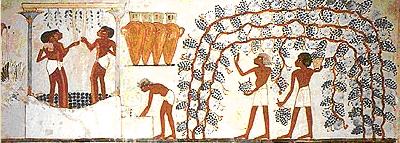
Tomb paintings have caused speculation for decades over whether ancient Egyptians drank red wine, since many of the wine-making images showed red or purple grapes being pressed, though until now there was no definitive proof for its production.
Much like today’s wine-bottles, the pitchers found in King Tutankhamun’s tomb also contained labels on the front, identifying the name of the wine, its year of production and harvest, the source of the wine, and even who grew the grapevines! For example, one jar held the label: “Year 5, Wine of the House-of-Tutankhamun Ruler-of-the-Southern-on, l.p.h. in the Western River. By the chief Vinter Khaa”.
In addition, these same techniques were used on some other containers from the tomb, allowing scientists to discover that the ancient drink Shedeh, once considered the most precious and sacred drink in Egypt, was made from grapes and not pomegranates, as it had previously been thought!
Want to read more?


Tomorrow: Welcome to the cave man art show!
Previous page | Next page
