By: The Scribe on Tuesday, May 8, 2007
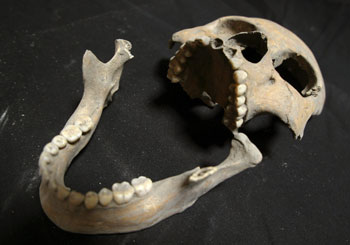 In April 2007, archaeologists uncovered the buried bones of 24 Pre-Columbian Mexican children – members of the ancient Toltec people who lived in Mexico from the 10th to 12th centuries AD. The bones were dug up at the ancient Toltec capital of Tula, and markings on the bones indicated that the children had been decapitated in a group and then buried together. Initial speculation is that this find may be evidence for child sacrifice among the Toltecs.
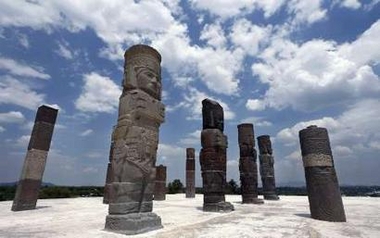
The Toltec civilization is best known for its fifteen-foot high stone warrior figures, though little about these people can currently be stated with certainty, because the Aztecs later plundered the ruins of Tula for building materials. Much of the historical evidence that might have otherwise survived was destroyed, causing historians to rely mostly on legends from other cultures to piece together Toltec history.
It is thought that the Toltec culture was highly militaristic, and much like the later Aztecs, used their military might to dominate the surrounding cultures. The Toltec architecture that remains has a very rough feel, and is characterized by snakes, skulls, and images of a reclining red jaguar, as well as their mysterious colossal statues.
The Toltec empire lasted until the 12th century, when it was conquered and destroyed by other encroaching cultures such as the Chitimecs. The Toltecs that survived in the south would be assimilated with the Maya – the very people that had once been subjugated by the Toltecs themselves. Shortly after the fall of Toltec civilization, central Mexico entered a period of chaos and warfare, and no group would rise to domination for another 200 years. Not surprisingly, the group who eventually assumed control was that of the Aztecs.
Want to read more?


Tomorrow: The real “Lost World”
By: The Scribe on Monday, May 7, 2007
 The word ‘chocolate’ is derived form the ancient Nahuatl language of the Mexican Aztecs, combining the words for ‘bitter’ and ‘water’ to make xocolatl. This name was formed because, long before Nestle developed its powdered form in a can, the ancient Aztecs were drinking hot chocolate in 1200 AD. But even before that, the Mayans had their own chocolate fetish…
2000 BC: the cocoa bean, from which chocolate is made, is reported to have originated in the Amazon.
600 AD: the Mayans migrate to South America and establish the earliest known cocoa plantations in the Yucatan, though they may have been familiar with the plant several centuries earlier – chocolate residue from an ancient Maya pot suggests they were drinking chocolate at this time.
There also appears to be evidence that the Mayans believed several of their goddesses functioned as guardians of cocoa, and would perform annual human sacrifices for these goddesses – ironically, giving the victim cocoa as his final meal.

1200 AD: the Aztecs attributed the creation of the cocoa plant to the god Quetzacoatl, who stole a cocoa tree from Paradise and traveled to earth with it on a beam of the Morning Star. The Aztecs believed their ancestors then learned how to roast and grind the cocoa beans, creating a paste that could be mixed with water to create a bitter drink. This drink allegedly brought wisdom and knowledge to the drinker.
The Aztecs also believed that this drink could fight fatigue, which can likely be attributed to the theobromine content. The Aztec emperor Montezuma allegedly drank his chocolate dyed red, and it was served in golden goblets that were thrown away after only one use!
Cocoa beans were also used for currency; after subjugating other tribes, the Aztecs would demand their tribute payment in cocoa beans. Records from 1200 AD provide a list of the annual payments being made to the Aztecs – and by this time, payments were coming from nearly all the tribes in Mexico.

It was not until the early 1500s that chocolate, in its sweetened form, became known to the general public… and so, chocolate mania spread across Europe!
Want to read more?


Tomorrow: Toltec child sacrifice?
By: The Scribe on Sunday, May 6, 2007
 Contrary to popular belief, it appears that the ancient Egyptians were not the first people to conduct brain surgery in the ancient world! A skull unearthed at the Burnt City has provided evidence of surgical practices that appear to have dethroned the ancient Egyptians as originators of such a highly skilled task.
This skull from ancient Persia, found in one of the Burnt City’s many burials, contains markings thought to have first been mentioned in an ancient Egyptian tale called “The Story of Sinuhe”, written around 2000 BC in hieroglyphs. In the story, an Egyptian physician and nobleman named Sinuhe discusses open brain surgeries in detail. Although there is still debate around whether or not the events described in the story actually took place, elements of the tale that are described in great detail – such as brain surgery – are typically assumed to be factual accounts, simply because of the great level of detail included.
It now appears that, with the appearance of this skull, archaeologists can comfortably say that the practice of brain surgery did not originate in ancient Egypt, but rather in Iran, the location of ancient Persia. While some smaller prehistoric sites in Europe have yielded skulls with holes on top, it is thought that this may have been done for aesthetic or cultural purposes, rather than medical, simply due to the smaller size of the holes.
The typical method of brain surgery at this time was called ‘trepanation’, which involves cutting or drilling a hole into the patient’s skull. This was done to relieve pressure from excess fluids around the brain, or in some cases, possibly to release ‘evil spirits’ from those with mental disorders. It appears that in most cases, the patient survived months or even years after their surgeries.
Want to read more?


Tomorrow: The history of Chocolate!
By: The Scribe on Saturday, May 5, 2007

An animated piece, considered to be the ‘first animation in the world’, was found on an earthen goblet from the “Burnt City” in Iran, dating around 5,000 years old. The sequence depicted on this goblet is that of a goat who jumps toward a tree and eats its leaves.
The goblet itself is 10 centimeters high, with an 8 centimeter diameter. The images show movement in a manner unprecedented in ancient art, because although other earthenware vessels recovered from the Burnt City show repetitive images, none of them indicate any movement.
Iranian archaeologist Mansour Sajjadi, who has worked at the Burnt City excavations for several seasons, commented on the context of the goblet: “while excavating the grave in which the cream-colored goblet has been found, we came across a skeleton that probably belongs to the creator of this piece.”
The archaeologists of the site also put together a 20-second animated piece based on the images from the goblet. This video may be downloaded and viewed.
Want to read more?


Tomorrow: Ancient brain surgery!
Previous page | Next page
