By: The Scribe on Tuesday, April 10, 2007
 Although the origins of werewolves are traditionally attributed to the Middle Ages, tales of humans transforming into wolves have been documented from as early as 440 BC.
Greek mythology contains the story of a king named Lycaon, who was transformed into a wolf after serving a bowl of human flesh to Zeus; another version of the story tells of Lycaon’s transformation into a wolf as punishment for sacrificing a child to Zeus. This tale resulted in the belief that from that point on, one man was turned into a wolf at the annual sacrifice to Zeus, but would be able to regain his human form after abstaining from human flesh for ten years.
In one of his writings, a Roman scholar named Pliny the Elder quoted the Greek author Euanthes, who told the story of a man who was selected by lot to swim across a lake, where he hung his clothing on a tree, and – upon swimming across the lake – was transformed into a wolf for nine years. The man was only able to swim back across the lake and regain human form if he did not attack any humans during those nine years.
The Greek historian Herodotus, in his work Histories, discussed a tribe to the north-east of Scythia called the Neuri, who were annually transformed into wolves for several days.
The Latin poet Virgil took a different approach, and in one of his writings described a sorcerer who was able to ingest a certain combination of lethal herbs that would turn himself into a werewolf; in the year 60 A.D., the Roman playwright Gaius Petronius composed his novel Satyricon, in which a character recites a story about a man who transforms into a wolf during a full moon.
Want to read more?


Tomorrow: Egyptian defense magic
By: The Scribe on Monday, April 9, 2007
 In 2003, archaeologists working in the Pacific islands of Vanuatu located the region’s oldest cemetery, which contained a rather surprising sight: although the bodies had been carefully placed in their graves 3,000 years ago… the skulls of 70 people were missing!
The earliest known inhabitants of the Pacific islands were the Lapita people, and though the burials in this cemetery date to their occupation of the islands, many of the bodies and heads found here belonged to individuals from completely different corners of the Pacific. Although the Lapita people settled on Vanuatu and in Polynesia, the various groups of Lapita differed genetically. The reasons for this have yet to be explained by archaeologists, and it is hoped that the cemetery on Vanuatu may provide valuable genetic evidence for the settlement patterns of people in the ancient Pacific.
As for the missing skulls, it is thought that the bodies were originally buried with their skulls attached, but were retrieved after the flesh had decayed. Many ancient cultures are known to have kept ancestral skulls in shrines or high-traffic areas of the home, in order to pay honor to the dead.
Oddly enough, one burial of an elderly man had three skulls placed on his chest – it is possible that they were his descendants, though perhaps not surprisingly, the man himself was headless.
Want to read more?


Tomorrow: Early Werewolf mythology
By: The Scribe on Sunday, April 8, 2007
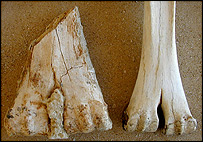 About twice the size of a modern camel, and standing about shoulder height of most African elephants, archaeologists unearthed the fossilized bones of a 100,000 year old camel from Syria. Standing about 12 feet high, human remains from the same period as the camel were also discovered nearby, suggesting that perhaps this camel was killed by a human.
 The camel remains were discovered by a joint Syrian-Swiss team at al-Hemel in the Palmyra region, about 250 km from the Syrian capital of Damascus.
It is unknown whether the human remains, which consist of a tooth and an arm fragment, may be attributed to a homo sapiens (a modern human) or a Neanderthal. The site of this discovery was next to a spring, where it is thought that the human may have stalked and killed the camel.
Archaeologists are still baffled as to where this species of camel originated, and why it disappeared, since this size of camel has not been attested to in any other country.
Want to read more?


Tomorrow: Get a-“head” in migration.
By: The Scribe on Saturday, April 7, 2007
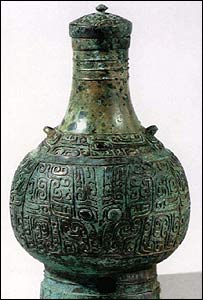 An ancient formula for brewing wine has been discovered by archaeologists on 9,000-year-old pottery fragments from Henan province, among the ruins of the ancient city Jiahu.
Tests by American scientists found traces of rice, honey, grapes, and other various herbs, a composition remarkably similar to modern rice and grape wines, confirming that the inhabitants of Jiahu had the technology and knowledge to brew wine 9,000 years ago.
Previously, the earliest known evidence for wine-making dated from around 7,400 years ago in Iran; this discovery now brings China to the forefront of early brewing traditions.
Archaeo-chemist Patrick McGovern led the team of researchers who discovered the wine formula; because he did not know exactly how the wine was made, aside from its ingredients, the formula was given to a brewery in Delaware that attempted to imitate the ancient wine – they now sell this product to the general public under the name “Chateau Jiahu”.
McGovern’s team also studied the residue of some 3,000-year-old wines, preserved inside sealed bronze vessels from the same region
Want to read more?


Tomorrow: Giant camels?
Previous page | Next page
