By: The Scribe on Wednesday, May 8, 2013
 Believe it or not, the role of Dalai Lama hasn’t been around all that long! There have only been 14 Dalai Lamas since the first one took his position of authority in the late 14th century.
The first Dalai Lama was Gedun Drub, born in 1391. He became founder of the Tashi Lhunpo monastery, and wrote many books on philosophy. What was the point? To put it bluntly, he and some other Buddhists thought that people were getting lazy and stupid.
The monastery became home for the “Yellow Hat Sect” of Buddhist monks, or Dgelugs-pa. They’re known for restoring discipline to the monastic lifestyle, promoting vigorous and rigorous academic studies, and minimizing the increasingly common reliance on magical rites.
The renewal of the Buddhist monastic lifestyle also imposed a vow of celibacy and abstinence from alcohol and meat for all monks in the sect.
As tough as it might have seemed for the monks, the Dalai Lamas haven’t had it easy personally, either. Up until 1578, the first and second gentlemen were only known as “abbots”—they didn’t even have a fancy title! It was the third successor who received the title of Dalai Lama, meaning “Ocean of Wisdom,” from the Mongolian king Altan Khan.
During these early centuries, four successors to the position died in their youth.
What does it mean to be a Dalai Lama? Buddhists from this sect believe that the Dalai Lama is a reincarnation of a past lama who made the conscious decision to be re-born, in order to continue his very important work. All Dalai Lamas since the first abbot, Gedun Drub, are reincarnations of Gedun Drub, who lived until 1474.
This means it can take some time to find the new Dalai Lama after the previous one dies! How do they know who the reincarnated child is? There are a number of rituals that High Lamas endure to pinpoint the location of the reborn Dalai Lama, after which they will bring a number of artefacts to the child’s home. If the child chooses the correct artefacts—namely, those that belonged to the Dalai Lama—it’s seen as a sign of reincarnation.
By: The Scribe on Monday, May 6, 2013
 Poor Princess Ahmose Meryet Amon. She lived around 3500 years ago, and died in her 40s. Like most royals, she was mummified and in this case, entombed at Deir Al-Bahri on Luxor’s west bank (though visitors to the Egyptian Museum in Cairo can now see her there).
Scans of the princess’s body revealed some interesting details about royal life and premature death in ancient Egypt. Indeed, she was revealed to be the earliest known sufferer of a condition caused coronary atherosclerosis: a buildup of plaque in the arteries, which can lead to heart attacks, strokes, and death.
Princess Ahmose evidently lived the good life in the royal household, because five of her major arteries contained blockages—including the ones that supply blood to the heart and brain. According to Gregory Thomas, professor of cardiology and co-leader on this major study about Egyptian mummies’ arterial health, said “if the princess was in a time machine and I was to see her now, I would tell her to lay off the fat, take plenty of exercise, then schedule her for heart surgery. She would require a double bypass.”
Normally, a mummy’s internal organs and heart are removed as part of the mummification process, but CT scans of the princess and other mummies from the Egyptian museum revealed calcification at organ sites that indicate artery damage.
In combination with the CT scan results, a medical text that dates back to around 1550/1580 B.C. (when the princess lived) describes the symptoms of chest and arm pain that precede severe or fatal heart attacks.
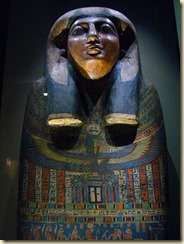 And while the ancient Egyptians didn’t have many of the modern risk factors available to them that we tend to associate with heart disease and atherosclerosis (ie. smoking, obesity, trans-fatty foods, diabetes), royal persons like the Princess Ahmose were members of the elite… and therefore more prone to developing heart disease than the average ancient Egyptian.
Adel Allam, professor of cardiology at Al Azhar University in Egypt, commented that “even the very poor people would eat a lot of pork, and the bread became mixed with honey. If ordinary people at this time did get a lot of carbohydrates and fat in their diets, then of course the elite would have got even more unhealthy food.”
In fact, some previous studies have revealed evidence for diabetes in ancient Egypt, despite being often thought of as a modern disease. Medical papyri written by ancient physicians refer occasionally to diabetes symptoms in their patients.
Additional research is being done on the princess and the other mummies, however, because there may also be a genetic element involved in who developed atherosclerosis—as well as the possibility that it can be brought on by chronic inflammation through an ongoing immune system response (ie. autoimmune condition).
Princess Ahmose, sadly, was known to have suffered arthritis and joint inflammation, as well as from dental disease—all which may have been a result of poor diet, thereby contributing the the development of atherosclerosis and bringing about her early demise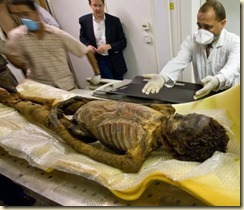
By: The Scribe on Friday, May 3, 2013
 …and we mean that literally!
Turns out that the family tree for the majestic creatures we know as blue whales and humpbacks just got a little bit bigger! The ancestors to modern baleen whales now have four new relatives in their history. In February 2013, scientists announced the discovery came thanks to, of all things, a California construction crew.
There were 11 species discovered at the construction site, including the four brand new ancient species who are now identified as ancient baleen whales. These particular species are part of a transitional step in whale history, and are related to the whales that became our modern whales—but are not direct ancestors to modern baleens.
Baleen whales are named for the frayed blades of material that hang from the roof of their mouth—kind of fingernail-like in terms of shape and flexibility—which are used by the creatures to strain seawater as they search for food.
These four new ancient species weren’t quite as passive in their food consumption, however—they had teeth! The fossils discovered by the construction crew were about 17-19 million years old, but the really fascinating part?
Toothed baleen whales were “supposed to have been extinct for about five million years or so” by that time, says palaeontologist Meredith Riven (California State University). So not only were these whales not extinct at the time they were thought to have been, but apparently there were still plenty of them thriving and living in this area.
Before finding these fossils, there’d been no other examples of baleen whales with teeth during the Miocene era—and after the initial discovery, palaeontologists were able to uncover hundreds of whale bones and more than 30 whale skulls from the construction site.
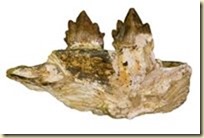 Of the four new species, three are considerably smaller than the fourth. They’re about the size of a modern dolphin, while the fourth species was a nine-meter whale that bears similarities to another ancient whale species from about 35 million years ago.
Work is still ongoing on the fourth whale species at the site, so there may be more revelations to come!
By: The Scribe on Wednesday, May 1, 2013
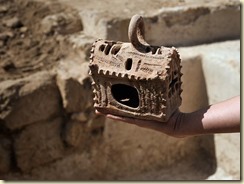 In a recent dig in Israel, archaeologists working on a large winepress from 500 A.D. made a surprising and delightful discovery. They found a church-shaped lamp that appears to be an actual model of a Byzantine-era church, about the size of a loaf of bread.
The find indicates that the owner of the winepress was likely a Christian, as the lantern has patterns on the roof and walls that would have shone flickering crosses of candlelight onto the walls of a darkened room. On one side of the lantern is an opening, just large enough for an oil lamp.
Finding a miniature church is rare, according to the librarian for Byzantine studies at Harvard University’s Dumbarton Oaks research center. However, it’s not unusual to find 2D renderings of churches in mosaics from the period.
 As for the winepress, the site worked on by archaeologists revealed six compartments for fermentation, along with a treading floor for a screw press, two collecting pits, and a setting vat. These were spread along over 84 square meters of space!
The location of the ancient winepress and the lantern discovery is near Hamai Yoav, along what used to be known as the ancient road to Ashkelon’s port, where wine was exported to places like North Africa and Europe.
Previous page | Next page
 Believe it or not, the role of Dalai Lama hasn’t been around all that long! There have only been 14 Dalai Lamas since the first one took his position of authority in the late 14th century.


