By: The Scribe on Thursday, June 23, 2011
When last we left our intrepid hero Theseus he was on his way to Athens in order to claim his royal birthright. He had already moved a massive stone and reclaimed his father’s sandals, sword and shield. His mother, Aethra had told him that he was the son not only of Aegeus (the then king of Athens) but also that Theseus was the son of Poseidon, the Greek God of the sea.
 He had chosen a route around the Saronic Gulf even though it was more treacherous than a sea route would have been. On the way to Athens, he encountered six entrances to the Greek Underworld. The first was at a place known as Epidaurus. This tiny town was sacred to the Greek God Apollo and was reputed to have been the birthplace of his son Asclepius. Asclepius was the Greek God of healing. His staff, entwined with serpents is still used today as a symbol for medicine.
Apollo was not the problem at Epidarus and neither was Asclepius. Instead, Theseus had to face a man by the name of Periphetes. In some legends, Periphetes was also known as Korynetes. He was an outlaw who didn’t have much going for him even though he was the son of Hephaestus, the god of blacksmiths, craftsmen, metal and many other similar things. Periphetes was lame and wielded a massive wooden club that was wrapped in bronze. Periphetes was lame like his father and only had one eye. He lived in Epidauros but was actively robbing travelers on the road from Athens to Troezen and killing them with his club.
The battle was a fairly quick one. Periphetes tried to strike Theseus in the head with the club but Theseus was able to grab the club from Periphetes and strike him with it, killing him. Theseus then was able to take the club for himself and was shown in many drawings as carrying the weapon and using it in future encounters. In some accounts, the club was made of iron instead of steel.
After defeating Periphetes, Theseus continued along his path until he came to the next 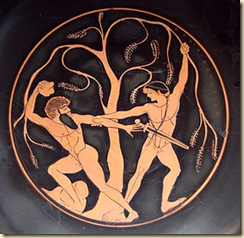 entrance to the underworld. This was located on an isthmus. There, he encountered a robber named Sinis. Sinis was a relative of Theseus as he also was the son of Poseidon. Sinis was a giant whose name meant “pine bender” This was an accurate name for the giant who killed travelers in a rather unpleasant way.
He would force travelers to help him bend two pine trees to the ground and then suddenly let them go. As a result, the pine trees would straighten up and the force would rip unwary travelers in two. In some legends, Sinis tied the people directly to the pine trees and in others he had them help him bend them down. Theseus managed to tie Sinis to his own pine trees and allowed them to rip him apart. It was a fitting end to someone who killed travelers in a most unpleasant way. Once Sinis was dead, Theseus was able to continue on his way to Athens.
Tomorrow: Theseus’ journey to Athens to claim his birthright.
By: The Scribe on Wednesday, June 22, 2011
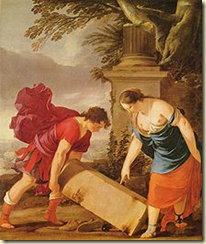 Theseus was a character that appeared in many Greek myths. Like some of the other heroes in Greek mythology he was the son of one of the Gods. In Theseus’ case, he was the son of Poseidon, the Greek god of the sea. Theseus was also said to have had a mortal father as well. In addition to sleeping with Poseidon, Theseus’ mother, Aethra also slept with Aegeus on the same evening that she slept with Poseidon.
He was said to have reformed Athens. His mortal father Aegeus had ruled Athens before Theseus however Theseus was considered to have founded many of the traditions that were part of Athenian daily life. Different poets, authors and playwrights attributed many different things to Theseus.
One legend states that Theseus grew up in Troezen, the city state where his mother lived. in order to claim that he was the son of Aegeus, Theseus had to recover his father’s sandals and sword from under a huge rock. When he did, his mother was permitted to tell Theseus who his father was. Because the task marked Theseus as a hero, he was able to journey to Athens and claim his place as Aegeus’ son. Since Aethra had slept with Poseidon on the same evening that she had lain with Aegeus it was believed that Theseus had both human and divine qualities that allowed him to perform truly heroic feats.
After Theseus had retrieved his father’s sandals and sword he was then given a choice between two routes to Athens. The first was by sea. This was considered to be a much safer route. The second, the route that Theseus ultimately chose, followed a path around the Saronic Gulf. The gulf is part of the Aegean Sea. This was a treacherous route and Theseus would have to complete a number of tasks.
Completing tasks was a fairly common theme in Greek mythology. Hercules, for example, had to complete twelve tasks that are known as the Labors of Hercules. In the case of Theseus, he would have overcome the bandits who guarded six separate entrances to the Greek Underworld.
Even after Theseus arrived in Athens, he had other tasks to complete. He didn’t introduce  himself to his father right away. His father’s wife, Medea, did recognize him and wanted to make sure that Theseus would not live long enough to claim his rightful place on the throne. She sent him on an errand to capture the Marathonian Bull. He was able to bring the bull back to Athens where it was sacrificed. Medea was upset that this plan had not worked but she had other tricks up her sleeve. Her last attempt on Theseus’ life was to poison him with a cup of wine. Luckily, Aegeus recognized the shield, sword and sandals that he had buried under the rock. He realized that Theseus was his son and prevented the poisoning from taking place.
Tomorrow: The first of Theseus’ encounters with the bandits who guarded entrances to the Greek Underworld.
By: The Scribe on Tuesday, June 21, 2011
Although many ancient cities have been destroyed by time, the ruins of ancient Carthage are still visible. The city was dominated by a large necropolis or burial ground. One area of this necropolis is known as the Tophet, a massive child cemetery where the remains of approximately 20,000 urns have been unearthed. The remains inside were charred and often belonged to newborn babies although remains belonging to children as old as two.
A number of theories have arisen about how the children came to be buried in the Tophet. Worship of the god Ba’al Hammon and the goddess Tanit called for child sacrifice and it is the remains of those sacrifices that are found buried in the Tophet. Other theories are that the infants had died naturally of causes such as disease.
But if the babies in the Tophet had been sacrificed to Tanit and Ba’al Hammon, where did they come from? Were the Carthaginians sacrificing their own children? And how many children were sacrificed at one time?
If historical accounts are to be believed, the babies that were sacrificed were often the children of servants or were purchased by affluent Carthaginians rather than offering their own children to the flames. Some circumstances called for special sacrifices, however, and in cases such as famine, war or other disasters, Carthaginians may have been forced by the priests to offer their own children up in sacrifice. One story states that in 310 BCE, up to 500 children were killed and their bodies were then placed into a sacrificial fire pit. The urns were used to store the remains which were gathered up after the ceremony was complete.
A number of historians wrote about the child sacrifice that was practiced in Carthage. Noted historians and philosophers such as Orosious, Philo and Plutarch mentioned that child sacrifice was performed at the Tophet (a name which actually means “roasting place”).
However, some individuals believe that since the authors of these reports were Roman for the most part that it may have been an attempt to slander the Carthaginians and turn public opinion against them. The Carthaginian military commander Hannibal vowed to destroy Rome and travelled across the Alps accompanied by his army and a number of elephants in an attempt to take the city itself. He occupied much of Italy for approximately fifteen years before being defeated by the Roman general Scipio Aemilianus. Rome and Carthage fought in a series of Punic Wars which ultimately led to the fall of Carthage in 146 BCE.
Whether you believe that the Tophet was a scene of numerous child sacrifices or you believe that the area was a graveyard for children the facts remain the same. The area, which was estimated to be as large as an acre and a half by the fourth century BCE, was home to the remains of more than twenty thousand infants and children. It is no wonder, then, that visitors to the area still find the Tophet to be a spooky and unnerving tourism destination.
By: The Scribe on Tuesday, June 21, 2011
 Visitors to Scotland may have noticed monumental stone slabs decorated with intricate patterns and markings. These stones, known as stelae were erected during the 6th to 9th centuries CE. The stones were put up by a group of people known as the Picts. They settled in eastern and northern Scotland during a period of time between the Late Iron Age and the Early Mediaeval periods.
The Picts had their own unique language which is no longer spoken today. Scientists and anthropologists believe that the language may have been related to the Brythonic languages which were spoken by Britons who were living in the southern areas of the British Isles. The Picts were mentioned in the Roman conquest of Britain but disappeared from any historical accounts around the 10th century. It was believed that at that time, the Picts merged with the Gaels and that their distinct culture ceased to exist.
Scientists have been unable to determine the reason why the Picts may have decorated the large stone slabs. The markings on the stones are not well understood. It is thought that some may have been personal memorials while others may have been decorated with clan markings, or symbols that showed what a person’s lineage may have been. While some acted as personal memorials they are rare.
It is believed that between thirty and sixty separate symbols were used on Pictish stones.  Some were quite intricate and complicated. Some stones are decorated with images that represented animals such as salmon, wolves, stags, eagles and adders. Some Pictish stones were decorated with a creature known as the Pictish Beast. The Pictish Beast is a mythological animal that resembles a seahorse. Scientists are not sure what the beast is supposed to represent. Some stones are decorated with images of common, everyday objects that were used by high status individuals.
There are three different classes of Pictish stones. The first, class 1, are made of rough, unworked stone. These tend to be the earliest stones and date from between the 6th and 8th centuries. These stones do not have a cross on them but do have other symbols carved into the surface of the stone.
Class 2 stones are somewhat more complex. They often have crosses or other Christian  motifs on them. They tend to be more rectangular and may be decorated on both sides. They tend to date from the 8th and 9th centuries. This is the beginning of the period when the Picts were becoming Christianized.
The last category of stones dates from the 8th and 9th centuries. Unlike the other stones the latest versions are not marked with symbols that are uniquely Pictish. They often have crosses on them and have many different uses and forms.
Individuals who want to see the Pictish standing stones will usually have to go to a museum or other facility in order to see them. The majority have been moved from their original locations although a few still stand at the sites where they were originally placed.
Previous page | Next page
 He had chosen a route around the Saronic Gulf even though it was more treacherous than a sea route would have been. On the way to Athens, he encountered six entrances to the Greek Underworld. The first was at a place known as Epidaurus. This tiny town was sacred to the Greek God Apollo and was reputed to have been the birthplace of his son Asclepius. Asclepius was the Greek God of healing. His staff, entwined with serpents is still used today as a symbol for medicine.
 entrance to the underworld. This was located on an isthmus. There, he encountered a robber named Sinis. Sinis was a relative of Theseus as he also was the son of Poseidon. Sinis was a giant whose name meant “pine bender” This was an accurate name for the giant who killed travelers in a rather unpleasant way.


