By: The Scribe on Tuesday, January 1, 2008

The earliest form of alternate transportation for humans wasn’t the wheel after all – it was something much simpler, and much less time-consuming to build… not to mention convenient for winter! That’s right: northern Europeans invented ice skates around 3000 BC, which would have assisted humans in saving energy on their daily travels – not to mention help them move from one place to another much more quickly!
The first skates were made of animal bones in southern Finland, where the extremely high density of lakes would have resulted in a rather treacherous landscape for humans trying to cross frozen bodies of water on foot. And so, someone devised the brilliant idea of trimming down horse and cow bones, piercing them at either end, and strapping them onto one’s feet with leather thongs.
Unlike the skates known to Olympic athletes and minor hockey players today, these ancient skates actually were not used on their own, but were complemented by a long stick that was used at the same time. Skaters would strap the skates to their feet, straddle the stick, and pole themselves along the ice – think of cross-country skiing, except with only one pole and on skates instead of skis.
The thing is, skating is an awfully strange activity to have developed as a hobby – it seems like a much more practical idea to have come from humans living in the frozen lands of northern Europe, where surviving was a priority and winters were incredibly harsh. Ice skates would then allow hunters to find food with less energy expenditure, which meant that less food needed to be consumed to survive – which tends to be a bonus under extreme winter conditions.
Although experiments in reconstructing the ancient skates showed that a person would have moved quite slowly while using them – around 2.5 miles per hour – the energy expenditure in using the skates on Finland’s nearly 60,000 frozen lakes would have reduced a human’s energy requirements by around 10%.
Talk about a legacy in human history!
Want to read more?


Tomorrow: More Ancient Standard
By: The Scribe on Friday, December 28, 2007
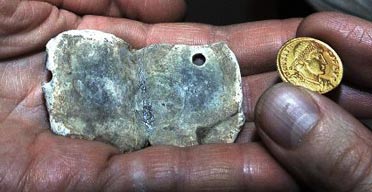
It was somewhere around 1,650 years ago that someone living in the Roman Empire became more than a little ticked off with how things were going – and so they committed a small act that could probably be called ‘treason.’ Or blasphemy, for that matter… not to mention that they were criminally defacing state coinage.
The ruler of the Roman Empire at this time was the Emperor Valens, and Roman Britain was experiencing a period of extreme turmoil and unrest – and it didn’t help that an exiled Roman aristocrat named Valentinus was trouncing around the British countryside and stirring up trouble in the form of negative attitudes toward the Roman leadership.
And while curse charms are nothing unusual – Greek and Roman curse objects and tablets are fairly common finds, usually consisting of a curse scrawled on a piece of lead and then thrown into hot springs, or with a hole punched into the lead to hang it up somewhere – a curse object against an Emperor is more than unusual… it’s absolutely unheard of.
Absolutely no curse objects or tablets against an Emperor have been found from Roman times until now, as such an act would have been extremely dangerous. The item which changes all that, is a piece of scrap metal that was found in a Lincolnshire field: whoever cursed the Emperor hammered a coin with an image of the Emperor’s face into a piece of lead, and then folded the lead overtop his face. The piece of lead would have then been taken into a temple and hung up, where the curse could be enacted through the power of the gods.
Since Roman Emperors were often treated as god-like figures – in fact, many were deified after their death – anyone who was discovered cursing an Emperor would have likely suffered extreme torture and death, and their families would have faced possible exile or imprisonment.
Want to read more?


Tomorrow: More Ancient Standard
By: The Scribe on Thursday, December 27, 2007

It was around 26,000 years ago that the people living in ancient Southwest France decided that they had a favorite food – very favorite, for that matter. Prior to this discovery, the people had occasionally treated themselves to a hearty dinner of reindeer meat… but they began to ask themselves, why only occasionally? And with a large supply of reindeer to be found in the area – not to mention how tasty they were – why not eat them on a more regular basis?
In fact, so many ancient reindeer bones were found in this area of Europe that the people even began to use the bones to do things like carve calendars into them, use the bones as counting devices, and fashion them into ornamental pieces.
Two recent studies on the consumption of reindeer in ancient times analyzed bone remains from rock shelters and limestone caves, in order to learn things like: how the meat was butchered, information about the reindeer population, and how far the hunters had to travel in order to find the reindeer. The remains showed that around 64,000 years ago, the humans living in these caves had to travel a significant distance to hunt reindeer, and would then only bring back the best cuts of meat to their community.
Over time, the population of reindeer increased at a significant rate – which meant the hunters didn’t have to go far at all to find a good source of nutritious meat. Eventually, 90% of the human populations’ meat came from reindeer, and nearly all parts of the animal were being eaten – and the remaining parts used to create other items.
Talk about a reason for getting coal in your stocking…
Want to read more?


Tomorrow: More Ancient Standard!
By: The Scribe on Tuesday, December 4, 2007

On the banks of the Nile near Amarna, something a little strange and unexpected turned up… although historians have long believed that Egyptians imported their glass during the reign of Akhenaten, an industrial complex and the remains there now show quite the opposite.
The site at Amarna contained a glass-making shop, with a potter’s workshop and specific rooms that were designated as production areas for blue pigment and architectural inlay materials. An ancient furnace next to the site was utilized by researchers to make their own reconstructed version, which they used to make a full-sized glass ingot out of local sand!
The previously held belief was that the Egyptians imported their glass from surrounding countries and integrated it into their own artifacts, in order to create their elaborate art projects which made ancient Egypt such a famous culture in history – but the discovery of a glass workshop such as this suggests that the Egyptians had far more advanced industrial manufacturing capabilities than they were previously given credit for.
At that rate, who knows how many items they were able to make on their own, without relying on outside trade sources? This would have allowed more money and trade goods to flow inside of Egypt, keeping the wealth inside the country and thus contributing to the richness of their ancient culture.
The glass site near Amarna was found close enough to an ancient temple site that it is likely the workshop was used to produce decorative pieces for the temple during its construction. It is entirely possible that materials for other state buildings came from this location as well, but either way, the Egyptians were far more than simply skilled artists – they were highly efficient and advanced producers of industrial materials as well!
Want to read more?


Tomorrow: Anti-Government sentiment in ancient Rome
Previous page | Next page
