By: The Scribe on Thursday, November 29, 2007
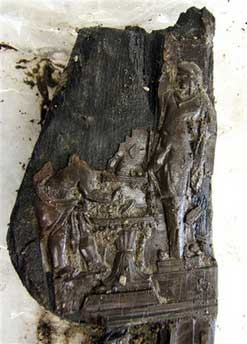
For the first time in history, pieces have been found of an ancient Roman throne – a throne that was buried in 79 AD, after the eruption of Vesuvius covered the city of Herculaneum with lava and ash, killing thousands of people. As one of the three cities that was destroyed in the eruption – the others being Pompeii and Stabiae – Herculaneum was closest to the volcano’s base and would have been the first to be destroyed.
The ancient wooden throne was decorated with bas-reliefs in ivory that depicted several ancient gods, which spanned across the entire chair. Two legs and a portion of the throne’s back makes up the most of the remains, and were located very near to the Villa dei Papyri, which is believed to have been the home of Julius Caesar’s father-in-law during the first century.
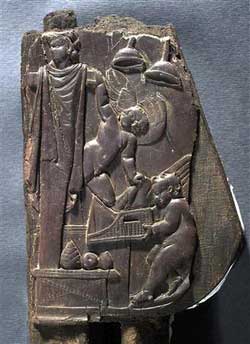
Prior to the discovery, Roman thrones were known only from artistic depictions – this throne is incredibly detailed in its own artwork, with images of Greek figures from myth shown in a Romanized style. The gods Attis and Dionysus are prominently featured, and other decorative features are made up of flowers, phalluses and pine cones – perhaps more than a little unusual for the modern eye.
The cult of Attis was prominent at Herculaneum during the 1st century AD, and since the god was associated with life, death, and rebirth, it is likely that the theme of the Roman throne was that of fertility – which explains the decorative features of choice.
While little is known as to how the throne would have been used – let alone whether the chair even belonged to the resident of the Villa dei Papyri – the cultic associations certainly point to it having belonged to someone who was prominently involved in Attis worship.
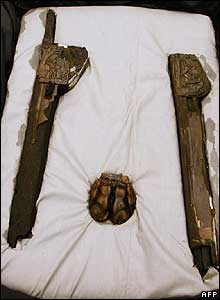
Either way, the survival of such a large portion of wooden furniture is rather astounding, though organic materials aren’t entirely unheard of in Pompeii or Herculaneum – the volcanic mud that came after the eruption did a very good job at preserving nearly everything, even food from the time of the eruption, in both cities.
Want to read more?


Tomorrow: Baby Cremation
By: The Scribe on Wednesday, November 28, 2007

The book of Nehemiah in the Bible describes in detail the construction of a city wall in Jerusalem, located in the ‘City of David’ , as a replacement for the wall which had been previously destroyed by the Babylonians. Although many historians and scholars have claimed for years that this wall would never be identified or found, a team of archaeologists working on a rescue excavation for a collapsing tower have done just the opposite.
According to Eilat Mazar, director of a Jerusalem-based research organization’s Institute of Archaeology, the team found shards of pottery and a number of arrowheads under the tower, which indicate that both the tower and the nearby wall date back to the 5th century BC. Earlier estimates had placed the wall’s construction to sometime during the Hasmonean Period (142 – 37 BC), but the items found there date to the Persian Period, when Nehemiah lived.
The section of the wall that has been dated to Nehemiah’s time is about 30 meters long, and a portion of the tower that measures about 6 x 3 meters has also been dated to the 5th century. Nehemiah’s role in Jerusalem’s history was in his determination to rebuild the city, a century after the city had sat desolate due to the Babylonians’ destruction of the First Temple. Despite the hostility of neighboring people, Nehemiah incited the Jews of the city to action, and the Bible relates how the entire city wall was completed in an incredibly fast 52-day timeframe.
Naturally, skeptics are calling the announced find ‘interesting’, but point out that since the debris and artifacts were not found connected to a piece of the wall structure, the wall could have theoretically have been built later.
Want to read more?


Tomorrow: Seat of the Roman Empire
By: The Scribe on Tuesday, November 27, 2007
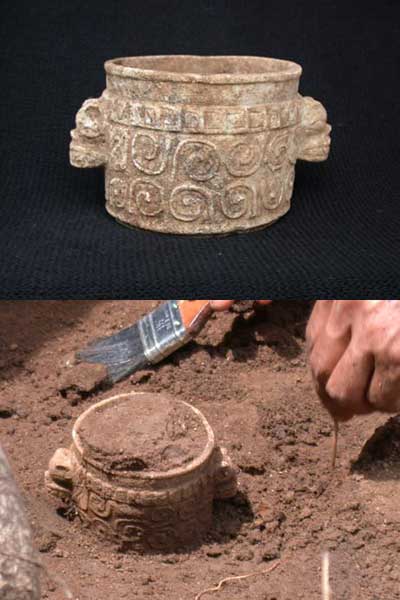
In the grave of an elite member of the Mayan Empire, archaeologists discovered a vase situated next to the skeletal remains – and oddly enough, the vase still contains some remains of food that was placed inside the vase at the time of burial. The vase itself is the first among its kind to be discovered archaeologically in modern times, and it may actually be able to shed some light on the ancient rituals practiced by the Mayans.
The food remains inside this intricately carved “death vase” reveal more about the ancient Mayans’ practice of ancestor worship than was previously known – the vase included remnants of corn pollen, cacao, and something called ‘false ipecac’ which is known to induce bouts of severe nausea when ingested.
These trace remains may suggest that “death vases” such as this one were used in the ancient rites that produced trance-like states through an intense form of physical purging – the Mayans communicated with their ancestors through visions, which they would induce by such practices as bloodletting, taking a powerful chocolate enema, or by drinking excessive amounts of alcohol and then repeatedly throwing up.
All evidence points to whatever drink was inside of the vase as having contained ipecac, which would have made the person ingesting the drink throw up – and throw up a lot. Then through this, they would have had ‘visions’ wherein they could talk to their ancestors.
What kind of drink would have contained this nausea-drug? The white-marble death vase probably held a gruel primarily made with corn, with cacao added for flavor, and the drug added for the… ‘religious’ experience.
Prior to the discovery of this vase in its context, other Mayan death vases existed in museums only due to looters having taken the intricately carved pieces out of tombs and selling them on the black market or to museums for their own profit – this is the first of the death vases to be scientifically excavated.
The place where the grave was located is slightly perplexing, however – it was found underneath a palace in a small settlement inside of Honduras’ Palmarejo Valley. The palace and the vase point to a higher level of prestige than should have been prevalent at an otherwise typical and unimportant farming village – so why was a high status burial located inside of a residential building in a tiny settlement?
The likeliest explanation is that the person who was buried here was an important historical figure for the people of this town – perhaps someone whose death marked the end of an era, such as a community founder or original member of the town’s ruling lineage. Interestingly enough, the vase itself isn’t as old as the burial – the vase was added to the grave about a hundred years later, likely in commemoration for the individual.
The decoration on the death vase is made up of sculpted scroll images and tiles that look like snake scales, with handles that were carved to resemble a leaf-nose bat’s head.
Want to read more?


Tomorrow: Nehemiah’s Wall?
By: The Scribe on Monday, November 26, 2007

Often considered synonymous with ‘adventurer’ or someone who has exceptional sailing skills, the truth of the matter is: the Argonauts were not real people.
The Argonauts were a group of heroes from Greek mythology who, before the familiar story of the Trojan War apparently took place, accompanied the hero Jason on his quest for the Golden Fleece in the kingdom of Colchis. These men were known as Argonauts simply because they sailed on a ship called the Argo, which was named for its builder, Argus. Literally, “Argonauts” translates as “argo sailors.”
During the period when the tale of Jason and the Argonauts was supposed to take place, a prehistoric tribe of people is known to have lived in the area, and thus when historians attempt to pinpoint exactly who the Argonauts would have been – if they were real – they will sometimes refer to the heroes as ‘Minyans’. The Minyans were real, the Argonauts weren’t – which tends to be where the confusion sets in.
The Argonauts consisted of approximately 50 men, and the team was supposedly assembled after an oracle was received by King Pelias. What many people don’t realize, however, is that the heroes who made up the group of Argonauts are not faceless characters – a relatively comprehensive list exists of all the men who were a part of Jason’s Argonauts, and among them? An extremely familiar individual: Hercules.
Hercules actually played quite a central role in the tale of the Argonauts, and it was his idea to appoint Jason to be their leader in the first place. However, Hercules did not complete the quest for the Golden Fleece with the rest of the Argonauts – after his companion Hylas was abducted by nymphs while the Argonauts were on land, Hercules was distraught and began searching for Hylas, unable to concentrate on anything else. Eventually, the Argonauts were forced to set sail without him, leaving Hercules behind to continue the search for his companion.
After the quest for the Golden Fleece, the remaining Argonauts either went back to their lives or onward to other journeys in future myths. Some familiar names from mythology who are typically counted among the Argonauts are: Admetus, Atalanta (though this is disputed, as she was female), Castor and Pollux, Laertes (the father of Odysseus from Trojan War fame), Philoctetes (who later fought in the Trojan War), Nestor (an old, wise leader during the Trojan War), and the famous figure who descended to the Underworld to find his dead wife – Orpheus.
Want to read more?


Tomorrow: More Ancient Standard
Previous page | Next page
