By: The Scribe on Monday, November 5, 2007

When talking about art in ancient history, it’s not unusual to stumble across unfamiliar pieces of terminology – and sometimes, the jargon is so obscure that there’s no way you’ll understand what it means unless someone explains it to you.
One of these random pieces of art terminology is the term ‘bilingual pottery’, which was a type of pottery that existed in ancient Greece around the 6th century BC. These vases almost exclusively came from Athens, and included the older black-figure style of decoration on one side of the pot and the newer red-figure style on the other side. Often, both sides would show the same scene, just each one done in a different style!

So, instead of having pots that spoke two languages, the ancient Greek bilingual pots actually showed a period of style-change in the artistic community. Why did the painters and potters decide to showcase both styles at once? It may have come about as a reflection of potters’ uncertainty as to whether or not the public would be willing to accept this new style of decoration – after all, if the public didn’t buy it, they’d have to come up with some new decorative style to market.
They need not have worried, however – red-figure decoration soon took off, and pieces of bilingual pottery became rarer and rarer. In fact, the period in which they were produced was quite short, which may be why so few examples have survived into the present day.

The names of potters who produced these kinds of pieces still survive, however – among those who created bilingual vases are included the Andokides Painter, the Lysippides Painter, Psiax, and Oltos. Of course, the painting style wasn’t limited to vases – Epiktetos the painter created some bilingual cups, while the Andokides Painter worked on both vases and bilingual amphorae.
Want to read more?


Tomorrow: Etruscan terracotta… forgeries!
By: The Scribe on Sunday, November 4, 2007

Tigranes seemed to be set: he had an enormous amount of territory, vast armies at his disposal, and more than enough resources to boot. What could possibly go wrong? Of course, there was one thing he hadn’t counted on – the return of troublesome in-laws. Indeed, his father-in-law Mithridates IV managed to find refuge in Armenian lands after his peace treaty with Rome, and had been hiding out there ever since.
It was inevitable that Tigranes would eventually have his own conflict with the Romans – the two greatest powers in the world had to come to a head one way or another, since there was only so far either of them could expand before running into each other. The Roman general Lucullus was in control of the army now, and it just so happened that he knew where Mithridates IV was hiding. Rome demanded that Mithridates IV be expelled from Armenia, but naturally, Tigranes simply couldn’t give up his ally and father-in-law.
So, Tigranes went to battle with Rome in 69 BC because his father-in-law needed a place to stay. The battle was held at the city of Tigranocerta in Armenia, and though by all rights it should have been an easy victory, some of the non-Armenian guards betrayed Tigranes in the midst of battle by opening the city gates to the Romans – which forced Tigranes to redirect 6000 of his cavalrymen into the city in order to rescue his wives, children, and other assets. As a result, Tigranes officially lost the battle.
Not one to be shafted from victory, Tigranes and Mithridates regrouped and met Lucullus at the city of Artaxata the following year. The Armenian and Pontic forces were 70,000 strong, and cut a devastating swath through the Roman legions – so bad were the losses that between 68 and 67 BC, Lucullus’ troops staged three mutinies! Finally, Lucullus realized he was fighting a losing battle, and moved the fight in a different direction – instead of continuing to fight on the rough terrain of Northern Armenia, he moved south to plunder lands held by Tigranes’ brother.
Even so, Lucullus’ plan was a failure, and he was not able to defeat or capture either Tigranes or Mithridates. Disgusted in his performance, he was recalled by Rome and replaced with a new general: Pompey the Great. Meanwhile, Mithridates was able to return to Pontus with an army of 8,000 men, and Tigranes proceeded to recover much of his former territory. However, in the process, he fought and defeated his younger son who had accepted an army from Parthia – forcing the man to seek protection under the newest Roman general.
With his lands recovered and fully believing himself secured against Rome, Tigranes’ confidence would become his downfall. In 66 BC, Pompey advanced into Armenia with the younger son of Tigranes allied at his side. Realizing his mistake, Tigranes the Great – now nearly 75 years old – surrendered to Rome. To Rome’s credit, Pompey actually treated Tigranes with great dignity and generosity, allowing the former ‘king of kings’ to retain some portions of his empire in exchange for only 6,000 talents of silver. As for the unfaithful son, both Tigranes and Pompey agreed to send him back to Rome as a prisoner.
And so, until his death in 55 BC, Tigranes the Great – held in great respect by Rome for his military skills and vast territorial accomplishments – was thus allowed to rule Armenia as a Roman ally.
Want to read more?


Tomorrow: More Ancient Standard
By: The Scribe on Saturday, November 3, 2007
 Although Tigranes and Mithridates had experienced some great successes in their alliance, the Roman Empire managed to cut a blow to the strongest force Europe at this time. Mithridates IV was defeated – but not beaten – in the First Mithridatic War, and soon after forged a temporary peace settlement with Rome. This had certainly not been part of Tigranes’ plans, and so turning from his Pontic alliance, Tigranes decided to go it alone against the Parthian Empire.
The king under whom he had been held hostage died in 88 BC, and due to excessive internal squabbling and numerous Scythian invasions, Parthia seemed ripe for the taking. Tigranes promptly seized control of Parthia and his seventy valleys, ravaged the countryside, forced compliance out of the lands along the upper Tigris, and swept his army across Mesopotamia, the Euphrates, parts of Syria, and then Phoenicia, taking control of as much territory as possible.
Apparently, breaking the alliance with Mithridates had been a good thing! After a bloody feud in Syria for the throne, in 83 BC the Syrians actually chose Tigranes as their protector, offering him the crown. In acceptance, he destroyed the last remnants of the Seleucid Empire.
Tigranes had no qualms about devastating large territories and shipping off their inhabitants to a new city he’d built called Tigranakert. At the height of his empire, his borders stretched from the Pontic Alps to Mespotamia, and all the way across the Caspian Sea to the Mediterranean. In a bit of a display of machismo, he went as far as Ecbatana in Persia and claimed the title ‘king of kings’ – an arrogant gesture even for him, since neither the Armenians nor the Parthians used this title for their leadership.
Prior to Tigranes’ assumption of power, none of the Armenian kings had issued coins, let alone coins with their own image stamped on them. Taking up the Seleucid tradition – after all, he had taken away their Syrian kingship – Tigranes had coins minted at Antioch and Damascus, and displayed the image of himself wearing an Armenian tiara with ear-flaps. Most of the coins were silver tetradrachms or copper, though a few gold examples have survived.
With so much territory and power, Tigranes seemed set. Who could oppose him now…?
Want to read more?
Tomorrow: The conclusion!
By: The Scribe on Friday, November 2, 2007
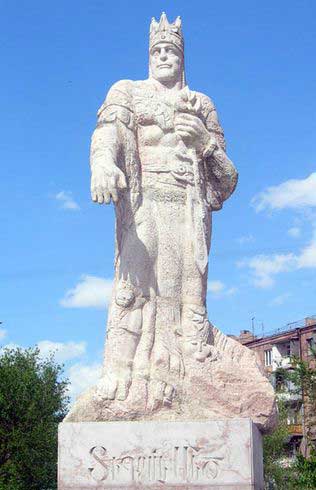
Born in 140 BC, Tigranes the Great was an intelligent man whose military exploits, for a short while, earned him the position of the most feared man in the Roman Empire. As king of Armenia, he was a representative of the Artaxiad Royal House and was married to Cleopatra of Pontus – he was forty-seven and she was only sixteen at the time of the marriage.
For the majority of his life, Tigranes was a hostage at the court of King Mithridates II of Parthia – when he was 40 years old, Tigranes was able to purchase his freedom by giving away an area of land called the “Seventy Valleys” to the Parthians, and only then did they allow him to do so because his father had died, leaving the throne open to his succession.
When Tigranes took power, the foundation of the empire in Armenia had already been well laid by his father. However, the Armenian mountains created natural borders between different sections of the country, which had caused the feudalistic Nakharars to exert a little more power over their regions and provinces than was appropriate. Naturally, Tigranes saw that this could cause significant problems in the future, and he decided that he’d much rather consolidate his power in Armenia before heading out and conquering more land – leaving the door open for regional leaders to revolt really wasn’t an option.
After taking care of the organizational matters in his own empire, he quickly forged an alliance with Mithridates VI of Pontus by marrying his daughter. The two leaders were able to forge their way into Asia Minor and began to expand their empires together – but it wasn’t long before the Romans noticed what was happening. In 90 BC, the Roman Republic sent legions after Tigranes and Mithridates, but Tigranes thought better of fighting the Romans at this point, and although he supported the Pontic alliance, he refused to get directly involved.
With Tigranes forging new ground in the East and his ally gaining ground in Roman-controlled Europe, the Romans realized that more needed to be done. In 88 BC, Mithridates ordered the massacre of 80,000 Romans in Asia – and as the two kings slowly made their way around Cappadocia, the Roman senate appointed Lucius Cornelius Sulla to command an army against the Pontics and Armenians.
As the power of the Roman Empire advanced on Mithridates, it looked as though the dynamic duo’s partnership would soon come to an end…
Want to read more?
Tomorrow: Part 2!
Previous page | Next page
