By: The Scribe on Friday, July 12, 2013
Imagine the surprise of some local construction workers in Poland, minding their own business and doing their jobs, when suddenly they happen upon an ancient burial ground… but not just any burial ground, of course. These… were vampire burials.
 Four skeletons were found at the site in Gliwice, and all four individuals had been buried with the head cut off and placed between the legs. Polish folk beliefs from this area state that placing a deceased individual’s head between the legs for burial would prevent a potential vampire from finding its way through the ground’s surface and back to the living world. Apparently the vampire would be so preoccupied with finding its head, it wouldn’t bother anyone else.
Archaeologist for the dig, Dr. Jacek Pierzak, told a Polish newspaper that “it’s very difficult to tell when these burials were carried out,” though preliminary thoughts are that the burials took place during the early modern period (Late Middle Ages through to around 1800). Tests will be conducted on the skeletal remains to determine a more precise date.
None of the bodies were buried with any goods or objects—which is quite unusual, and further supports the assertion that the individuals were buried in accordance with folkloric beliefs for preventing alleged vampires from rising and attacking the locals.
The last known instance of a vampire burial in Poland, according to the archaeological record, was found in 1914—and again, the deceased had been decapitated and the skull buried between the knees.
By: The Scribe on Monday, July 8, 2013
 It’s not just senators in modern-day governments who appear to sit around and do nothing, angering taxpayers with their seeming lack of effort to do anything other than collect a paycheque.
No, in fact, senators throughout history have been the targets of angry citizens… such as the Roman senator Fistus. In ancient Rome, the senate was a very wealthy establishment, and for some time, held a considerable amount of power.
The Roman senator Fistus was likely an individual of great wealth, and perhaps due to some decision he made—or didn’t make?—he was cursed. Literally! A 1,600-year-old curse tablet, acquired by the Museo Arcaheological Civico di Bologna (Italy) in the late 19th century, was recently deciphered by Celia Sanchez Natalias of the University of Zaragoza.
Whoever wrote the curse definitely had no qualms about expressing their hatred for the senator. The Latin expression for “crush” is used four times in the curse:
“Crush, kill Fistus the senator … may Fistus dilute, languish, sink, and may all his limbs dissolve…”
It’s arguably worse than a present-day attack ad! And the wording is interestingly Greek in form.
The lead tablet containing the curse shows a depiction of the Greek goddess Hecate, who has serpents in her hair and an eight-pointed star covering her delicate lady parts.
Hecate is also directly invocated on the tablet… and sadly enough, we may never know if the senator got what the angry party believed he deserved!
By: The Scribe on Monday, July 1, 2013
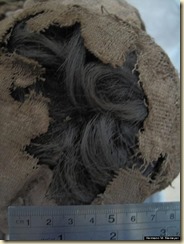 According to a study by the University of Chile in Santiago, the hair of mummies from the site of San Pedro de Atacama in Chile has revealed that the ancient people living here between 100 B.C. and 1450 A.D. had a tough time kicking their nicotine habit.
Popular theories on the people in this region, prior to the study, centered around a short-stinted use of tobacco that led to a greater use of snuffed hallucinogens—but it looks like this new finding refutes that theory rather soundly.
The hair of the mummies showed that nicotine consumption was all-encompassing in terms of the population, with no variation according to wealth or social status. Everyone smoked!
The hair samples came from 56 mummies that were excellently preserved due to the dryness of the soil and high soil salinity in the Atacama Desert. Various objects were buried with the mummies—jewelry, weapons, ceramics, textiles, metals, and various snuffing paraphernalia such as tubes and mortars—and these objects provided researchers with information on the social standing & wealth of each individual.
Nicotine was found in the hair of 35 mummies whose ages at burial ranged from young to old, and the traces of nicotine were unrelated to the snuffing paraphernalia also found buried within the tombs.
While there’s not a whole lot to say about the find as of yet, preliminary thoughts on the unexpected “everyone smoked!” discovery seem to simply be that this pre-Hispanic society wasn’t stratified by the use of nicotine—everyone used it, regardless of social standing, for hundreds of years.
More results on the mummies will be published this October in the Journal of Archaeological Science.
By: The Scribe on Friday, June 21, 2013
 Solstice is word that gets tossed around several times a year, and today marks the first day of summer for 2013—the Summer Solstice, if you will. But what does solstice actually mean, and where did this word and concept come from?
Simply put, a solstice is an astronomical event that happens twice a year, when the Sun reaches its highest or lowest point relative to “celestial equator” on the “celestial sphere.” The term itself comes from the Latin words sol (meaning ‘sun”) and sistere (meaning “to stand still”).
It was actually the ancient Greeks who were responsible for the concept of the “celestial sphere”, though they also believe that the stars rotated around the Earth over the course of a day—and that the Earth remained stationary. They thought that the stars were part of an invisible stationary surface, keeping them fixed and rotating. (This concept actually forms the basis of some modern astronomical thought, wherein the celestial sphere is acknowledged to exist, though only the stars rotate and not the sphere itself.)
Why is this important? In terms of the summer, it was through the acknowledgement of a Summer Solstice that some Greeks were able to make important and valuable contributions to science and our understanding of the Earth.
 We know that one ancient Greek astronomer named Aristarchus observed a Summer Solstice in 280 B.C., and he was responsible for proposing the heliocentric hypothesis: the earth revolves around the sun, and not the other way around. Sadly for Aristarchus, the idea wasn’t popular during his lifetime, and it was only when Copernicus made the same claim 1800 years later that it gained any ground.
Another ancient Greek, a mathematician and geographer named Eratosthenes, was able to calculate the circumference of the Earth after observing the sun’s shadow at the Summer Solstice’s noon in Alexandria and Syene. By knowing the geographical distance between the two cities, he calculated a circumference of about 250,000 stadia—or 24,662 miles.
The Summer Solstice has traditionally had less of an “urgent” feel about it—we’re not heading into winter, dreading the loss of the sun—but it has still contributed to scientific advancement both in ancient and modern times, and thus has an important place in human history!
Previous page | Next page
 Four skeletons were found at the site in Gliwice, and all four individuals had been buried with the head cut off and placed between the legs. Polish folk beliefs from this area state that placing a deceased individual’s head between the legs for burial would prevent a potential vampire from finding its way through the ground’s surface and back to the living world. Apparently the vampire would be so preoccupied with finding its head, it wouldn’t bother anyone else.


