By: The Scribe on Saturday, September 29, 2007
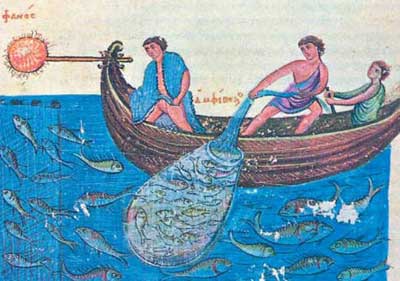
Fishing gear found in a shipwreck from the 7th century AD, off the coast of Dor in Israel – a location west of Galilee – suggests that fishermen in this area tended to work the night shift… and did so far more often than anyone had previously believed.
Among other things, the shipwreck yielded something called a ‘fire basket’, which is the first evidence in the ancient eastern Mediterranean for a practice known as fire fishing. Although several ancient images and writings had suggested that people in this area practiced fire fishing, there had previously been no evidence for its actual use.

Fire baskets were mounted onto the end of fishing boats by being placed on the end of giant lantern-like devices, which kept the fire suspended overtop the water. The light from the fire would then attract fish to the boat, and the fishermen would be able to see the fish in the water far more easily than they could without a fire illuminating the surface.
The fishermen would then be able to easily spear the fish or other creatures that swam near the boat, or they could throw their nets into a spot in the water where the most fish congregated. In fact, this practice may date back to around 400 BC, when the ancient Greek philosopher Plato wrote about a similar practice that involved striking at fish from above the water.

This evidence, combined with some pieces of ancient art and Plato’s writings, suggest that fire fishing was very important in the ancient Mediterranean, and was likely practiced throughout New Testament times and well into the Byzantine era.
Other finds from the 7th C shipwreck included: an iron five-pronged fishing spear; a pile of rectangular, lead fishing net sinkers that would have been used to weight down nets; a bronze weight in the shape of a woman; and a tubular, iron “sounding lead”. The sounding lead was perhaps the most intriguing of the additional finds, since these were actually metal bobs used to measure water depth.
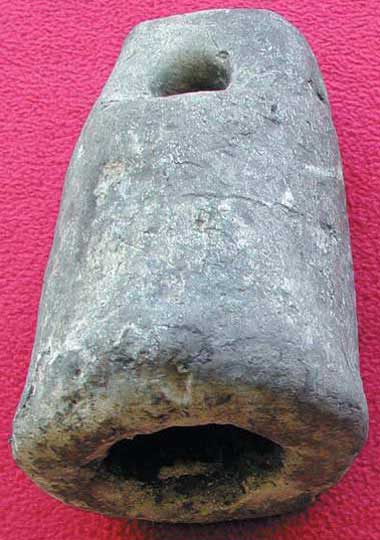
What the ancient fishermen would have done with the sounding lead was: fill the hollow middle of the lead with tallow, attach the lead bob to a sounding line, and then throw the line and lead over the side of their boat. The length of the line, combined with the amount of debris stuck to the tallow, would then indicate a depth measurement to the fishermen. This information could then be used to return to a specific fishing ground – particularly at night or during low visibility, when a sounding lead functioned as a vital navigational aid.
Want to read more?


Tomorrow: 3500 year old baby!
By: The Scribe on Friday, September 28, 2007
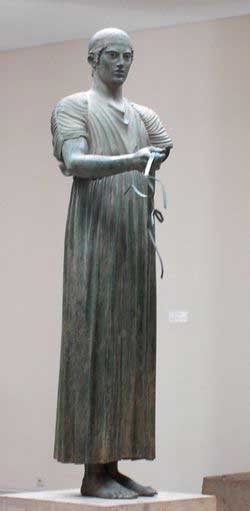 The ‘Charioteer of Delphi’ is one of the most famous surviving statues from ancient Greece, and is considered by many to be one of the best and finest examples of ancient bronze statues. Found in the Sanctuary of Apollo at Delphi during the late 1800s, the Charioteer is a rare example of an almost complete statue, dating to almost 2,500 years ago.
Also referred to as ‘Heniokhos’, the rein-holder, the statue was erected in Delphi to commemorate the victory of a specific chariot team at Delphi’s Pythian Games. The Pythian Games were held once every four years in honor of Delphi’s patron god, Pythean Apollo, and it is suspected that the Charioteer was part of a much larger statuary group that probably included several groomsmen, a chariot, and up to six horses. Although some fragments of the horses were found in the same vicinity as the Charioteer, there isn’t enough evidence to conclusively say how many animals were included in the group.
According to an inscription on the base of the statue, the piece was commissioned by Polyzalus, the tyrant of a Greek colony in Sicily called Gela. He dedicated it to Apollo as tribute for the god’s help during the chariot race, which had allowed him to win. Literally, the inscription reads: “Polyzalos dedicated me…make him prosper, honored Apollo.” Unfortunately, the name of the sculptor is unknown, but most scholars believe that the style of the statue suggests it was cast in Athens.
The Charioteer himself is mostly complete, with only his left arm missing – even his inlaid glass eyes and copper detailing on the eyelashes and lips still survive! The headband around the top of the statue was made of silver, though any precious stones that may have adorned it have long since disappeared.

The soft curls on the head of the statue indicate that the Charioteer was meant to represent a young man, tall and nimble, which was typical of ancient chariot racers – and modern jockeys, for that matter (Ed.’s note: Sometimes we make mistakes! Michael Escher quite accurately pointed out that modern jockeys are certainly nimble, but definitely not tall! Thanks for pointing that out Michael!). The cloak the statue wears is a xystis, which was the traditional clothing for a chariot driver: the base of the garment rests just above the ankles, and the waist is secured with a belt placed high up on the torso. Two straps cross his upper back, which prevented the garment from catching wind and ‘ballooning’ in the midst of a race.
In terms of style, the Charioteer of Delphi is considered to be an example of ‘Early Classical’ or ‘Severe’ style, and while his pose is more naturalistic than the preceding Archaic period of Greek art, his stance is still quite rigid when compared to some later works.
Want to read more?

Tomorrow: Fire Fishing!
By: The Scribe on Thursday, September 27, 2007
Warning: Please be advised that the following post contains descriptions of graphic, historical violence, and may not be suitable for some readers.
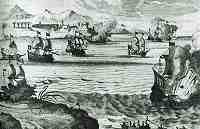 With his newly renewed hatred for the Spanish people, L’Ollonais began to increase the severity of his raids against both Spanish ships and towns along the coast. He forged a partnership with another Caribbean seaman named Michel de Basco, with whom he was able to amass a large army of pirates: a total of 600 men and 8 ships were under the control of these two buccaneers.
In 1667, L’Ollonais and Basco sailed for the Gulf of Venezuela, where they organized a land attack against a town at Lake Maracaibo. Although the town was defended by an “impregnable” fort with sixteen guns, L’Ollonais was able to approach the town from its undefended landward angle, pillaging the city and devastating its resources… however, L’Ollonais realized that many of the townspeople had somehow escaped, taking their most valuable items with them! Enraged, L’Ollonais and his men tracked down the townsfolk, torturing anyone they found until the person would reveal where he or she had hidden their possessions.
Unfortunately for the people, L’Ollonais was an expert at torture, and was able to find out all the information he wanted – he often sliced off portions of a person’s flesh with his sword, burned others alive, or in other cases, simply tied knotted rope around a person’s head until their eyes literally popped out.
 For the next several months, L’Ollonais and his crew continued to rape, pillage, and burn the area around Maracaibo, before eventually moving onto Gibraltar, a city along the southern shore of the lake. Although they were clearly outnumbered, the pirates were able to slaughter all 500 of Gibraltar’s soldiers, holding the city for random. Without mercy, he tortured, raped, and murdered many of the inhabitants – however, when the ransom was finally paid, L’Ollonais refused to leave. Instead, he plundered all of the city’s valuables, enslaved whoever was left, and burned the rest of the place to the ground.
Later that same year, L’Ollonais mounted another expedition, this time with 700 men at his disposal. He planned to make attacks in the Caribbean, first capturing the port of Puerto Cabellos with a follow-up at San Pedro… but before he could make it to San Pedro, the fleet was ambushed by the Spaniards, where L’Ollonais was barely able to escape with his life. The historian who wrote The History of the Buccaneers in America in 1684 explains L’Ollonais’ reaction after capturing some of the attacking Spaniards:
“[L’Ollonais] drew his cutless, and with it cut open the breast of one of those poor Spaniards, and pulling out his heart with his sacrilegious hands, began to bite and gnaw it with his teeth, like a ravenous wolf, saying to the rest: I will serve you all alike, if you show me not another way [to San Pedro].”
The rest of the captured Spaniards showed L’Ollonais how to get to San Pedro, but unfortunately, there was barely any treasure left once they arrived. Angry, many of the surviving members of L’Ollonais’ crew abandoned him, diminishing his army to only one ship. Believing that the small force could still conquer their next stop – Nicaragua – L’Ollonais sailed out… only to be wrecked along the way to the Gulf of Darien. As the men came ashore to find food, they were promptly captured by the Native Americans in the area, who were also known allies of the Spanish. In The History of the Buccaneers, it was written that, in an ironic twist of fate, the natives “tore him in pieces alive, throwing his body limb by limb into the fire, and his ashes into the air.”
L’Ollonais was defeated at last.
Want to read more?


Tomorrow: More Ancient Standard!
By: The Scribe on Wednesday, September 26, 2007

Jean-David Nau was born sometime around 1635, to a French family presumably of lesser means. He became an indentured servant in Martinique until the early 1650s, and upon the end of his service, he decided to pursue a career that was decidedly more profitable than working for someone else. He wandered around the Caribbean islands for a while, before eventually arriving in St. Domingue and joining in with the area’s Buccaneers.
As much as he enjoyed robbing Spanish ships and killing those aboard, Jean-David showed great proficiency for piracy and it appeared that his talents were being wasted – and so, the buccaneer governor of Tortuga gave Jean-David his own ship to command, which he eagerly accepted. It didn’t take long before he had plundered plenty of ships on his own, slaughtering everyone aboard and becoming one of the first Caribbean pirates to carry out organized land attacks!
Due to his extreme cruelty and merciless treatment of the people on the ships he plundered, Jean-David soon earned the nickname “Francois L’Ollonais”, which literally meant “The Flail of the Spaniards” – however, this reputation also meant that others in the area were able to prepare themselves for his potential attacks. About a year into his career as a pirate, L’Ollonais and his crew were shipwrecked during a bad storm off the Yucatan peninsula, where a group of Spanish soldiers were conveniently waiting to kill anyone who made it to shore.
Although his entire crew was killed the moment any one of them made it to land, L’Ollonais was able to survive by smearing himself with the blood of his dead crewmen, covering himself with their bodies, and pretending to be dead as well. When the soldiers were thoroughly satisfied that all the members of the ship had either drowned or been killed, they left – whereupon L’Ollonais dressed himself in the clothes of a dead Spanish soldier, released some of the Spanish crew’s slaves, and made his way back to Tortuga under the cover of darkness.
Thoroughly enraged against all Spaniards, L’Ollonais and his new crew entered a town, holding all of its members hostage for a ransom that was payable by the town’s Spanish rulers. Understandably upset, the governor of Havana sent a ship to the town to take care of L’Ollonais – however, L’Ollonais was able to strike first, capturing and beheading the entire crew… except for one man. This one man was spared so that he could take a simple message back to Havana from L’Ollonais: “I shall never henceforth give quarter to any Spaniard whatsoever.”
Want to read more?


Tomorrow: Part two!
Previous page | Next page
