By: The Scribe on Monday, September 17, 2007

It has typically been thought that before Columbus discovered the “New World”, there were only a few, large civilizations on the mainland in Central America, with the Caribbean islands holding just a few, isolated villages on their own. The people who lived there were thought to have been fairly primitive, only holding basic interactions with other villages on neighboring islands, if they bothered to even talk to their neighbors at all.
And yet, it now appears that this view may be entirely unfounded. In the eastern Caribbean, 2900 kilometers away from Central America’s jade mines, several 1500-year-old jade axe blades have popped up on the island of Antigua. Needless to say, this is a highly unusual find, particularly if the theory of primitive societies on the Caribbean islands is true… after all, the jade from these Mayan mines in distant Guatemala couldn’t have just appeared on the island by chance! Someone had to bring it there – to that “isolated, primitive village” that typically eschewed outside contact.
It turns out that making assumptions about ancient history isn’t always the best course of action… since it now appears that there was an entirely different social atmosphere in the ancient Caribbean than previously assumed. Instead, it appears more likely that the Amazon and Orinoco Rivers in South America originally served as early trade highways up to the coast of Central American Guatemala. From there, a culture known as the Saladoid people created their own artifacts out of pottery and jade… and eventually moved to the Caribbean islands around 500 BC, becoming the “primitive people” of previous thought.
Since there are no jade deposits anywhere in the eastern Caribbean, it has always been a bit of a puzzle to figure out where jade artifacts from these islands could have come from – not to mention that most archaeologists believed that the Saladoid people only traveled to neighboring, small islands on short canoe trips here and there.

With the appearance of the jade axe blades on Antigua however, these formerly held beliefs are changing. For the first time, a source of jade and the jade from an artifact have been matched – which is how archaeologists have been able to determine that these blades came from a Mayan mine in Guatemala, and the blades themselves can be dated to around 250-500 AD.
What does that mean? Essentially, it means that these “primitive” Saladoid people who were living in the Caribbean were actually maintaining some long-distance trade with people on the mainland of Central America. Their civilization was complex enough to have trade relationships with mainland tribes – and, if they were trading with people from one area, why couldn’t they have traveled up to the Yucatan Peninsula, stopping at various points along the way?
If this theory is correct – and by all means, it should be, since the jade has been confirmed to have come from Central America – these Caribbean island-dwellers must have had some seriously refined seafaring capabilities, probably traveling in large, dugout canoes.
Scientists have also noted that some Saladoid artifacts contain some pieces of turquoise, namely of a type that doesn’t occur naturally in any known area of the Caribbean. So where is the closest known source? Turns out it may have come all the way from Chile… and that those “primitive, ancient Caribbean people” weren’t so primitive and isolated after all!
Want to read more?


Tomorrow: A brief history of polo
By: The Scribe on Sunday, September 16, 2007
 According to a 2000-year-old recipe for hair dye, the ancient Greeks and Romans were harnessing a scientific force that they had no idea even existed – they were using nanotechnology on their very own heads.
The Greeks and Romans used hair dye with some measure of frequency, most often for the purpose of dying their gray hair to black. Their dry mixture contained ingredients such as slaked lime and lead oxide, which – when exposed to human hair for approximately 3 days – causes nanocrystals made from lead sulfide to form inside the shaft of hair.
This reaction is caused when sulfur from the amino acids that are naturally present in hair keratins mix with the lead in lead oxide – initially, this is what causes the hair to turn black, but it apparently also causes lead sulfide nanocrystals that are highly similar to those found in modern, advanced scientific processes!
In simpler terms, the chemical compound that forms inside of the human hair is what colors the hair without damaging it – and the process by which the hair is dyed black is very similar to modern nanotechnology. Fortunately for the Greeks and Romans, this kind of lead-based hair dye is safe for human use, since the compound typically has trouble penetrating the skin.
Interestingly enough, the chemical engineering that came from this dye process – where the tiny crystal structures line up to form ‘quantum dots‘ – is something that scientists have admitted is a “current challenge in nanotechnology”, and is actually a process that researchers are currently trying to figure out how to develop on their own.
Turns out there really is some truth in the saying “it’s all been done before”…!
Want to read more?


Tomorrow: More Ancient Standard!
By: The Scribe on Saturday, September 15, 2007

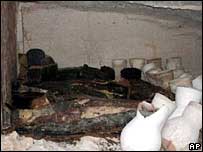
It turns out that the Biblical “land of milk and honey” may be just that after all… and lots of honey, for that matter. It turns out that the inhabitants of northern Israel developed their own beekeeping industry about 3,000 years ago – and the beehives are still intact today. Thirty beehives found in the city of Rehov date to around 900 BC, and give all indications that a healthy, thriving honey industry was well established during the Biblical timeframe.
Although beekeeping in the ancient world wasn’t an unusual practice in itself – beeswax was often used to create molds for metal casting and to create writing surfaces, while honey made an excellent medicinal substance, was added to food, and could often be used for religious purposes – nothing like the intact hives at Rehov in Israel have ever been found. Next to the hives were also remnants of ancient honeycomb and pieces of beeswax!
The beehives were made of straw and unbaked clay, and each one had a hole at the end where bees could move in and out of the hive. There was also a lid at the opposing end, allowing beekeepers to easily access the honeycombs inside. All 30 hives were discovered sitting in an orderly fashion: they sat in rows of three hives high, inside a room that could have comfortably held 100 hives. Clearly, beekeeping was an organized industry – after all, the population of the city at the time these hives were in use was probably about 2,000 people, and was made up of Israelites, Canaanites, and other individuals from the surrounding tribes.

While it may seem unusual to have a beekeeping industry located right in the center of the city, a consideration must be made of the religious use of honey – next to the hives, archaeologists located an altar that was decorated with fertility figurines, which likely links this hive collection to religious practices. Also, it’s entirely possible that the ruler of this city simply preferred to have such a lucrative industry under his control – namely, in a location where he could keep an eye on things.
Want to read more?


Tomorrow: Greco-Roman… nanotechnology?!
By: The Scribe on Friday, September 14, 2007
 As they excavated a burial chamber in Luxor, the group of archaeologists who worked there hoped with all their might that they would discover a new mummy inside this tomb. When they finally made it inside the chamber, they found seven coffins, which they hoped would contain the carefully wrapped mummies of Egypt’s royal queens, or perhaps even the mother of Tutankhamun himself!
In a public display that seems to characterize today’s Egyptian finds, both researchers and local/international media were invited to watch the opening of the last coffin as it sat in its chamber, only a few steps away from Tutankhamun’s own ancient tomb. With bated breath, the archaeologists opened the final coffin, and found… flowers?
Indeed, instead of simply finding a body wrapped in its burial shroud, the coffin contained a perfectly preserved garland of flowers, estimated to be at least 3,000 years old. According to some of the team who had worked on excavating the tomb, the find was better than a mummy – after all, there is absolutely nothing like it in any museum in the world.
While there are plenty of drawings of flowers on Egyptian artifacts and documents, nothing like the garland has ever been found, not to mention that no one had ever even considered something so fragile would survive for three thousand years. Looking back at Egyptian art, it isn’t too difficult to see that there are many images of members of the Egyptian royal family wearing garlands of flowers, many of which were entwined with strips of gold, around their shoulders – and that they wore these golden garlands both in life and death.
At only five meters away from the tomb of Tutankhamun, there are still plenty of theories as to whom it was that this new tomb belonged. However for now, this ancient flowery necklace is enough to keep researchers busy, as they continue to draw links between what was depicted in Egyptian art and the Egyptians’ real-life ancient practices.
Want to read more?


Tomorrow: Ancient beehives
Previous page | Next page
