By: The Scribe on Friday, June 7, 2013
 It’s no secret that the French love their wine… but when did they begin this devotion-esque relationship with the vine? Recent chemical analysis of an ancient wine press from southern France has revealed that wine was produced quite a bit earlier than previously believed.
A team from the University of Pennsylvania, led by biomolecular archaeologist Patrick McGovern, investigated artefacts from the ancient French coastal town of Lattara. Lattara is one of the best-preserved Iron Age sites in the country—and using modern scientific technology (mass spectrometry, infrared spectroscopy), researchers were able to analyse the residue left behind in ancient Etruscan and Massaliote amphorae.
The amphorae were discovered in the town’s merchant quarters—not a surprise, considering that around 600 B.C., the Etruscans were trading wine across the coastal French Mediterranean… while the Greeks (who also loved themselves a serving of wine or six) had an established colony at what is present-day Marseilles, France (then called Massalia).
The analysis of the amphorae confirmed that they’d once held wine, due to the presence of 2,500-year-old tartaric acid (this acid is naturally occurring in grapes). There were also chemical “fingerprints” of pine resin, rosemary, and basil—things thought to have either been added for flavoring, preservation during transport, or perhaps to boost medicinal properties.
 Not too far from where the amphorae were found, archaeologists also found a limestone pressing platform with tartaric acid residue, as well as grape skins and seeds scattered around. According to McGovern, “the combination of botanical and chemical evidence makes a pretty tight argument” for wine production at the southern French town of Lattara during the 5th-century.
A full study on these findings has just been published in Proceedings of the National Academy of Sciences.
By: The Scribe on Wednesday, June 5, 2013
 It’s well-known by historians that many pre-Columbian societies enjoyed playing ball games, though the details of these games remain scarce. At the site of Piedra Labrada, where archaeologists have discovered 50 buildings, five ball courts have also been revealed—along with over 20 sculptures.
And until now, those sculptures of anthropomorphic figures, snails, and snake heads, were fairly standard subject matter for this sort of site. Mesoamericans often painted their sculptures in red and ritually “killed” them as offerings in year-end rituals—meaning they broke the statues into pieces and buried them.
But at Piedra Labrada, archaeologists discovered something unusual… a 5 foot, 4 inches tall granite statue of a pre-Columbian ball player! That said, the statue was discovered decapitated—but that’s not too strange, considering the ritual use of some statues (as previously mentioned).
Archaeologists identified what the statue was supposed to be by its attributes—the head has a carved helmet, and the figure is wearing a yugo around the waist. A yugo is like a belt, but much stronger, in order to protect the mid-section of the body during ball games.
One of the figure’s wrists also has a what’s being called a protective yoke, which matches with the few details of pre-Columbian ball games that we do know. In some games, players used a heavy rubber ball that would be thrown from one side of the ball court to the other—and sometimes, the ball could only be hit with the wrist!
The statue was found in the largest of Piedra Labrada’s ball courts; the court platform is shaped like an “I”, running about 131 feet long.
Initial study of the Mesoamerican statue has archaeologists speculating that it might have been carved around 600 A.D. by the Mixtec, an indigenous people of the area. Plenty of additional study will be needed, but that’s no surprise—archaeologists are really just getting started on their understanding and investigation into the city’s history, having only begun work here about a year ago.
By: The Scribe on Monday, June 3, 2013
 Everyone has that friend… you know who it is… the one who shows up late, but gets really excited about arriving and expects everyone else to get excited too? Well, it may be that Christopher Columbus was one of those friends.
Except with, you know, arriving on “newly discovered lands” and all that.
Christopher Columbus has long been known for being the “discoverer of the New World”, crossing the vast waters between Spain and the Caribbean in 1492—and of course, finally setting foot in America. Which he thought was India. Chris was definitely a special guy.
But here’s the thing—a British adventurer, a former Royal Navy officer named Philip Beale, believes that Columbus may not have been the first to set foot in the Americas. His theory is that the Phoenicians actually reached the New World a staggering 2,000 years before Columbus even knew what a boat was!
Beale said, “of all the ancient civilizations, they were the greatest seafarers—Lebanon had cedar trees perfect for building strong boats, they were the first to use iron nails, and they had knowledge of astronomy and currents.”
The theory is based on the writings of the ancient Greek historian Herodotus, who wrote that the Phoenicians circumnavigated Africa in 600 B.C.
And whether this theory is true or not, it is known definitively that Columbus wasn’t the first man on the scene—Viking settlements in Newfoundland place the New World’s discovery at least at 900 A.D. That makes Chris the second arrival at best… but possibly the third.
Will it ever be known for sure whether the Phoenicians made it to the Americas? Probably not. A number of artifacts that were thought to be of Phoenician origin, discovered on American soil, turned out to be forgeries.
Still, the incredible sailing abilities of the Phoenicians make it worth considering… did they discover America?
By: The Scribe on Friday, May 31, 2013
Sadly, not all discoveries in archaeology are of the “amazing!” and “how fascinating…” variety. Sometimes we learn a little more about ancient times and are saddened by the truth of the past. It’s easy to idealize ancient cultures, because most of what’s left behind presents a one-sided picture of ancient society. Aside from the remnants of war, the ugly bits of everyday life aren’t as easily found or seen.
 One of those heartbreaking discoveries has come to light in the Dakhleh Oasis in Egypt’s Western Desert, at a 2,000 year old burial of a child. The body, buried in what’s known as the Kellis 2 cemetery, displays signs of what may be the earliest known case of child abuse in the archaeological record—and the first case ever found in Egypt.
The Dakhleh Oasis town of Kellis has been continually occupied since Neolithic times, making it a key site for understanding the archaeological record of the area. The cemeteries located near the oasis are also highly valuable in that they’re allowing scientists to examine the early beginnings of Christianity in Egypt.
The body of the 2 or 3-year-old child, buried during a Romano-Christian period, was buried according to early Christian mortuary practices. Burial 519, as it was first known, seemed like a typical burial until lead researcher Sandra Wheeler and colleague began to notice fractures on the skeleton—arms, collarbone, and elsewhere.
Although other child skeletons have shown skeletal trauma, “this is the only one that had these really extreme fracture patterns”, says Wheeler. X-rays and other procedures on the skeleton showed additional fractures on the ribs, pelvis, back, and forearm. The injuries were also at different healing stages when the child was buried, suggesting strongly that the trauma was repeated and nonaccidental.
And while researchers can’t say with absolute certainty that the fractures are diagnostic evidence of child abuse, one set of fractures on the child’s upper arms—fully broken bone, on each arm—would have taken significant force to create. Researchers have been able to deduce through modern clinical knowledge that in order to create those types of breaks, someone would have had to grab the child’s arms and used them to violently shake the toddler.
Other injuries, such as those to the ribcage and spine, were likely the result of direct blows to the body.
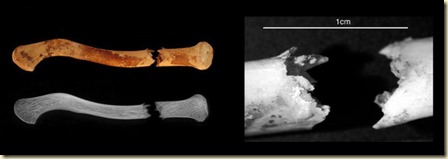 Did the abuse cause the child’s death? Archaeologists and researchers are not certain, though the collarbone break shown above may have contributed to it.
One good piece of news out of this discovery is that the child in Burial 519 was the only child skeleton (out of 158!) in the cemetery to show evidence of abuse, suggesting that child abuse was not a normal practice in this ancient community. Rather, all other evidence confirms the common belief that Egyptians highly valued children as members of society.
Carbon dating shows that the cemetery was in general use between 50 and 450 A.D., during a Roman period in Egypt—Romans had quite a different concept of children, and were not afraid to use corporal punishment. It’s possible this abuse case may have been a result of Roman influence, but we may never know for certain.
(Research on this case will be published in an upcoming issue of the International Journal of Paleopathology.)
Previous page | Next page
 It’s no secret that the French love their wine… but when did they begin this devotion-esque relationship with the vine? Recent chemical analysis of an ancient wine press from southern France has revealed that wine was produced quite a bit earlier than previously believed.
 Not too far from where the amphorae were found, archaeologists also found a limestone pressing platform with tartaric acid residue, as well as grape skins and seeds scattered around. According to McGovern, “the combination of botanical and chemical evidence makes a pretty tight argument” for wine production at the southern French town of Lattara during the 5th-century.


