By: The Scribe on Saturday, August 4, 2007
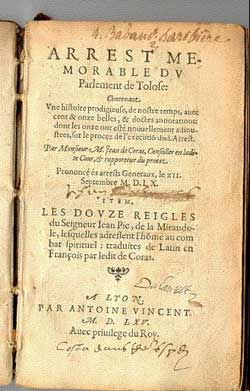 The tale of Martin Guerre is one of the most intriguing stories about everyday people to come down through history: it is a stranger-than-fiction tale of identity theft in the 16th-century, and it happened in an average, unassuming village in the French countryside. This is the story of the return of Martin Guerre.
Born Martin Daguerre around 1525 in French Basque country, Martin’s parents moved the family – Martin, his younger brother, and both parents – to the village of Artigat when he was two years old for reasons unknown to history. After the move, the Daguerres changed their name to Guerre and tried their best to adapt to the customs of their new neighbors, and it was during this time that Martin’s four sisters were born.
The family spent time learning the local language, Provencal French, and eleven years later – when Martin was almost 14 years old – he was married to a girl from a neighboring peasant family that was financially well established and highly respected in the local community. Bertrande de Rols was transferred with a substantial dowry to boot: a vineyard, bed with feather pillows, linen and wool sheets, a bed cover, cash, and other valuable household items. Following traditional Basque custom, Martin and his new wife moved in with Martin’s father: the young lord was to live with the elder lord and be his subordinate. Regardless of tradition, it was a good arrangement in the first place as Martin and his new bride were only just shy of their fourteenth birthdays.
Unfortunately for the two of them, Martin turned out to be impotent and thus was unable to consummate the marriage. Still, the Guerre family remained hopeful, and Martin continued to grow to become a very active young man, enjoying acrobatics and becoming very adept at swordplay. Meanwhile, Catholic canon law stated that an unconsummated marriage could be dissolved after three years, and Bertrande’s family pressured the young woman to separate – however, the Guerres continued to consult local ‘wise women’ and healers who eventually came up with a solution: they had the local priests sing four masses, took communion, and ate special cakes that allegedly would break the spell that Bertrande had come to believe was preventing them from consummating the marriage.
Whether Martin’s impotence was the result of a spell or not, it was not long after this ‘spell-breaking’ that Bertrande conceived their first child and gave birth to a boy. However, Martin was still unhappy – he detested Artigat, and couldn’t stand living under his father’s power. He felt confined by the routines, the daily fields, and even his marriage, and even tried at one point to leave and join the King’s army – and was only stopped when his father learned about the plan.
Then one day in 1548 – perhaps in retribution, or perhaps simply out of spite – Martin took some grain that belonged to his father, without asking permission. In traditional Basque custom, theft from a family member was the gravest crime of all. Realizing what he’d done, Martin left Artigat, leaving his patrimonial inheritance, his parents, siblings, wife and newborn son. Bertrande, it seemed, was in a catastrophic situation – without proof of her husband’s death, she couldn’t remarry, and without knowing whether Martin was alive or dead, she had no place in French peasant society as either a widow or a wife. How was she to be taken care of and how would she afford the means to live?
Time moved on… but one day in 1556 – almost eight years later – a man appeared in the village, presenting himself as the long-lost Martin Guerre…
Want to read more?


Tomorrow: The return of Martin!
By: The Scribe on Friday, August 3, 2007
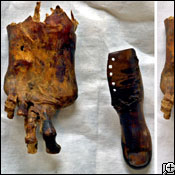
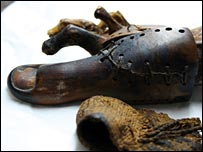 Found on the foot of an ancient Egyptian mummy, it appears that a false toe commonly referred to as the “Cairo toe” may have been more than purely decorative – in fact, it may have been the world’s first functional replacement body part! The worn-down false toe was found fastened onto the mummified foot of a middle-aged woman, and it appears that the amputation site of her large toe had healed perfectly during her lifetime – probably allowing her to wear a false toe with some level of comfort, and thus enabling her to walk properly again.
The toe is similar to another ancient Egyptian false toe from the British Museum, which is why both toes were previously thought to have just been cosmetic additions for the wearer without any additional benefits. However, it was recently noticed that the toe from Cairo shows signs of wear and also bends in three places – exactly the same way as any other human’s large toe works.

Alternately, the fake toe from the British Museum does not bend, and was made out of the less durable material called cartonnage, which is a kind of papier-mache made from linen, plaster, and glue. While it also shows signs of wear, suggesting that it was worn during the owner’s lifetime, the fact that it does not bend seems to imply it was used for the sake of appearances only and did not help the wearer to walk correctly.
Tests are planned to determine whether either one of these false digits could actually help someone who was missing their large toe to walk unhindered – if the tests are successful, it will mean that the Cairo toe is officially the world’s oldest artificial body part, beating out a hollow bronze leg from Rome by over a thousand years!
Want to read more?


Tomorrow: Ancient identity theft!
By: The Scribe on Thursday, August 2, 2007

The city of Varna in Bulgaria is one of the oldest cities in Europe, with a history dating as far back as 4600 BC during the Chalcolithic period. The people who lived in Varna at this time have been simply called the ‘Varna Culture’, and the majority of information about this culture comes from the Varna Necropolis.
The Necropolis was accidentally discovered in 1972, and the enormous extent of the site has resulted in around 30% of the area still remaining unexcavated. There are 294 documented graves, many containing highly sophisticated pieces of gold and copper jewelry, gold-painted pottery, high-quality obsidian blades, stone beads, and shells. In total, the amount of artifacts from the excavated graves numbers over 4000 items – which represents an incredible amount of wealth to have been buried for any civilization, not to mention one which lived over 6,000 years ago!
The burials themselves vary, as it appears that bodies were either placed in a crouched or extended position – or in some cases, there was no body at all… only grave gifts! And oddly enough, those graves that didn’t contain a body were the ones that held more gold artifacts than any others. Out of all the goods that were found, 3000 of these were gold, weighing around 6 kilograms in total – these people were not lacking for finances! In fact, Grave 43 itself contained more gold in that one burial than has been found in the entire rest of the world from the Chalcolithic period.
Based on the artifacts and burial goods from Varna, it is likely that the Varna culture traded extensively with people from the lower area of Volga in Russia, as well as with groups living in the Greek Cyclades. Copper from the artifacts also seems to have come from a mine in south-central Bulgaria, while the shells have been identified as Mediterranean Spondylus mollusks – evidently, these people were experienced travelers!

Although little else is known about the Varna culture’s society, the burials do give some indication of a social hierarchy at least during some period of the culture’s existence. Grave 43, the oldest known burial in the Necropolis, was of a male who must have been part of the society’s elite: not only did it have more gold than any other graves, but he was also buried holding a war mace and wearing a gold sheath on his penis. In addition, small golden bull-shaped platelets from the grave suggest a common prehistoric association between bulls, warfare and male virility.
The culture seems to have come to a dramatic and immediate end around 4100 BC, and this has commonly been ascribed to a sudden climate change in the region. While it can be said for certain that the Varna culture was very concerned with the afterlife, as evidenced through the care and wealth they put into the Necropolis burials, the rest of their history will likely remain mysteriously hidden for the rest of time.
Want to read more?


Tomorrow: Beware of the mummy’s…toe?
By: The Scribe on Wednesday, August 1, 2007
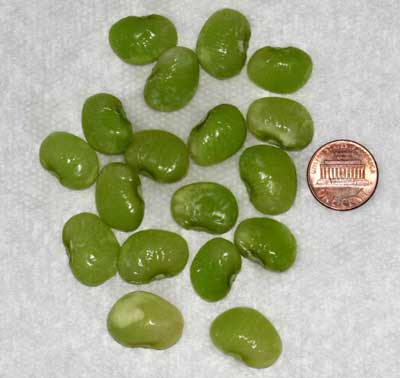
Though generally not considered a favorite food of children, it turns out that lima beans were once touted as a sacred, elite-only delicacy among the Moche civilization of northern Peru. Known for their lively painted and sculpted pottery vessels, many of the images they created were records of daily life – including important symbols and their favorite foods. Among these paintings are recognizable images of lima beans… and some are depicted in a rather interesting way.
At the Larco Museum in Lima, there is an extensive collection of Moche pottery that have lima bean designs, where some of the lima beans are actually anthropomorphic: the little beans have been given expressive faces, legs, feet, and in some cases appear to be representations of messengers or warriors. On some pots, there are symmetrical rows of lima beans that cover the entire surface of a pot, with distinctive speckles to show their specific genus.
Research into these pots, as well as the dieting habits of the ancient Moche people, give all indications that these lima beans were consumed primarily by the ruling elite, which would have placed them in a position of importance and prominence – and likely ensured their role in any number of religious rituals as well. Since cultures like the Moche tended to allow only the ruling elite as members of the community priesthood, there is a fair amount of certainty concerning lima beans’ ritual significance.
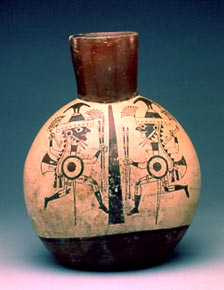
Other studies have focused on the lima bean’s role as a type of proto-script, meaning that many of the images of beans on Moche pottery actually held ideographic connotations – they were pictures that held distinctive ideas in their depiction. Thus, not only were lima beans consumed by the elite, but they also held symbolic meaning in their usage.
Lima beans have had a long history in South America, with remains of beans dating to around 6000 BC. While there are several different types of lima beans that grow across Central and South America, the Moche people would have consumed the denser variety of bean that is familiar in most grocery stores today.
Want to read more?


Tomorrow: Gold of the dead
Previous page | Next page
