By: The Scribe on Tuesday, July 3, 2007

Around six million years ago, something rather drastic happened: the world lost an ocean. Fortunately, it’s returned since then, but during the Messinian Salinity Crisis, there was no Mediterranean Sea. Instead, there was a bit of a wading pool… or possibly even completely dry land.
During the Messinian period of the Miocene epoch, it seems that what is now known as the Strait of Gibraltar actually closed up, disallowing the flow of water from the Atlantic and resulting in the Mediterranean seabed simply evaporating – in some places up to 3 miles below sea level. As this occurred, there were also some cases of extreme erosion, creating several enormous canyons in and around the coastline, after which the evaporation procedure left behind deposits of evaporite mineral sediments.
It was during some routine geological work in the Mediterranean that geologists found evidence for this ancient desiccation of the sea, as they found mineral deposits that only form when large amounts of isolated salt water evaporate over time. Combined with layers of marine fossils, which indicats repeated periods of drying and flooding, as well as now submerged canyons that are cut into the sides of the sea basin, geologists realized there was enough evidence to confidently assert that, for some period of time, there was no Mediterranean sea.
During the period of dehydration, earth’s sea levels rose by 10 meters – if this happened today, many of the world’s major cities and landforms would be completely submerged! The global climate was also changed during this time, causing almost the entire Mediterranean basin to become a wasteland devoid of plant and animal life, and at 3 meters below sea level inside the basin, the temperature would have been almost 50 degrees hotter at the bottom than the temperature at sea level. With that kind of heat in and around the basin, added to the increased salinity of the area, the great civilizations of Egypt, Greece, Rome, and any other known Mediterranean culture could not have developed – unless the sea was refilled.
Eventually, the Strait of Gibraltar opened again, allowing water from the Atlantic to once again refill the Mediterranean basin, but not until the earth’s oceans had already been permanently altered by the loss – the freezing point of the ocean had been raised, and the average salinity of seawater significantly reduced. Even today, the salinity of the Mediterranean is higher than the North Atlantic, and thus it continues to have a higher rate of evaporation.
Want to read more?


Tomorrow: Iranian Salt Men.
By: The Scribe on Monday, July 2, 2007

The city of Crocodilopolis was located on the western bank of the Nile, southwest of Memphis in Egypt. Known to the ancient Egyptians by the somewhat less redundant name of Shedet, this city was the center of worship for the Egyptian god Sobek, the (you guessed it) crocodile god. Ever the subtle geniuses when it came to naming foreign places, the ancient Greeks dubbed it “Crocodile City”, or “Crocodilopolis”, as it is now remembered.
Inhabitants of Crocodilopolis worshiped a manifestation of Sobek through a sacred crocodile kept at the city, named ‘Petsuchos’ – a name that means “son of Sobek”. The crocodile was adorned with gold and jewels, and was kept in a temple with its own pond, sand, and special priests to serve his food. After the residing Petsuchos died, the body would be mummified and given a special burial – and then promptly replaced with another “son of Sobek”.

Crocodilopolis never became a large city, nor developed any major political standing in the area, and in the 3rd century BC the city passed into the hands of the Ptolemies. It was renamed Ptolemais Euergetis for awhile, but was renamed again to Arsinoe only a short time later by Ptolemy Philadephus II to honor his sister and wife, Arsinoe II.
On the plus side, Crocodilopolis was located in the most fertile region in Egypt – part of the current-day Fayum – which meant that the city was a haven for farmers growing corn, vegetables, flowers, and olives. Currently, what remains of Crocodilopolis is quite minimal – there are several mounds of ruins, and a few column bases here and there, but not much has been left behind by the sands of time. There is a modern city near the ancient site, however the modern inhabitants seem to have decided against penning up a crocodile inside the church.
Want to read more?


Tomorrow: Disappearing Ocean!
By: The Scribe on Sunday, July 1, 2007
 As the only known woman from ancient Rome whose poetry has survived into modern day, Sulpicia’s poems stand out as a bold female voice in a male-dominated field of ancient literature.
Sulpicia was likely the daughter of Servius Sulpicius Rufus and the niece of Roman politician Messalla – powerful members of the Roman elite, called the patrician class. Messalla was well known as a patron of literature and art, and combined with her station of birth, Sulpicia would have been very highly educated by personal tutors.
Very little remain of her writings, however of the eight rather demure poems that have survived, at least half of them are addressed to a lover by the name of Cerinthus – most certainly a pseudonym for her real lover, if not a fictional character in the style of other Roman poets like Ovid or Catullus.
Her work managed to survive the centuries by preservation through the writings of another poet named Tibullus, and for many years, scholars attributed Sulpicia’s writings to Tibullus himself. However, they are now known definitively as written by this high-born woman, and serve as a little piece of insight into the inner workings of a woman in love in ancient Rome!
Here is one of Sulpicia’s poems, translated by Jon Corelis, where Sulpicia seems to suspect that her lover has become interested in a prostitute – and naturally, is furious at such insulting behavior.
Sulpicia 4: A Curt Reply
I’m glad you take me for granted enough to show me
what kind of man I almost let possess me.
Go chasing after hookers and spinning-girls and whores:
forget Sulpicia, daughter of Servius.
But I have friends who care, and who will spare no pains
to see that no cheap slut humiliates me.
Want to read more?


Tomorrow: Crocodilopolis (no we didn’t make that up)
By: The Scribe on Saturday, June 30, 2007
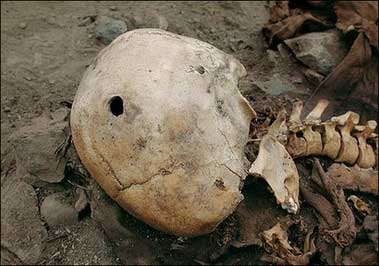
Near Lima, Peru, archaeologists believe they have discovered the first gunshot victim in the Western Hemisphere. In a shallow grave, surrounded by a large group of ancient Incan bones, the skull had an almost perfectly round hole, leading experts to wonder at first whether it had been made by a slingshot, spear, or some other circular weapon.
The Incans who died here, however, appear to have been killed rather violently – likely as a result of the Spanish Conquistadors, who battled against the Incan empire around 500 years ago. The shallow graves seem to suggest that the victims were buried in a hurry, which usually means that the burials were conducted during a time of conflict – in this case, possibly during a known uprising against the Spanish invaders in 1536.
In order to determine what made the hole in the one victim’s skull, forensic experts looked for a trace of metal around the wound, believing there was a very slim chance that any traces would remain after this long. However, against the odds, they found minute fragments of musket ball metal stuck inside the area surrounding the hole! Further examination revealed that the musket shot was less than an inch in diameter, and was powerful enough to enter the back of the victim’s skull and exit through the top of the head at an angle.
Since identifying this skeleton as the first gunshot victim in the Americas, two more gunshot victims have also been located among the bones, with further research on their conditions still to come!

As for the hastily buried bodies, their burials absolutely did not conform to the typical Incan burial customs: they were facing the wrong direction in the graves, they were wrapped only in a simple cloth, the graves were far too shallow, and there were no burial offerings – something absolutely unthinkable in many ancient burial rites. A closer look at the Incan mummies also revealed something more disturbing – many of the bodies seemed to have been hacked up and were missing limbs, there was evidence of impalement by iron weapons, and chunks of the bodies appeared to have been torn apart, in addition to the several bodies with gunshot wounds.
Although it is still not conclusively known what occurred here, the Incans buried here were clearly victims of some horrific and extremely violent acts. Hopefully, further forensic study on the bodies from these graves will help to shed some light exactly what happened at this site in Peru.
Want to read more?

Tomorrow: Scandalous Roman poetry!
Previous page | Next page
