Archive for the ‘Ancient Egypt’ Category
By: The Scribe on June, 2012
Ramses II, more popularly known as Ramses the Great, was not one to rest on the laurels of such a gaudy title. As the man known to be the greatest pharaoh in Egyptian history, he earned not only a pretty nifty nickname, but also enjoyed the- ahem- “spoils” of such a position, having eight royal wives over his long life but as many as 200 concubines.
Somehow, even with all of those ladies in his life, Ramses the Great actually found time to rule over his kingdom. He did so for longer than any other Egyptian pharaoh, as he ascended to the throne in his early 20s and lived to be either 90 or 91 years old, depending on which scholar you ask. Ramses’ reign was so long that it was not his first son that would eventually take over for him, but his thirteenth, Mereneptah.
In fact, his long list of royal wives was not so much due to the fact that Ramses was a ladies’ man and more of a simple reality for a person who lived several decades longer than many people would back in ancient Egypt. Ramses the Great actually fathered over 110 children, not counting the “unofficial” children (to put it nicely) that he undoubtedly fathered with all of those concubines.
Aside from having enough children with different women to make an NBA All-Star blush, Ramses also was a part of many other historical events, possibly the most important of which was the second battle of Kadesh.
During a battle which Ramses was highly praised for (he embellished a bit on the outcome to his subjects), Ramses actually had to settle for a draw, which led to the historic agreement. Over 5,000 chariots and 10,000 soldiers fought in the huge battle in what is now Jordan, and though Ramses would prefer that we remember it as a dominant victory for his charges, Ramses still managed to set up the first recorded peace treaty in history, which is quite a groundbreaking accomplishment in its own right.
As much as Ramses wanted to be known as a great leader on the battlefield, his real passion seemed to be in architecture, as some of his works (most famously The Great Temples at Abu Simbel) astonish visitors to this day with their majesty and scope. Ramses’ signature was the large scale of his monuments and temples, as he was always concerned with ensuring that his legacy would be secure for thousands of years to come.
Unfortunately, when Ramses passed away after about 90 years of life, the riches and stature that he had helped Egypt gain could not last long without him. None of the pharaohs that followed him approached his greatness, and the Egyptian empire fell not even 150 years after the passing of Ramses the Great. Today, his mummy can be found in the Egyptian Museum in Cairo.

By: The Scribe on June, 2012
Even by today’s standards, the love affair of Mark Antony and Cleopatra VII was pretty scandalous. Queen Cleopatra of Egypt had already had relations with Julius Caesar in a political power move that solidified her status as Egypt’s leader and gave her a son, cleverly named Caesarion.
However, when Caesar was assassinated years later, neither Cleopatra nor Roman triumvirate member Mark Antony were very pleased with the ascension of Caesar’s legal heir, Octavian. Further making family get-togethers awkward was Antony’s decision to abandon his wife, Octavia Minor, who was Octavian’s sister. He left Octavia Minor in favor of the infamous charms of Cleopatra, becoming something of a stepfather to Caesar’s son with the Egyptian beauty in the process.
This did not go over well in Rome, where not only did Octavian probably not like his sister being kicked to the curb, but politicians worried that Antony’s newfound unity with Cleopatra (and thereby, Egypt) would be a threat to the Roman Republic.
See, Antony may not have been heir to the throne, but he was a famous military leader and had the loyalty of many of Caesar’s veteran soldiers. In fact, leading up to the Battle of Actium, Antony’s military might equaled that of Octavian. The final slap in the face was when Antony unsuccessfully tried to lobby for Caesar and Cleopatra’s son, Caesarion, to take the throne instead of Octavian.
Things escalated, as they have a way of doing in these types of family dramas, and war was declared. The Battle of Actium was the decisive scrap between the two forces, as Antony’s large warships were outmaneuvered by Octavian’s smaller vessels. Also, Antony’s ships were undermanned due to a nasty outbreak of malaria preceding the battle. Finally, Quintus Dellius, one of Antony’s best generals, defected to Octavian’s side before the battle and gave away Antony’s strategies.
The sea battle turned out to be a disaster for Antony, and afterward many of his soldiers deserted him. Unfortunately, that wasn’t even the worst thing to happen to the famous loverboy, as he got some bad intel that claimed Cleopatra had been captured, and thus decided to end his own life in a Shakespearean twist. Even his suicide attempt (via stabbing himself with a knife) didn’t work out that well, and he had time to be taken to Cleopatra and die in her arms.
Cleopatra obviously did not take this development well, and she tried to work her charm one more time by attempting to arouse the pity of Octavian. She was not successful, and she ended up committing suicide as well, famously doing so by coaxing a poisonous asp to bite her. To add insult to injury, Cleopatra’s son with Caesar, Caesarion was killed under Octavian’s orders later on that year, allowing Octavian to know that he had vanquished all of his challengers in one fell swoop.
With these events, not only did the long line of Egyptian pharaohs end, but the Roman Republic became the Roman Empire. If there was any good to come out of it in terms of Marc Antony and Cleopatra’s doomed romance, it was that their three children together were spared from the vengeance of Octavian and raised by Antony’s spurned wife, Octavia Minor. Obviously, she did not carry a grudge as well as her brother.
By: The Scribe on January, 2012
It’s no secret that the Ancient Egyptians knew a thing or two about food—along with precious jewels, gold, and statues, they often left plenty of food behind when burying their dead. But it wasn’t all ritual offerings… in fact, the Egyptians had special concern for the animals they mummified along with people.
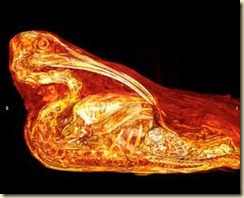 How so? Well, believing that the afterlife would require the same kinds of provisions as needed in life, they packed a delicious lunch for their animals. Or, specifically in this case, for sacrificed sacred ibis birds.
Millions of ibis mummies have been found at shrines across Egypt, where they were sacrificed to the god Thoth who represented wisdom and writing. It was only recently that PhD candidate Andrew Wade (University of Western Ontario) and colleagues used a CT scanner to look inside an ibis mummy to discover what’s inside.
It’s known that the Ancient Egyptians removed and preserved the organs not only of humans, but also of the creatures they buried—but what wasn’t previously known was that they were so concerned about the afterlife that they actually packed food into the stomachs of the sacrificed ibis birds, likely to ensure they’d thrive on “the other side.”
Wade has commented that “the ibis mummies suggest Egyptians believed that birds also travelled to the afterlife. It suggests the provision of an afterlife food source to the bird, and lends support to the idea that the viscera of ibises and humans alike were meant to continue their living function within the afterlife."
It must have been nice to know that even in death, you’d never go hungry!
Reference: Journal of Archaeological Science, DOI: 10.1016/j.jas.2012.01.003
By: The Scribe on July, 2011
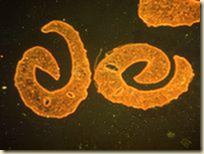 Archaeologists have found eggs belonging to a parasite that plagues modern humans on a series of naturally preserved African mummies. Eggs were found on the mummies as early as the 1920’s but only now have scientists been able to prove that the mummies were infected with Schistosoma mansoni. What is exciting about this discovery is that it proves that the parasite is not just a product of modern urbanization.
The parasites cause a disease known as schistosomiasis. The disease is not usually a lethal one but it can cause lingering health problems including anemia, impaired growth and impaired cognitive development. It can also cause damage to internal organs as well. It can be more serious in children but even in adults it makes day to day living much more difficult.
It is believed that approximately 200 million people are currently affected by schistosomiasis. It is most common in agricultural regions that rely on irrigation channels to keep crops hydrated. Because it tends to thrive in developed areas it was believed that the parasite was actually a product of modern urbanization.
This belief has been challenged by the Nubian mummies. Originally, scientists had thought that a close relative of S. mansoni had left the parasite eggs on the mummies. The eggs were originally thought to be those of S. haematobium. This parasite causes many of the same symptoms but is found in regions other than those with irrigation channels.
Now scientists have been able to determine that the Wadi Halfa were most affected by this parasite. The Wadi Halfa created farms alongside the Nile River approximately 1500 years ago. They utilized irrigation channels in order to keep their crops hydrated. Up to twenty-five percent of the Wadi Halfa were believed to have been infected by schistosomiasis.
The findings are also important because they point to the fact that the Wadi Halfa may have also used irrigation channels. Previously, it was believed that they were not sophisticated enough to have utilized this farming technique. Scientists had previously believed that the Wadi Halfa were reliant on nature in order to plant their crops and keep them irrigated.
Scientists tested skin found on some of the naturally mummified bodies that were unearthed in Egypt. Because the skin was dry and mummified it was possible to test it for various proteins. When scientists tested the skin of African mummies they found proteins that belonged to S. mansoni and not S. haematobium.
The snail that transmits this disease is found mainly in irrigation channels near civilized areas. It prefers standing water that may have higher levels of contaminants and additives in it. It’s relative, S. haematobium is also transmitted via snail but in this case, the snails prefer water that is moving, clean, and well oxygenated.
The discovery was only possible because the mummies had been buried. The environment in the area where they were buried not only preserved the external skin but the internal organs as well. This is different than man-made mummies which may have had the internal organs removed.
Previous page | Next page


