Archive for the ‘Ancient Egypt’ Category
By: The Scribe on April, 2011
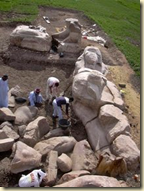 A 42 foot (13 meter) statue of Pharaoh Amenhotep III was recently unearthed in Luxor, Egypt. The city, which is located in the southern part of Egypt is the site of two separate temple complexes. Both the temple complex of Karnak and the temple complex of Luxor are located inside the modern city. The city is also located across the river Nile from other important archeological sites such as the West Bank Necropolis, the Valley of the Kings and the Valley of the Queens. These last two sites are where many ancient Pharaohs and their wives were buried.
Amenhotep III ruled Egypt from 1386 BCE to 1349 BCE. During this time, the country prospered and artistic splendor was allowed to reach its peak. Over 250 statues have been unearthed that depict this pharaoh in addition to large stone scarabs that commemorate everything from his hunting prowess to the creation of an artificial lake that Amenhotep had built for his wife, Queen Tiye. Tiye was only one of several women that Amenhotep married during his lifetime. Many of them were foreign and came from areas such as Babylon and Ammia (which is located in modern Syria). He also married the daughter of several of his allies as well. 
The temple where the statue was found was not located in Luxor itself but was actually located on the West Bank of the Nile. Amenhotep had constructed a large funerary temple which was a normal practice for pharaohs at the time. The statue, which is constructed out of seven blocks of quartzite, was originally positioned in front of the northern entrance to the temple complex. Although the statue was missing a head, it was possible to identify it as being that of Amenhotep III.
Two other statues were also unearthed at the same time as the Amenhotep statue. One depicted the Egyptian God Thoth. While this deity is often depicted with the head of an ibis (a long-legged wading bird) the statue unearthed at the temple showed Thoth depicted with the head of a baboon. Thoth was associated with magical arts, writing, science and judging of the dead. A second statue measured six feet in height and depicted the goddess Sekhmet. Sekhmet was a warrior goddess who was also associated with healing.
 The temple where these statues were found has recently been the focus of massive excavations. An earlier excavation in 1928 actually unearthed the statue but it was buried again. It is believed that a twin to the Amenhotep statue will be unearthed in future excavations. It is surprising that so many artifacts and statuary can be located in the ruins of the temple due to the fact that the structure was heavily damaged in the past. Both flooding and a massive earthquake in 27 BCE were believed to have contributed to the damage that the temple had sustained.
The temple is one of several that were constructed by pharaohs on the West Bank but of the temples, it is one of the largest and grandest that has been unearthed to date.

By: The Scribe on March, 2011
The role of women in ancient times varies from culture to culture. In some, they rode into battle beside the men. In others, they were expected to remain at home where they would bear their husbands children and keep the household in order. One culture where women were permitted and even encouraged to work outside the home was that of Ancient Egypt.
 In Ancient Egypt, there were several examples of women not only working as doctors, but, in some cases, overseeing the work of other physicians. The literary works that they authored on the topic of medicine were, in some cases, being read and studied hundreds, if not thousands of years later.
Of the female doctors who lived and worked in Ancient Egypt, perhaps the best known was Merit Ptah. She lived around 2700 BCE and was believed by many to be the first named female physician in history. She lived and practiced around the same time as Imhotep, who was well known as a healer, architect and builder of the Pyramid of Djoser. Although she was one of the best known female doctors, she was not the first woman to have practiced medicine in Ancient Egypt, and unlike another female doctor, her writings were not studied for thousands of years. She gave birth to a son who later became a High Priest and who gave her the title of “Chief Physician”.
Peseshet was a female physician who lived during the Fourth Dynasty (2613 BCE to 2494 BCE). Some historical records suggest that she may have been a physician and others that she may have been trained and employed as a midwife. Regardless of her training, she was given the title of “lady overseer of the female physicians”. This title is important because it shows that not only were a number of women working as doctors, but that they were also administrated and supervised by a woman as well. It was believed that she may have begun her medical training at a school for midwives that was located at Sais although it is unknown just how far her medical training progressed. 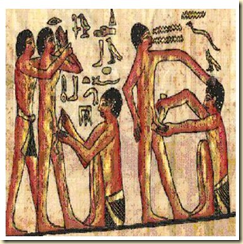
A third woman who was well known as a doctor in Ancient Egypt was Cleopatra (not to be confused with the former Queen and member of the Ptolemy dynasty). In Ancient Egypt, doctors tended to specialize in the treatment of certain diseases or parts of the body. Cleopatra was a doctor who worked in the twin fields of gynecology and obstetrics. In addition to working in the field, she also wrote extensively about her medical specialty and women’s health in general. Her works continued to be the focus of study for more than a thousand years.
Egyptian medicine was a unique mixture of magic and scientific fact. They were able to treat many diseases and injuries much more successfully than doctors could thousands of years later. They showed a need for cleanliness and a knowledge of anatomy and physiology that was very sophisticated for the time and yet, still believed in the need for divine blessings and magic charms.
By: The Scribe on March, 2011
People who have watched the movie The Mummy have heard of Imhotep. In the movie, he was an ancient, undead monster who was condemned to a living death for loving the wife of the Pharaoh. Many people may not realize that there was a real Imhotep who lived between 2655 and 2600 BCE. They also may not be aware that he is responsible for some of the pyramids that we know and love. While he was not the architect behind the Great Pyramid, Imhotep was the first one to take the mastaba structure that was the common shape for tombs and turn it into a soaring structure that endures to this day.
But building pyramids is not Imhotep’s only claim to fame. He was also credited for inventing many things, including an improved form of the papyrus scrolls that were used for all types of writing. He was also believed to have been one of the earliest and best known Egyptian physicians as well. Although two other physicians, Hesy-Ra and Merit-Ptah also lived at the time, it is Imhotep’s writings on medicine that have attracted the most attention. The Edwin Smith Papyrus, believed to have been written by Imhotep, is full of his observations on anatomy as well as descriptions of various ailments and cures. The cures depicted on the papyrus are lacking in many of the incantations and strange ingredients that were common to Egyptian medicine at the time. The papyrus is notably lacking in the magical thinking that was so common at the time.
Although Imhotep seemed to have been able to separate out magical thinking from scientific observation, much of his life was steeped in religion and superstition. He became the patron saint of Egyptian scribes who were known to pour him a libation before they began any work. He was also depicted on a portion of a pharaoh’s statue. This had never been done before.
 Although much of his work was done in the name of the Pharaoh Djoser, it was believed that Imhotep lived on after Djoser’s death. It was believed that he then went on to work for the Pharaoh Sekhemkhet. Unfortunately, Sekhemkhet’s reign was so short (only six or seven years) that he did not survive to see the completion of his pyramid. Although Imhotep was responsible for building some of the largest and most visible tombs in Ancient Egypt, his own resting place has never been found. It is believed to be located somewhere near Saqqara, an area that served as a necropolis for Memphis.
After his death, his reputation continued to grow. He was awarded divine status after his death and was worshipped by a cult that was based in Memphis. He was linked to several gods and goddesses including Nut (the sky deity), Hathor (who eventually became the wife of Ra), and Ma’at, who stood for truth, cosmic order and justice. He eventually became the god of medicine and healing although this did not happen until about two thousand years after his death.
By: The Scribe on February, 2011
When people think about where the pharaohs of Egypt were buried, the pyramids come instantly to mind. It is true that some rulers of ancient Egypt were buried in these large, elaborated tombs. But this didn’t start happening until around 2630 BCE. This is when building started on the Pyramid of Djoser. The thing is, there were quite a few pharaohs who lived, and died, before the idea of building pyramids was ever thought of. So where were the earlier pharaohs buried? And why was there a sudden switch to larger, more elaborate tombs?
If you were a ruler or a noble during the ancient period of Egyptian history, you were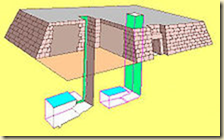 buried in something called a mastaba. This was a tomb that was shaped like a rectangle. It had sides that sloped outwards and was built from either stone or bricks that had been formed from mud. Because of the Egyptian’s belief in the afterlife, they needed a place where a person’s body could sit and not be disturbed. In Egyptian religion, you needed a body that had not rotted away or been disturbed by animals or other humans. If your body was destroyed, you were denied a place in the afterlife and eternal life was out of the question.
Although it looked like a fairly uncomplicated structure from the surface, a mastaba was actually fairly complex. The bench-like structure that emerged from the sand was not where the body was actually located. Instead, the bodies of the deceased were placed in a sealed chamber that was located deep below the surface of the sand. The structure above had places where offerings could be brought by family members could be placed. The body inside was mummified. This was necessary because the way that the body was sheltered meant that it could not dry out naturally, the way it would if it was placed in the dry air of the desert.
The problem was that these tombs were large, obvious, and known to be the resting place of wealthy Egyptians. So, what’s a poor person to do? In many cases, grave robbers broke into the mastabas and carried off most of the contents that had any value. They often went so far as to destroy the carefully wrapped and preserved bodies as well. Because a defiled body meant no entrance into the afterlife, this was something that frightened and upset ancient Egyptians. They wanted a way to make sure that their graves would remain untouched.
 This was one reason why many ancient Egyptians chose to be buried in tombs cut in rock walls instead of mastabas. In fact, by 1550 BCE, the use of mastabas was quite rare. However, they were not totally overlooked. In fact, the earliest pyramid was actually constructed to look like a stack of mastabas that had been placed one on top of another. The Step Pyramid of Djoser was designed to look like mastabas that had been stacked to form steps. It was believed that the steps would allow the soul of the Pharaoh Djoser to climb into heaven.
Previous page | Next page
 A 42 foot (13 meter) statue of Pharaoh Amenhotep III was recently unearthed in Luxor, Egypt. The city, which is located in the southern part of Egypt is the site of two separate temple complexes. Both the temple complex of Karnak and the temple complex of Luxor are located inside the modern city. The city is also located across the river Nile from other important archeological sites such as the West Bank Necropolis, the Valley of the Kings and the Valley of the Queens. These last two sites are where many ancient Pharaohs and their wives were buried.
 The temple where these statues were found has recently been the focus of massive excavations. An earlier excavation in 1928 actually unearthed the statue but it was buried again. It is believed that a twin to the Amenhotep statue will be unearthed in future excavations. It is surprising that so many artifacts and statuary can be located in the ruins of the temple due to the fact that the structure was heavily damaged in the past. Both flooding and a massive earthquake in 27 BCE were believed to have contributed to the damage that the temple had sustained.