Archive for 2007
By: The Scribe on July, 2007
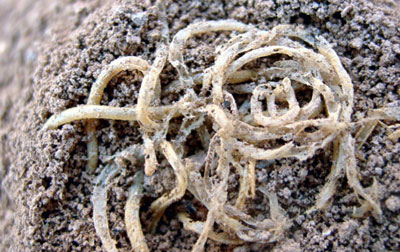
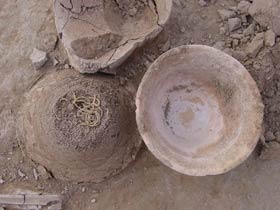
While it is often taken for granted that Italy holds the title of Pasta Inventor, a discovery of the world’s oldest noodles has turned this belief on its head. Underneath 10 feet of sediment, at a small archaeological site near the Yellow River in northwestern China, the dried remains of thin, yellow noodles about 50cm long were found inside of a clay pot.
It seems that the noodles were inside of someone’s bowl for dinner, when a sudden catastrophe caused the settlement’s inhabitants to try and flee the area. This theory comes from the discovery of a number of skeletons at the site that were strewn about in various positions as though the people were attempting to escape the area.
The most likely explanation is a catastrophic earthquake that caused severe flooding from the river – enveloping the settlement and in the process, inverting someone’s bowl of noodles. This unique and unlikely combination of factors caused a vacuum space between the ground soil and the bottom of the bowl, preserving the noodles from decomposition!
The noodles are very similar in appearance to La-Mian noodles, a traditional Chinese dish made by repeatedly pulling and stretching the noodle dough by hand. It is a very labor-intensive process, suggesting that the community that made these ancient noodles already had a well-established sense of cuisine and cooking practices. Scientific analysis of the noodles revealed that they were made from millet grains, unlike modern noodles that are made using wheat flour.
Prior to the discovery, the earliest known record of noodles comes from a book written during the East Han Dynasty in China, dating somewhere between 25 and 220 AD – however, there has always been some debate as to whether the Chinese, Arabs or Italians invented the food first. With the discovery of these noodles, all signs point to China as the first noodle production powerhouse.
Want to read more?


Tomorrow: Coatless Neanderthals

By: The Scribe on July, 2007

It was around 1100 AD that an obscure native culture, known as the Gallina, lived in a small area of New Mexico’s northwest. And it was around 1275 AD that the entire culture suddenly vanished without a trace.
Until recently, less than one hundred skeletons from the Gallina culture have been found, but a new cache of seven skeletons has added a twist to the tale of this vanishing group of people. The bones of five adults, one child, and one infant all show evidence of violent murder. One skeleton had a fractured skull, jaw, forearm, pelvis and thighbone, and several ribs were also cracked. Another body had cut marks on the upper arm, similar to the kind of marks made by an axe. The skull of the child, probably about two years old at the time of death, had been crushed.
Two of the bodies were also arranged in an unusual way: an adult male and a female were face down, on their knees, with their heads bent back far enough to rest between their shoulder blades. The female’s head had been snapped back so far that a piece of her vertebrae had been forced into the back of her skull. This could have been the result of a deliberate pose, or it is possible that the individuals were crouched defensively when their necks were broken. This kind of position also shows that whoever killed these people did not bother to bury them – they simply carried out the murders and moved on.
Another unusual feature of the murder scene was a burnt pit house quite near to where the bodies were found. According to reports from previous Gallina sites, in 90% of cases, attackers tended to throw their Gallina victims inside their own houses and then burn the houses on top of them. However at this site, the bodies had simply been thrown into a pile. According to archaeologists working at the site, it is extremely likely that more bodies and burnt houses are nearby – though whether they will show such evidence of brutal murder is uncertain.
Although very little is known about this culture, two of the adult skulls showed distinct evidence of culturally-induced cranial deformation – they have an unusual flattened shape which has not show up anywhere else in the American southwest. It is entirely possible that distinctive internal traits such as these were the cause of violent conflicts with other groups of Gallina people in the area, or it may have also been the result of drastic climate change in the region.

In fact, one of the main theories on the massacre site is that the Gallina culture’s disappearance was the result of genocide. Around 1100 AD, shortly after the culture appears in the archaeological record, the southwest of New Mexico was struck with severe drought. By about 1150 AD, the water table had begun to drop, preventing inhabitants of the region from growing as much corn as was needed to survive – it is possible that this could have been the source of stress between villages, as they struggled to ensure each group had enough resources. With competition for water and arable land, it is possible that internal strife took a turn for the worse – resulting in mass killings for the sake of food and water.
A second theory rests on the known evidence that other established cultural groups in the area, such as the Anasazi, abandoned their own massive settlements during the drought. If established groups like the Anasazi saw the new Gallina people as a threat – new, alone, without any political allies – they may have done what they thought they needed to do to restore the land’s harmony. After all, if they had no problems growing their corn for hundreds of years – and then a new group of people came into the area, and all of a their sudden corn wasn’t growing anymore – who were they going to blame?
Although the fate of the Gallina culture remains undetermined, the horrendous violence inflicted on the most recent skeletons certainly shows that whatever happened, the conflict was swift and ruthless – and let toward a complete destruction of an entire culture.
Want to read more?


Tomorrow: 2000 year old noodles, yummy!
By: The Scribe on July, 2007

During the height of Mayan civilization, it seems that the court of every ruler had for itself a scribe: someone who could record the goings on of the king, write down the local history, and compose messages or important documents. Paintings of scribes from this time depict them as seated cross-legged on the floor, wearing a short kilt, a headpiece, and holding a pile of brushes, ready to write.
Court scribes would have been men of very high rank – well educated, with noble families in positions of power. Primarily, they were responsible for glorifying the king’s accomplishments through art and literature, and many of these pieces were used as public displays to strike awe into the hearts of the people – if one was to compare a Mayan scribe’s job with a modern career, he could be likened to a professional propagandist.
Though they lived in the lap of luxury for most of their lives, the downside of being a Mayan scribe came during times of war – after all, if the enemy can capture someone who has spent a great deal of time in the king’s court, hearing all of his strategies and plans, what better target than a royal scribe? In addition, any scribe who had devoted his life to another ruler’s glorification certainly wasn’t going to be of any use to an enemy king… and so, since Mayans could always use another excuse for a public spectacle, the attacking tribe would humiliate the scribe in a public ceremony, first mutilating him amidst the cheers of the watching crowd, leading toward his execution. One of the favored methods of torture was breaking a scribe’s fingers and tearing out his fingernails, though cutting the fatty pads of flesh off the fingers to the bone was also an option.

Although it may seem more viable for an enemy king to have simply retrained captured scribes and forced their allegiance, it was likely that the king would have had many of his own scribes already, and simply not needed the services of another. In addition, it also wasn’t unusual for a scribe to be related to the defeated king in some capacity or another, which would have made any forced allegiances questionable at best.
Want to read more?


Tomorrow: Ancient CSI: New Mexico
By: The Scribe on July, 2007
During the Viking Age in Scandinavia, there was a group of poets who performed their poetry in the courts of Viking leaders and kings – this so-called courtly poetry, more commonly known as Old Norse poetry, would be performed in solo by a poet called a skald.
Each skald tended to emphasize the deeds of his king in his poetry, and the constructed poems tended to be subject to rather intense technical demands. These complicated forms of verse were comparable to those of Welsh bards, and in the same manner, the topics of poetry were rather limited to testimonials and memorials of a king’s or well-known aristocrat’s battles and deeds. In fact, it wasn’t unusual for a Viking king himself to take an interest in poetry, and many kings actually became their own skalds! For this reason, the majority of skaldic poetry that survives today can be attributed to specific authors and kings.
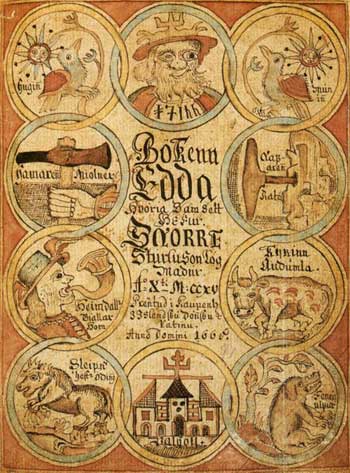
As time moved on, the 10th century began to see an increase in syncretizing of pagan and Christian themes, and by the 11th century, skaldic poetry had become extinct in a Christianized Scandinavia. Icelandic skalds continued to practice well into the 13th century however, which gave many of the poets time to write down their own compositions as well as traditional poems that might have otherwise been lost. One skaldic poet even compiled a manual called the Prose Edda, hoping to preserve an understanding of this poetic art for the future.
To make matters a little more interesting, skalds also tended to compose other pieces of poetry that weren’t necessarily meant for recitation in the court. They were known to have composed satire, and on rare occasions, they constructed erotic verses called ‘mansongr’. Unfortunately for the skalds, the writing of mansongr was forbidden in many Norse jurisdictions under penalty of death.
Why? Not because of any moral objections, but because leaders were afraid of the poems’ potential for magical ensnarement! Erotic and love poetry often contained magical charms in several verses, and on other occasions, love poetry was seen as a smear on a woman’s reputation – thus potentially harming her family’s reputation as well.
Want to read more?


Tomorrow: To kill a Mayan scribe…
Previous page | Next page
