Archive for 2007
By: The Scribe on July, 2007
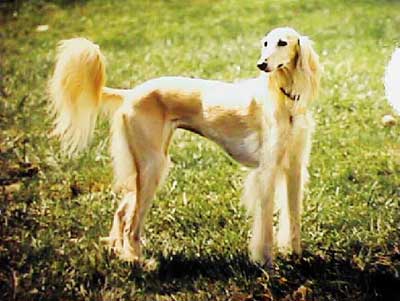
The Saluki is possibly the oldest known breed of domesticated dog, and its origins are traceable back to the time of the Pharaohs of ancient Egypt… and even further back than that. They seem to have originated in the Fertile Crescent area of Mesopotamia, and carvings from the Sumerian period around 7000-6000 BC have produced what appear to be images of Saluki dogs working alongside humans.
Saluki are ‘sighthound’ dogs, meaning that they hunt by sight instead of scent. With a powerful build and the modern nickname ‘Persian Greyhound’, the Saluki may actually be ancestors to today’s greyhound breeds. Another very early instance of sighthounds in ancient art comes from around 3000 BC, where the image of a dog resembling a Saluki was found on a stamp seal near Nineveh.
Egyptian tombs as early as 2100 BC have revealed paintings of Saluki dogs, including the tomb of an Egyptian governor named Rekh-ma-re, whose tomb images show a procession of people bringing him offerings. Among the offerings are three Saluki dogs of different colors: red, white, and golden. On the wall of a tomb for an Egyptian named Nebamun, dating around 1490 BC, there is an image of a multi-colored Saluki wearing a broad collar. Many other tomb carvings – such as the images of the young Tutankhamun riding in his chariot on a hunt – include depictions of dogs accompanying the Pharaohs as they hunted for sport or went into battle, and it is widely believed that these dogs were the domesticated Saluki.
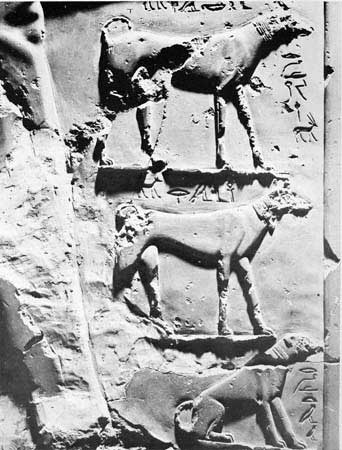
Due to the great respect and reverence for this breed, the breeding line continued for thousands of years, stringently kept pure by royal dog breeders and even the nomadic Bedouin! Bedouin tribes often owned Salukis and kept them apart from their other dogs, not only to preserve their genetic purity, but also to ensure their behavior and effectiveness in hunting was not tainted. Later during the Roman period, it is suspected that the Romans brought back Saluki from their conquests in Egypt – and then proceeded to crossbreed the dogs into today’s modern greyhounds.
Evidence for the continual respect held for Salukis since ancient times also survives in the form of a poem, written by an Umayyad poet sometime between 661-750 AD: “They have with them their hounds of Saluq, like horses wheeling in battle, dragging on their halters.” Pretty intense for a dog now kept as a typical household pet…
Want to read more?


Tomorrow: More viking goodness!

By: The Scribe on July, 2007
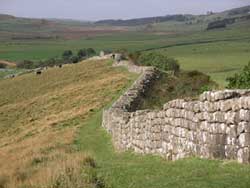 In the 1970s, excavators working at Hadrian’s wall came across a large number of ancient documents – Roman letters, contracts, and other writings – in and around the area. The documents are actually pieces of wood that had originally been composed using wax drawn onto wooden tablets with a stylus, but after sitting in the ground for 2000 years, the wax had long since decomposed – leaving only faint scratches in the wood where the writing had once been.
Hadrian’s wall is one of the most important Roman monuments in Britain, as it was the marker for the British northern border of the Roman Empire. In fact, Hadrian’s wall was the most heavily fortified border in the entirety of the Empire, and was a strong military defense against raids by Scotland’s Pictish tribes.
With a heavy military presence at the wall, perhaps it is not surprising that the first document to be deciphered from the cache was a Roman soldier’s shopping list! It seems that this soldier was heading to an auction with several key purchases in mind: a general outfit of clothing, which would have cost him around 8 percent of his annual income, and another 10 percent of his annual income would go toward the purchase of a new cloak. With Britain’s often harsh climate, a new cloak would have been absolutely necessary for a soldier’s well being – which is probably why it cost him a small fortune.
The list was deciphered by exaggerating the stylus markings on the tablet through digital imaging and virtual reconstruction technology. Noting the shadows that the etchings cast when low, focused light was shone on the wood, researchers were able to analyze the scratch marks and make out distinct letters.
Want to read more?

Tomorrow: Talk about an old dog…
By: The Scribe on July, 2007
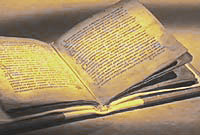 The so-called ‘Four Ancient Books of Wales’ were translated and compiled together by William Forbes Skene in 1868, and although by modern standards the compilation is flawed and translation likely rife with errors, Skene’s work is a comprehensive volume of four of the most important surviving texts of medieval literature. The four books were written in Middle Welsh during the 13th to 15th centuries, and contain both poetry and prose.
Some of the writings within the texts appear to be contemporary, however many portions of the documents seem to be centered around traditions that date as far back as the 6th and 7th centuries. Perhaps most important of all, the books also contain the earliest native Bardic Welsh references to the legendary King Arthur. Although the documents were likely written down into document form from traditional Bardic oral poems and stories, probably at the expense of wealthy and noble patrons, the subject matter seems to take on an esoteric quality – ranging from drunken brawls and battles, to words of wisdom, to almost mystic insights into human nature.
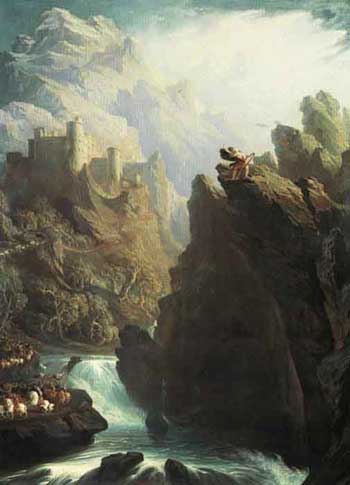
- The Black Book of Carmarthen: This manuscript is one of the earliest surviving works written completely in Welsh, and was composed around 1250 AD. The poetry in this book has some religious themes, though the most intriguing portions are the poems that can be associated with the legends of Arthur and Merlin – one poem discusses the Battle of Llongborth and Arthur’s involvement in it, though the actual location of this historical battle has long been lost.
- The Book of Taliesin: The most famous of the four Welsh manuscripts, this book is officially dated from the early 14th century – however, most of the contents are thought to be much older. With some of the oldest Welsh poems in this volume, many of the writings have actually been attributed to the poet Taliesin who lived at the end of the 6th century. This book contains some of the most famous Arthurian tales, such as the poem wherein Arthur and his knights sail the sea to win treasures, including a magical cauldron.
- The Book of Aneirin: This manuscript dates from the 13th century, though most of its Old and Middle Welsh poetry is attributed to Aneirin, a late 6th century Brythonic poet. The most famous piece from this book is a poem called Y Gododdin, commemorating the warriors who fell at the Battle of Catraeth in 600 AD.
- The Red Book of Hergest: This Welsh manuscript was probably composed somewhere between 1385-1410 AD, and was so named due to its red leather binding and association with the Hergest Court in the Welsh Marshes until the early 17th century. The book contains prose, including the extremely important collection of Welsh tales known as the Mabinogion.
Notably, J.R.R. Tolkien borrowed the title of the Red Book of Hergest for the imagined legendary source of his tales, entitled the Red Book of Westmarch.
Want to read more?

Tomorrow: A Roman shopping list!
By: The Scribe on July, 2007
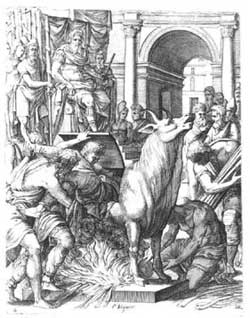 Sometime during the 6th century BC, a brass-founder by the name of Perillos of Athens made a proposition to Phalaris, the tyrant of Acragas. He had come up with a new means of execution for criminals: he would make a hollow brass bull with a door in the side, and the condemned could be shut inside. A fire would then be set underneath the bull, heating the metal to extreme temperatures and thus causing the person inside to slowly roast to death.
According to tradition, Phalaris had a penchant for cruelty and highly approved of this new device, and commissioned Perillos to ensure that the bull’s head be constructed in such a manner that the screams from the inside would pass through a complex system of tubes and stops, causing a noise to sound like the bellowing of an angry bull. Once the device was completed, the story goes that Phalaris asked Perillos to show him how this brazen bull worked – and once Perillos had climbed inside to demonstrate, Phalaris promptly locked the door and lit a fire underneath.
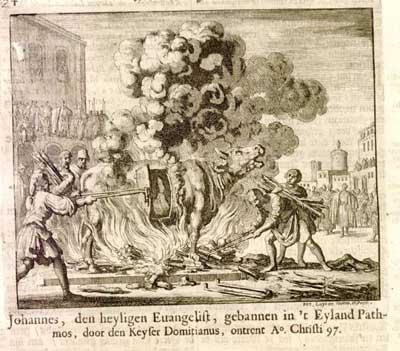
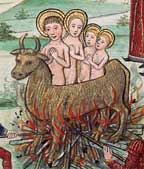 Although some historians have dismissed this story of the brazen bull as an invention of later, creative imaginations, the Roman historian Pindar – who lived a century after Phalaris – clearly associates the tyrant with the torture device in his own writings.
Later use of a brazen bull, however, is clearly documented during the Roman era. A number of Christian martyrs were reported to have roasted to death inside a bull, including Saint Eustace who was apparently roasted with his wife and children at the order of Emperor Hadrian. During the time of severe Christian persecutions under Emperor Domitian, Saint Antipas met his fate in a brazen bull, while Saint Pelagia of Tarsus was burned inside a bull in 287 AD at the orders of Diocletian.
Want to read more?


Tomorrow: The four ancient books of Wales!
Previous page | Next page
