Archive for 2007
By: The Scribe on July, 2007
 Although he may have enjoyed his newfound public recognition as a highly skilled military commander, the barons in Richard I’s various lands continued to revolt against him. In 1181-1182, there was a severe revolt over the county of Angouleme – according to historical documents, Richard had been accused of vicious cruelties against his own subjects:
“he carried off by force the wives, daughters, and female relatives of his freemen, and made them his concubines; and after he had extinguished the ardor of his lust on them, he handed them over to his soldiers for whoring.” source
Richard continually refused to pay the required homage to his father, and in 1183 – fed up with Richard’s insolence – Henry II and his other sons invaded Aquitaine to try and subdue Richard. As his own barons joined the king against him, Richard was somehow still able to hold off the invading armies, executing anyone they happened to take prisoner in the ensuing fray. However, it was in that same year that the young Henry died, leaving Richard the now-eldest son and therefore the rightful heir to the throne.
Yet, Richard continued to fight his father, and made as many outside allies as he could, including King Philip II of France. Working together, the two men were able to defeat Henry II’s army at the site of Ballans, and Henry was forced to name Richard his heir – with the supposed consent of Henry’s youngest son, John. Only two days later, Henry II died, and Richard I became the legitimate king of England.
In a strange and unprecedented move, Richard I barred all Jews and women from his coronation ceremony – even those Jewish leaders who had arrived with gifts for their new king. According to historical texts, Richard’s courtiers had the Jewish leaders stripped, flogged, and thrown out of his court. Shortly thereafter, rumors began to circulate that Richard had ordered all Jews to be killed, which caused the people of London to begin a massacre: Jews were robbed, beaten to death, burned alive, and many Jewish homes were burnt to the ground, and the inhabitants baptized by force.
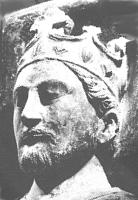 Although it is uncertain whether Richard ever actually ordered the mass killings of Jews, the Medieval historian Roger of Howeden claimed that the massacres and rioting were started by prejudiced and bigoted citizens who were subsequently punished with the most severity by Richard himself. In addition, Richard apparently realized that the rioting could destabilize his rule – and since he had planned to leave on crusade shortly after his coronation, he ordered the execution of those individuals who were associated with the most severe murders and Jewish persecutions. To further placate the people, Richard issued a royal decree that all Jews should be left alone, though it was very loosely enforced: as early as the following March, the violence continued, including a second massacre of Jews at York.
Before going on crusade, Richard reportedly swore an oath renouncing his past violence and cruelty. This oath allowed him to become ‘worthy’ to take up the cross – whether it was sincere or not is another matter entirely.
(By no means is this the end of Richard’s story, however the rest of his lengthy tale shall perhaps be told another day…)
Want to read more?


Tomorrow: Death by Brazen Bull

By: The Scribe on July, 2007
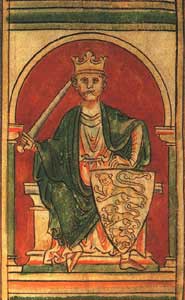 Richard I, commonly known as Richard the Lionheart and often associated in popular media with the legends of Robin Hood, was King of England from July 6th, 1189 to April 6th, 1199. The majority of his time in power was actually spent away from the kingdom, and he took part in a number of campaigns while on his way to participate in the Third Crusade.
As the third son of King Henry II of England, Richard was never expected to become king, though popular historical rumors often present him as the favorite son of Eleanor of Aquitaine, his mother. After his parents separated – likely due to Henry’s notorious liaisons – Richard remained with his mother, and received a very high level of education. He composed poetry, was gifted in terms of military and political abilities, and worked hard to keep his own territory under control… however, he and his brothers had a penchant for challenging his father’s authority.
In the spring of 1173, this rebellious streak resulted in Richard and his two brothers, Henry and Geoffrey, leading a revolt against their father. They had planned to dethrone Henry II, leaving the young Henry on the throne, but the King was able to crush the revolt and subsequently invade the lands belonging to Richard’s mother. By the end of the year, Henry II had captured and imprisoned his estranged wife. At only seventeen years old, Richard was the last of his brothers to hold out against his father – but because he refused to fight him in a face-to-face duel, Richard was forced to beg for a pardon and swear a new oath of allegiance.
Not long after, suspicions arose concerning Princess Alys, the woman betrothed to Richard. Henry II had made the arrangements for the engagement, and yet he kept the woman at his court for years, before the church demanded Henry II proceed with his son’s marriage. Unfortunately, by this time, rumors had circulated that Henry had made his son’s fiancée his own mistress, and that she had possibly borne Henry’s child – and somehow, Henry skirted the issue of his son’s marriage and kept Alys with him until his death, forcing Richard to later break the engagement and send Alys back to France on the grounds of having given birth to his own father’s child.
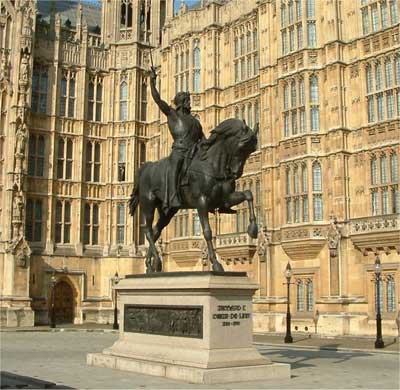
In the meantime, Richard seemed to take out his frustration over failing to overthrow his father on the territory of Gascony, and the increasing cruelty of his reign led to a severe and major revolt in 1179. The nobles of Aquitaine hoped to dethrone Richard, going so far as attempting to recruit his brothers against him, and stationed themselves inside a supposedly impregnable fortress. Naturally, Richard took the only logical option, and destroyed and sacked all the surrounding lands and towns – thereby isolating the revolting nobles from reinforcements or supplies.
With no way out and with an increasing sense of fear and hysteria, the nobles made a very poor choice: they left the safety of their castle and actually attempted to attack Richard outside of the fortress walls. Two days later, Richard had taken the fortress, subdued the rebels, and forced the remaining nobles to declare their loyalty to him. From that point on, Richard’s reputation as an extremely skilled military man commanded only grew.
And yet, he was still unsatisfied. Richard wanted the throne…
Want to read more?


Tomorrow: Richard challenges King Henry II and burns some Jews! (not cool!)
By: The Scribe on July, 2007
 While typically attributed to the French as a delicacy of their own invention, more recent studies have shown that frogs’ legs were indeed eaten with some measure of regularity in Western Europe around 5,000 years ago. At the hill fort site of Kutna Hora-Denemark in Czech Republic, the remains of 893 frog bones have presented evidence of frog consumption during the Neolithic period.
Since the bones were found in five different pits on the site, excavators were able to rule out various possibilities for the frogs’ presence, such as hibernation, accidental trapping, or death from natural predators. Another giveaway was the fact that the majority of the bones were hind legs – the part of the frog typically eaten, as it is the meatiest part of the creature. Due to the high percentage of hind legs and lower representation of complete skeletons – which would be typical in the case of natural trapping or spot for hibernation – the best explanation is that these pits contained food waste.
In addition, most of the frogs’ legs came from male frogs, suggesting that Neolithic Czechs hunted the animals purposely during March or April, the height of frog mating season; studies have shown that this is the time when frogs tend to congregate in large numbers, making them easier to trap.
The manner in which Stone Age humans ate their frogs’ legs is indeterminate, though it is likely that they skinned the legs and then ate the meat – and it is rather unlikely that frogs were considered a delicacy to the ancient Czechs. At the very least, the discovery proves that humans have eaten frogs for thousands of years, eliminating the notion of eating frogs’ legs as a purely French invention. Instead, it appears that the frog population during the Neolithic period in Czech Republic was at the right place in the right time – for the humans, that is.
Want to read more?


Tomorrow: Richard the Lionheart and Mel Gibson would get along very well.
By: The Scribe on July, 2007

Around 36 million years ago, giant penguins roamed the earth… or at least the tropics of Peru! Although scientists previously believed that penguins didn’t leave cold-weather areas like Antarctica and New Zealand for warmer areas until around 10 million years ago, the fossilized remains of two new penguin species have turned this theory completely around.
Both of the ancient penguins identified lived on the southern coast of Peru, not too far from each other – but the size of one of these penguins is where it really gets interesting. The Icadyptes salasi penguin stood around 5 feet tall, and had a long, protracted skull and an enormous spear-like beak around 7 inches long. Currently, the largest living penguins on earth are the Emperor penguins, who measure around 4 feet tall and have a much smaller beak.
The second species, Perudyptes devriesi, was around 2.5 or 3 feet tall – a size much closer to the living King penguins of today. Visible in the image below, both these penguin species stood much larger than the one species of penguin currently known to be living in Peru’s southern regions. The Icadyptes salasi also visibly dwarfs the second species whose fossils were found nearby!

As evidenced by the picture above, it is highly unusual for such large penguins to inhabit warm climates, but evidently both of these species thrived in the tropical environment! And although a 5 foot tall penguin would certainly be a force to reckon with, it is apparently only the third largest penguin known to have lived… evidently, 65 million years ago, penguins survived the mass extinction of the dinosaurs, living to grow into enormous sizes and later thrive off the coast of New Zealand at around 61 million years ago. Talk about a resilient creature…!
(Unfortunately, complete information on these even larger penguins is yet to be published…)
Want to read more?



Tomorrow: Fine dining in the stone age
Previous page | Next page
