Archive for 2007
By: The Scribe on July, 2007
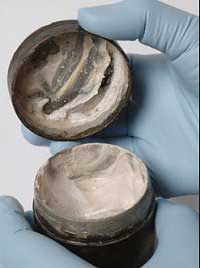 For anyone who thought women’s obsession with skin products was a thing of the modern age, a discovery at the site of a Roman temple on the banks of the River Thames in London has challenged the known history of women’s makeup. A 6 cm x 5cm tin container was found, and inside was a white cream with a very pungent odor. Although a product such as this should have decomposed and disappeared from the archaeological record long ago, the canister was of high enough quality and was closed tightly enough that it held its contents in stasis for nearly 2,000 years!
Found in a ditch with other ceramic pots – whose contents have long since disintegrated – excavators suspect that the ditch was a site of religious significance, where visitors to the temple would place offerings inside of pots or tins and leave them for the god. This cosmetic tin in particular was extremely well crafted, and must have been owned by someone of very high status as it would have been a valuable object at the time.
Roman women often put makeup on their faces before entering a temple, and it was not unusual for priests to have specific requirements concerning their adornment and cosmetic appearance. In the case of this tin, there were finger marks found on the lid once the container was opened – indicating that the last person to use this cream had taken the substance out from the lid, which is not an unusual practice for women today when opening a container of cream or facial product!
Tests on the Roman cosmetic revealed that the cream was made of refined cattle or sheep fat, starch, and tin oxide. A synthesized version of the cream, made by a team from the University of Bristol, revealed that the cream had a soft, pleasant texture when rubbed into the skin – although it felt greasy at first, the starch allowed the cream to create a smooth, powdery feel as it was applied. Intriguingly enough, starch is still used in modern facial and cosmetic products for this same reason! In addition, there did not appear to be any added perfume or scented components to the cream, making it a very ‘natural’ product.
Want to read more?


Tomorrow: Giant penguins, you don’t wanna miss this!

By: The Scribe on July, 2007

In the southwest of Germany, archaeologists from the University of Tubingen discovered an intact, carved woolly mammoth figurine from a location known as the Swabian Jura. Carbon dating placed the tiny figurine at 35,000 years old, placing its date of creation to around the same time as the first modern humans arrived in Europe.
Made of ivory, the mammoth is only 3.7cm long and weighs 7.5 grams – an incredible piece of skilled carving for such a small item. The mammoth is rather thin, with a pointed tail, arching trunk and thick, powerful legs. Decoration consists of six small incisions, and the soles of the feet have a delicately carved crosshatch pattern. The feet are also joined together at the bottom, suggesting that the figurine could have been strung onto a piece or rope or leather and worn as a charm.
Since mammoths became extinct around 4,000 years ago, this figurine is an interesting piece of insight into how humans viewed mammoths during the Ice Age – apparently they were familiar enough with the anatomy and cared enough for the creatures to depict them in art. Interestingly enough, parts of a lion figurine were also identified from the same deposit as the mammoth, though it is not as complete.
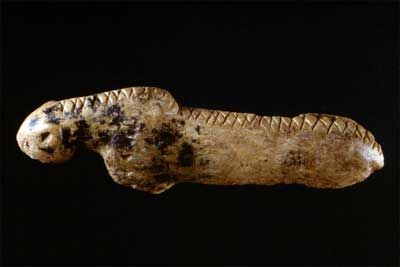
The lion figurine is 5.6cm long, and is depicted with an outstretched neck and head. Although the belly and legs are missing, the back of the animal is decorated with a crosshatch design that seems to represent fur. The muscular structure of the lion also seems to have been attempted, with defined leg joints that may be representative of the detailed limbs that have been lost.
These figurines are some of the most impressive examples currently known of figurative art from the Ice Age, and certainly help to understand the balance of life that existed between animals and humankind 35,000 years ago – not to mention the advanced level of human artistic skill!
Want to read more?


Tomorrow: Ancient Roman makeup
By: The Scribe on July, 2007
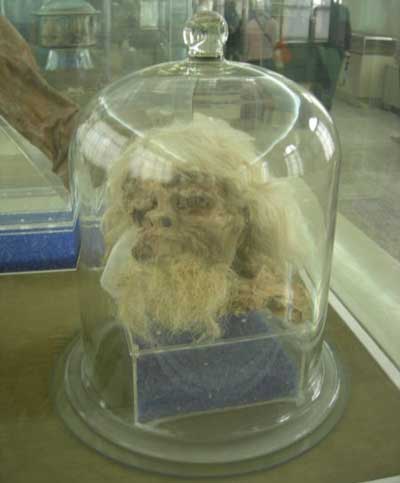
In 1993, a mummy was accidentally discovered in the Chehrabad salt mine in northwestern Iran, and since then, five additional ‘salt men’ have been found elsewhere inside the mine. Who they were and what they were doing there 1700 years ago has yet to be determined, however the unique preservation of the bodies is intriguing, and studies are ongoing in hopes to learn more about these ‘accidental’ mummies.
Salt Man 1: Found in 1993, this body had long hair, a gold earring and a beard, and was found with several items in his possession. These included a leather boot (with the leg inside), three iron knives, a sling and silver needle, pieces of leather rope, a walnut, some pieces of pottery and a grinding stone, and some textile fragments. The skull appears to have been fractured before death, but why he was there and exactly how he died has yet to be determined.
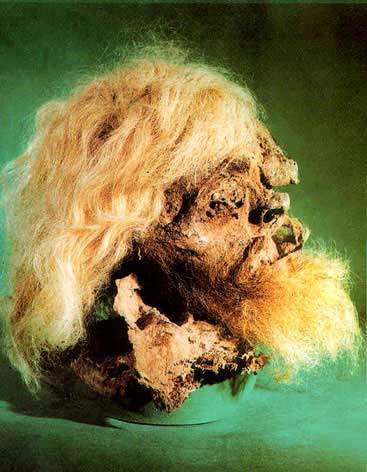
Salt Man 2: Found in 1994, the second salt man still had hair, a beard, nails, jaw, and hand and foot bones still intact. He was found with several pieces of clothing, a hand-woven rug with a unique pattern, and seems to have been around 35-40 years old at death. Interestingly, he was found only about 40 meters away from where the first salt man was discovered.
Salt Man 3: Found in 2005, the third salt man was located underneath a rock – which had unfortunately done a fair bit of damage to the skeleton. The body was found with a leather sack of salt, two pairs of shoes and two cow horns, and a clay tallow burner. According to excavators, the sack of salt was tightened as though he had just filled it and was probably about to leave the mine – whereupon he was crushed by the falling rock.
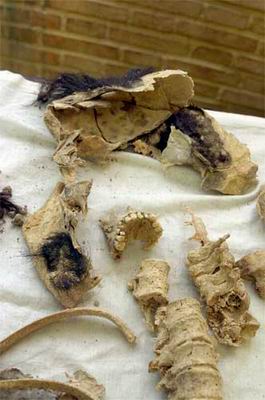
Salt Man 4: Found in 2005, the fourth salt man may actually be a salt woman! There were no traces on a beard on this mummy, and the height was significantly less than the previous mummies. This one was found with an iron knife inside a scabbard at the body’s waist, and two ceramic jugs with oil inside that might have been used for a lantern. The ‘man’ also wore two gold earrings, and was wearing a knee-length quilted garment and leggings that reached the thighs. Other speculation is that the body is of a young adult male, which could account for the size.
Salt Man 5: Found in late 2005, very little information has been revealed about this mummy.
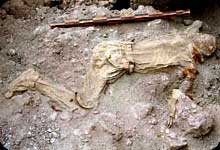 Salt Man 6: Found in 2007, this salt mummy has yet to be removed from the mine, as excavators are concerned about preservation. The mummy was revealed due to heavy rainfall in the area, and only about half the skull is currently visible underneath the large rock that probably caused his death. Since this salt man was only recently discovered, there is very little information available to the public at the current time.
Want to read more?


Tomorrow: 35000 year old mammoth carving
By: The Scribe on July, 2007

Around six million years ago, something rather drastic happened: the world lost an ocean. Fortunately, it’s returned since then, but during the Messinian Salinity Crisis, there was no Mediterranean Sea. Instead, there was a bit of a wading pool… or possibly even completely dry land.
During the Messinian period of the Miocene epoch, it seems that what is now known as the Strait of Gibraltar actually closed up, disallowing the flow of water from the Atlantic and resulting in the Mediterranean seabed simply evaporating – in some places up to 3 miles below sea level. As this occurred, there were also some cases of extreme erosion, creating several enormous canyons in and around the coastline, after which the evaporation procedure left behind deposits of evaporite mineral sediments.
It was during some routine geological work in the Mediterranean that geologists found evidence for this ancient desiccation of the sea, as they found mineral deposits that only form when large amounts of isolated salt water evaporate over time. Combined with layers of marine fossils, which indicats repeated periods of drying and flooding, as well as now submerged canyons that are cut into the sides of the sea basin, geologists realized there was enough evidence to confidently assert that, for some period of time, there was no Mediterranean sea.
During the period of dehydration, earth’s sea levels rose by 10 meters – if this happened today, many of the world’s major cities and landforms would be completely submerged! The global climate was also changed during this time, causing almost the entire Mediterranean basin to become a wasteland devoid of plant and animal life, and at 3 meters below sea level inside the basin, the temperature would have been almost 50 degrees hotter at the bottom than the temperature at sea level. With that kind of heat in and around the basin, added to the increased salinity of the area, the great civilizations of Egypt, Greece, Rome, and any other known Mediterranean culture could not have developed – unless the sea was refilled.
Eventually, the Strait of Gibraltar opened again, allowing water from the Atlantic to once again refill the Mediterranean basin, but not until the earth’s oceans had already been permanently altered by the loss – the freezing point of the ocean had been raised, and the average salinity of seawater significantly reduced. Even today, the salinity of the Mediterranean is higher than the North Atlantic, and thus it continues to have a higher rate of evaporation.
Want to read more?


Tomorrow: Iranian Salt Men.
Previous page | Next page
