Archive for 2007
By: The Scribe on June, 2007

In southeast Algeria, North Africa, there is a mountain range by the name of Tassili n’Ajjer in the Sahara that is composed of about 300 natural rock arches – and an incredible amount of rock paintings. These rock paintings date as far back as the Neolithic, and include depictions of horses, giraffes, crocodiles, and humans in the midst of cattle herding and hunting!

Some of the earliest pieces of rock art are actually less “paintings” and more “etchings”, as the artists seem to have sketched out images of local wildlife and human interactions, including some wildlife that now are extinct from the area.

In the picture here, there appear to be two female dancers, several big-horned rams, a camel with rider, and… a jellyfish!? Clearly, the jellyfish is rather out of place in this scene, but it attests to geological assertions that the Sahara was habitable for humans during the Neolithic period. In fact, much of the Sahara desert was covered in grasslands and lake basins, with giraffe, crocodiles, ostrich, hippos and antelopes living along the plains.

As usual, there are many theories as to why the Neolithic hunters chose to create so many paintings and etchings on Tassili’s rock arches. Some believe that it was a way to show appreciation to the gods, a symbolic representation of religious beliefs, while others have – perhaps not surprisingly – proposed that the humans in the pictures are actually aliens.

Whatever the reason may have been for creating the extensive rock art at Tassili, one thing certainly remains clear: humans have a penchant for artistic expression, regardless of the time or place. Perhaps they were merely creating art for art’s sake?
Want to read more?


Tomorrow: Crossbow history

By: The Scribe on June, 2007

What are these stones, and why do they seem to be named after canned preserves? The truth is, they’re actually named after the town of Jelling in Denmark, and currently rest in one of Jelling’s churchyards between two large, earthen burial mounds.
These enormous rune stones were carved in the 10th century, during the transition period between traditional Norse paganism and Denmark’s Christianization. Due to the lack of written history for most of Scandinavia’s past, the few inscriptions found on these stones are quite valuable for their historic worth.
The smaller – and older – of the two stones was set up by King Gorm the Old, the last ‘pagan’ king of Denmark, as a memorial for his wife, Queen Thyre. The larger stone was erected by Harold Bluetooth in memory of his own parents, King Gorm and Queen Thyre.
The Jelling stones have a strong association with the establishment of Denmark as a nation, a notion which may have originally come from the inscriptions. The older rune stone reads: “King Gorm made this monument in memory of Thyvre, his wife, Denmark’s salvation”.

The Bluetooth inscription says:
“King Haraldr ordered this monument made in memory of Gormr, his father, and in memory of Thyvre, his mother; that Haraldr who won for himself all of Denmark and Norway and made the Danes Christian.”
This stone also has an image of Christ on one side, and a picture of a lion wrapped in a serpent on the other.
Want to read more?


Tomorrow: More fascinating stuff!
By: The Scribe on June, 2007
*Note of Forewarning: This article deals with the topic of ancient sexuality, and may not be suitable for younger eyes.

One of the earliest gods of the ancient Egyptian pantheon was a god named Min, originally identified with Horus during the Predynastic period. First called the “Chief of Heaven” and associated with the sky, it was not long until Min became the primary fertility god of ancient Egypt.
In Egyptian art, Min was depicted wearing a tall feather crown, holding a flail in his right hand, and in his left hand… well, that’s where things start to get a bit awkward. Min is what can be called an ‘ithyphallic’ god, which means that he is shown in artwork with an uncovered and erect phallus – however, it should be noted that this kind of imagery was not necessarily seen as a sexual image by the Egyptians. Instead, it was a normal way of showing Min’s role as an agent of fertility.
In his role as a fertility god, Min was in charge of the rain, and each year at the beginning of the harvest season, there was a “Festival of the Departure of Min” – his statue would be taken out of his temple and brought into the fields, where participants would sing praises to Min and play games in the nude, hoping this would cause him to bless their harvest with his favor.
Playing games in the nude was not really a big deal to the ancient Egyptians – after all, in their hot and humid climate, serving women, dancers, and even farmers would work in the nude. Children typically didn’t even wear clothing at all until their official coming of age ceremonies.
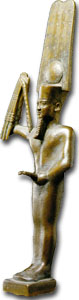 Where things get a bit awkward for modern historians, however, is in the discussion of Min’s symbols. All the ancient gods had their own symbols, since religion was such an integral part of daily life in ancient Egyptian culture. Min’s symbols were mostly typical of a fertility god: a white bull, a barbed arrow, and… lettuce?
Lettuce, an item not usually associated with fertility, was apparently a favorite food of Min. Why? According to the ancient Egyptian texts, this particular variety of lettuce was considered to be an aphrodisiac – and not only that, but this lettuce plant was tall, straight, and when pressed… it produced a white, milky sap substance that was, of course, easily associated with another male bodily fluid.
In fact, ancient Egyptians considered a lot of things to be aphrodisiacs… some varieties of onion were forbidden to celibate priests, in fear that they might desecrate themselves if they took a bite! Regardless, Min was an extremely important ancient Egyptian god, and well respected among the people. Although seeing a depiction of a man holding himself on the side of a building or as a public statue would have a completely different meaning today, to the Egyptians, this was perfectly normal and acceptable. In fact, if Min and his phallus weren’t around – they might not have anything to eat next harvest season.
Tomorrow: Tasty jelling stones!
By: The Scribe on June, 2007

Contrary to popular belief, it appears that women had a very high presence in Roman military forts, living and working alongside the men even in wartimes. Although previously it was thought that the forts were exclusive to men, a number of objects and their distribution pattern throughout a number of Roman forts have begun to dispel that notion!
A typical Roman soldier was not legally allowed to have a wife, although commanding officers frequently had wives and children. The belief was that the only women in a Roman fort would have been these officers’ wives, and that any other women inside the forts were prostitutes or concubines – women who didn’t live there on a regular basis. However, it is likely that this concept was reinforced by male military historians in the 19th century, who believed that women were merely a distraction and a disruption to military life.
In direct contract to this outdated belief, over 30,000 objects such as hairpins, beads, perfume bottles, and spindle wheels have been found all across the fort buildings and in along their streets. These kinds of artifacts show that women played roles as craftspeople, traders, and shopkeepers, in order to keep the small town-like economy of the forts running smoothly. After all, if the men were expected to receive military training and work for the army all day – who would be left to negotiate shipments of food supplies and mend clothing?
Another intriguing piece of the puzzle comes in the form of 11 babies, buried underneath the barracks of one of the forts. Historians who still believe the forts were segregated have tried to explain this phenomenon as coincidence, claiming the babies’ remains were accidentally brought into the fort in shipments of soil and then laid down in the barracks’ foundations unawares, however that is highly unlikely – a coincidence of 11 burials transported from elsewhere is rather impossible.
According to archaeologists, tombstone inscriptions in and around the Roman forts detail how many soldiers left property to women upon their deaths, which is a very significant act for any Roman male, and not something he would have done for a concubine or prostitute. These Roman soldiers were forming long-term relationships with women while inside the forts, and though they may not have legally been allowed to wed, it appears that women still lived and worked alongside the soldiers as common-law wives, taking care of the soldiers and bearing their children.
Want to read more?


Tomorrow: All hail the god of…. lettuce?
Previous page | Next page
