Archive for 2007
By: The Scribe on June, 2007
 According to recent studies, it appears that people in the Stone Age didn’t drink milk – at all. Although modern Europeans rely on milk as a part of their diet, ancient Europeans were only able to digest milk up until the end of childhood – after which their bodies simply weren’t able to process the lactose through their systems.
DNA analysis of Neolithic skeletons showed that there might be a reason why today’s Europeans have the highest percentage of lactose tolerance in the world, more precisely in Europeans from north and central regions. It turns out that before dairy farming, humans had no need to be able to digest milk during adulthood, and it was only after dairy animals were introduced in Europe around 8000 years ago that humans began to be able to drink milk without getting sick.
The truth is, most mammals lose the ability to produce lactase after childhood, an enzyme in the intestines that is needed to digest lactose – it turns out that humans who still produce lactase actually have genetic mutation that allows them to do so. Essentially, Neolithic humans were normal in their lactose intolerance – and most European and African humans are the weird ones with a genetic mutation that allows them to keep drinking milk.
Today, the only modern humans that can properly digest milk are those from European, African, and Middle Eastern descent – wherever prehistoric farming communities began to use dairy animals like cows, goats, and sheep in their farm habits. The mutation developed as milk began to be a regular staple in the diet, providing nutrients when other harvests were small, leaving the rest of the world behind in their ‘normalcy’.
So, although you may enjoy your ice cream today, if you’re ever given the opportunity to travel back in time to the Stone Age, leave the Yoplait behind – unless you really want to make your prehistoric ancestors ill.
Want to read more?


Tomorrow: Roman soldiers had to clear their rooms too.

By: The Scribe on June, 2007
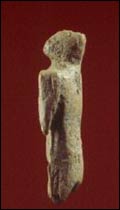 In a cave in southwestern Germany, three very small ivory figurines were discovered that seem to suggest Early Man wasn’t as artistically inept as once thought. These tiny figurines have been dated to around 30,000 years old, making them part of the period in time when scientists believe Neanderthals and Homo Sapiens lived as neighbors to each other.
All three of the figurines were less than 5 centimeters long, and are each very distinct forms: one is a bird that closely resembles a duck, one is a horse, and the third piece is a semi-human and semi-animal creature that appears to have the face of a lion and a man’s body.
Hailing from three additional sites not too far from Hohle Fels cave, where these figurines were discovered, archaeologists have a collection of 17 other artistic objects, including a rather complex musical pipe made of swan bone. These 20 objects in total, all from the Swabian Jura area in southwestern Germany, make the collection the “oldest body of figurative art in the world”, according to British archaeologist Anthony Sinclair.
These objects also refute the previously established notion that early humans were only capable of primitive cave paintings, and hadn’t yet developed their aesthetic senses. It was thought that early man slowly developed their skills over time, as they acquired better tools and materials – but looking at these figurines, clearly this evolutionary theory is now entirely unnecessary!
 The earliest objects considered to be art are still cave paintings, however, and these are located in underground chambers in the Ardeche region of France. At 29,000-34,000 years old, these charcoal drawings depict horses, rhinos, and a deer. There has been a small stone carving found in the Golan Heights near Israel, thought to be dated at around 200,000 years old, but this has yet to be confirmed – so for now, these tiny ivory figurines are our best link to the evident artistic proficiency of early humankind!
Want to read more?


Tomorrow: Milk – it does a body poor, apparently…
By: The Scribe on June, 2007
 According to some finds from the tomb of King Tutankhamun, the boy king greatly enjoyed a wee nip of red wine now and again…
Wine was actually a luxury item in ancient Egypt, with beer and mead being much more popular alcoholic beverages among the masses. And naturally, if the King enjoyed wine while he was alive, he was going to need something to drink in the afterlife! Although the containers for wine were readily identified from the tomb, the color and makeup of the wine was not known until scientists were able to carry out chemical analysis on the compounds left behind inside the containers.
It turns out that these wine pitchers had an acid residue inside, which Spanish scientists were able to identify as a substance typically left behind by red wine after it has dried up. In the extremely dry and sealed environment of King Tut’s tomb, the acid did not disintegrate or break down as it otherwise may have in a humid environment. Scientists took scrapings from the inside of the pitchers, and used techniques known as ‘liquid chromatography’ and ‘mass spectrometry’ to reveal the syringic acid left behind when a compound found in red wine called malvidin breaks down.
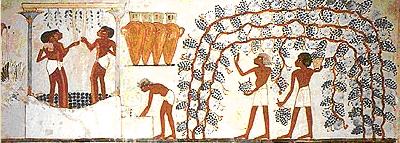
Tomb paintings have caused speculation for decades over whether ancient Egyptians drank red wine, since many of the wine-making images showed red or purple grapes being pressed, though until now there was no definitive proof for its production.
Much like today’s wine-bottles, the pitchers found in King Tutankhamun’s tomb also contained labels on the front, identifying the name of the wine, its year of production and harvest, the source of the wine, and even who grew the grapevines! For example, one jar held the label: “Year 5, Wine of the House-of-Tutankhamun Ruler-of-the-Southern-on, l.p.h. in the Western River. By the chief Vinter Khaa”.
In addition, these same techniques were used on some other containers from the tomb, allowing scientists to discover that the ancient drink Shedeh, once considered the most precious and sacred drink in Egypt, was made from grapes and not pomegranates, as it had previously been thought!
Want to read more?


Tomorrow: Welcome to the cave man art show!
By: The Scribe on June, 2007
 Macrinus was proclaimed emperor on 11 April 217 AD, only three days after the assassination of Caracalla, having managed to distance himself from the deed. Notably, Caracalla had died without a son, and since there was no obvious heir, Macrinus was able to take over the position with relative ease.
Although Macrinus was the first emperor to never have served in the senate, he needn’t have worried about gaining their support – the senate was happy to see Caracalla go and have his reign of terror ended! By reversing some of Caracalla’s harsh taxes and allowing political exiles to return to Rome, Macrinus’ acceptance as emperor was secure – or so he thought.
His first snag came when Julia Domna, mother of Caracalla, seemed to have gained some inkling of Macrinus’ role in her son’s death. She began to conspire with the military against Macrinus, however he soon caught wind of her dealings and ordered her to leave the city of Antioch, where the Severans had been ruling. In protest, she refused – and instead starved herself to death. It didn’t take long – she was already at an advanced stage of breast cancer.
Meanwhile, Macrinus was discovering that being emperor wasn’t as easy as he had originally thought. He was very reluctant to engage in military conflict, instead choosing conciliation and treaties with enemies. While this was very good for the area, since it promoted peace and a significantly lower loss of life, it also meant that the soldiers were getting restless – and when they finally did engage in battle against the Parthians, a historically inferior enemy, the Roman army suffered humiliating defeat.
 Even worse, Macrinus had failed to pay a visit to Rome after becoming emperor, thereby neglecting to gain the support of the empire’s main city. The failure of his own prefect to restore the city after several summer floods and fires also put a harsh damper on Rome’s appreciation of their new leader.
To make matters worse, after Julia Domna’s death, her sister Julia Maesa decided she’d had enough of her family being deposed. Though all the Severan women were evicted from the imperial palace, they returned to their original home in Syria and began to plot against Macrinus. Using their influence, they proclaimed Julia Maesa’s grandson Elagabalus the “true successor” of Caracalla.
Woman are good at spreading rumors, and in this case, it helped their cause – they managed to spread word across the Roman empire that Elagabalus was the illegitimate son of Caracalla, born of a union between first cousins. That was good enough for the malcontented army, and they proclaimed him the true emperor at a military camp on 16 May 218 AD. Less than a month later, although he had desperately attempted to regain support by increasing military pay and handing out a bonus, the Roman legions deserted him to follow Elagabalus, and the army marched against him on 8 June 218 AD. Macrinus was soundly defeated, and although he attempted to flee, he was soon captured and executed – with his own 9-year-old son’s execution soon to follow.
The moral of the story? Looking at both Caracalla and Macrinus’ reigns, it would seem that if you’re the Emperor of Rome, keep the army happy above all else – they hold the power to make or break your reign, even if you’re a sadistic terror to the rest of the Roman masses.
Want to read more?


Tomorrow: King Tut and his love of red wine
Previous page | Next page
