Archive for 2007
By: The Scribe on June, 2007
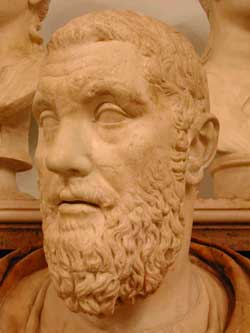 As prefect of the Praetorian Guard – the personal bodyguards of the emperor – Marcus Opellius Macrinus was privy to many of the goings on in the palace, whether he should have been or not. Having grown up in a middle-class family in Caesarea, Macrinus had somehow managed to gain the opportunity to study law and finance, and would later move to Rome to make a name for himself as a lawyer.
With his high reputation, the Roman emperor Caracalla appointed Macrinus prefect of the Praetorian Guard in 212 AD, a position that made Macrinus second in command to the emperor, and head of the only military body allowed inside Rome’s boundaries. Unfortunately for Rome, Caracalla didn’t seem to care for petty things like ruling the Empire, and instead spent a great deal of time in the field with the army, leaving Macrinus to deal with all of what should have been the emperor’s correspondence.
This, of course, is not the most intelligent way to rule an empire, especially when you’ve sent off a request by mail to have the head of the Praetorian Guard – the same man who you’ve personally assigned to read and reply to all your mail – arrested and executed. Naturally, Macrinus intercepted this little piece of correspondence, and decided he had better do something to save his own skin.
Why Caracalla had decided to kill off his most trusted ally in Rome is still a bit of a mystery, though the traditional explanation is that Macrinus received a prophesy that he would depose and succeed the emperor. Although he tried to keep it quiet for the sake of self-preservation – Caracalla was widely known for his merciless executions of rivals – it would have been relatively difficult to quash all the rumors that undoubtedly circulated in the palace. Well aware of Carcalla’s murderous streak, Macrinus decided that the only way to save himself was… to kill the emperor first.

In the spring of 217 AD, Caracalla went east with the Roman army, his Praetorian Guard alongside him. Macrinus had formulated his plan, making select choices of other guards to include in the plot. It was April 8th when the emperor and his guards made their way to visit a Temple of Luna in the area – and while in the temple, one of the Praetorian Guards named Martialis stabbed the emperor with a dagger, grateful for the opportunity, since he held a personal grudge against Caracalla: he’d been passed over for a promotion he had thought he deserved.
Of course, the only way to ensure the plot fully succeeded was to kill Martialis, and it was only a matter of days before Macrinus had proclaimed himself emperor. In order to distance himself from the assassination – since the Roman army had rather liked Caracalla, probably because of the amount of time he’d spent with them – Macrinus immediately proclaimed Caracalla a god, which earned himself the army’s support.
Want to read more?


Tomorrow: Part 2, the Emperor Assassin

By: The Scribe on June, 2007
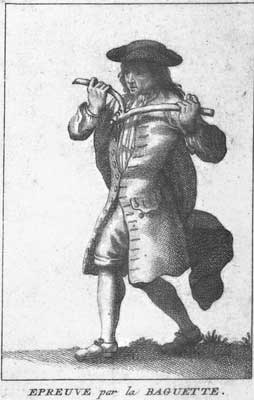 Dowsing, a practice wherein an individual divines the location of water and other objects, has been a part of human culture since early prehistory. Cave drawings and Egyptian hieroglyphs attest to this ancient practice; however there is still some significant skepticism over whether or not dowsing is a legitimate scientific practice. Generally purported to be a practice of superstitious spiritualists, some researchers do believe there is evidence to support the claims of some dowsers.
What was its original purpose? It is likely that dowsing was originally used to divine the will of the gods, most particularly in the areas of telling the future and determining guilt in legal trials. Apart from the ancient images of people holding ‘divining rods’, 15th century Germany is the most probable candidate for the more ‘modern’ aspects of dowsing.
Dowsing in 15th century Germany was mainly used to find underground sources of metal, and the technique was spread through Europe when German miners traveled to England to work in the country’s coal mines. As readily as the practice may have been accepted at first, it didn’t take long before the church caught wind of this ‘fortune-telling’, and in 1659, the Jesuits declared dowsing a satanic practice.
During the 16th century, practicing dowsers were labeled as ‘water witches’, and even being suspected of dowsing could be cause for arrest and trial as a heretic or for practicing witchcraft. In 1701, the Inquisition ceased using a dowsing rod during their guilt trials, though the practice never completely stopped among the general public. Practiced in secret, dowsers continued to keep their ‘abilities’ alive until the Victorian era, when dowsing became a popular practice among the high-born of society.

Victorian society had a fascination with spirituality and mysticism, and dowsing again grew more widespread – popping up everywhere from parlor games to mining companies.
In more recent years, several scientific studies have been carried out in an attempt to determine whether dowsing is simply the result of chance, or whether those claiming dowsing abilities can actually sense the changes in Earth’s magnetic field – thereby leading them to natural underground sources such as water and metal. Dowsers have used everything from wooden Y-shaped rods, to brass L rods, to bent coat hangers, to crystal pendulums for their practice. Often, dowsers will pose questions of their divining device, and depending on the sway of the pendulum or shift in magnetic fields, the dowser will interpret the answer.
Although most scientists still remain unconvinced at the authenticity of dowsing claims, the practice continues into modern day, mainly as a water-locating trend. Notably, this is a phenomenon that has survived in human culture for almost 10,000 years – and whether or not any dowsing claims are true, it is certainly worth consideration as an ancient practice that has been passed down with some level of sincerity throughout the millennia
Want to read more?




Tomorrow: The Assassin King!
By: The Scribe on June, 2007

Sometime between 1800 and 1200 BC, a group of settlers arrived on the island of Sardinia in the Mediterranean, and proceeded to build over 30,000 stone towers across the landscape. Although only around 8,000 of these structures survive to date, it appears that the network of towers – called Nuraghe – was constructed so that each tower had a line of visibility to the next, forming a strategic chain of visual communication.
Nuraghe were built in a beehive or truncated cone shape, and relied on the weight of the stones – instead of a typical building foundation – to keep the structures in place. Standing up to 20 meters in height, it remains unknown as to what exactly these structures were used for. Suggestions have been made, such as: chieftain dwellings, religious structures, military strongholds, or place of assembly for local governors. While all ideas are certainly credible, it should be considered that the Nuraghe are all placed in strategic locations across the island – not only did each tower have visual contact with its neighbor, but they were also placed along important passages on the island.
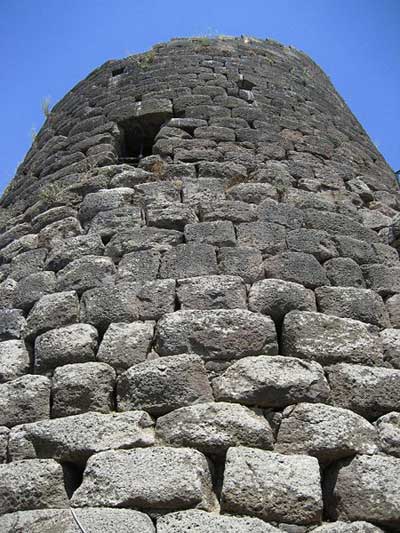
The most important Nuraghe in Sardinia is at the site of Barumini, where an entire complex was constructed about 1500 BC around a three-story tower. Now considered a UNESCO World Heritage Site, Barumini was once a fortified village with a number of smaller Nuraghe centered around the three-story one, containing many corridors as well as a cache of small, bronze statues.
Although little is known about the so-called “Nuragici people”, they left behind some other small pieces of art, such as stone carvings and statues of female goddesses, and bronze representations of chieftains, hunting men, warriors and animals.
It is also speculated that the Nuragici had contact with the Mycenaean and Phoenician cultures during the height of their cultural development, which may have had some influence on Nuragici art and architecture. The Mycenaeans, renowned for their megalithic defensive architecture, may have provided inspiration for the strategically located, giant Nuraghe towers, while Phoenician skill at bronzeworking may have influenced the Nuragici’s use of bronze for their artistic statues.
Want to read more?


Tomorrow: Down with Dowsing
By: The Scribe on June, 2007

Archaeologists working in the Shimonogo ruins of Western Japan’s Moriyama, about 200 miles from Tokyo, uncovered what is believed to be a piece of the world’s oldest melon! Radiocarbon analysis dated the melon to around 2,100 years old, making it the oldest piece of melon found with fruit on the rind – a very rare find.
It is thought that the melon flesh was preserved due to where the fruit was located in the ruins, which was about one meter underground in a moisture-rich soil that seems to have acted like a vacuum-sealing. Since it was not exposed to the air, the fruit was kept in a soil layer unsupportive to the micro-organisms that typically break down organic remains.
The piece of ancient fruit is about 10.5 centimeters long, and the rind has been discolored to a deep brown. Chemical analysis has also identified the species of melon as native to Africa, suggesting that it probably made its way to Japan via India and Middle Eastern traders. Previous to this find, the oldest melon piece in the world was a found in China and dated to around the 4th century AD.
The Shimonogo settlement was surrounded by moats during Japan’s Yayoi period, which spanned around 300 BC – 300 AD. This could account for the kind of soil in the area and the prime conditions for preservation. While this find is rather limited in its practical use, it can certainly help to shed some light on the potential trade relationships between Japan and the Middle East during this period in history – as well as provide a bit of insight into the dining habits of the settlement’s people.
Want to read more?


Tomorrow: Sardinia’s Nuraghe (gehzunteit?)
Previous page | Next page
