Archive for 2007
By: The Scribe on June, 2007

A specialist by the name of David Johnson has done some work of his own on the Nazca lines, and has come up with a theory that is considered somewhat more plausible than some of the previously suggested ideas. Because the region is one of the driest in the world, the Nazca people actually created known underground waterways that made use of some of the excellent reservoirs located below the desert surface.
Through a somewhat controversial method known as dowsing, Johnson tracked the water tunnels, in order to determine whether the areas of the ground around the images contain water or not, and it is his belief that the pictures lie in correlation to water sources. The images were thus created as large-scale maps so that inhabitants of the area could find water, no matter where in the desert they were located. The glyphs themselves were then depictions of water gods, or religious figures that the Nazcans believed to represent each water source.
In 1985, archaeologist Johan Reinhard published a report using archaeological, topographical, ethnographic and historical data to demonstrate that Nazca religion and ritual was greatly centered around the worship of mountains and water sources. It was his belief that the figures were a part of Nazcan religious practices involving crop fertility and water provision, wherein the Nazca lines were used as sacred paths that led to places where each deity could be worshiped. The gods could see the images on the ground that honored them, and thus act benevolently toward the people, knowing they were being venerated. The various figures were thus symbolic of the gods and their attributes, though the specific meaning of each image has yet to be deciphered.
Reinhard’s theory built on the work of Johnson, and has since become the most accepted explanation for the Nazca lines, due to the ethnographic information that compared what archaeologists know of the ancient Nazca people with the modern religious habits and practices of some Andean cultures.

Although Reinhard’s theory is widely understood as the most logical explanation for the Nazca lines, they still present a fascinating visual wonder along the Peruvian coast, and will continue to serve as objects of wonder about this ancient culture and their curious but fascinating drawings on the desert floor.
Want to read more?


Tomorrow: Who’s up for a 2000 year old bowl of fruit salad?

By: The Scribe on June, 2007

Why did the Nazca people make these pictures? It’s a good question, and one that actually hasn’t received a satisfactory answer yet. But for the sake of entertainment, here’s a list of the various theories that have popped up over the past few decades since the lines’ discovery. Who knows…maybe one of these ideas will spark a conspiracy theory of your own!
Maria Reiche (1903-1998): a German mathematician and archaeologist, Reiche believed the Nazca lines were an astronomical calendar that determined planetary events like solstices and when important stars rose. She associated certain drawings with known constellations, and thought the lines could be used as observatories. She completed a lot of work and managed to have the lines declared a World Heritage Site in 1995, though she was never able to prove her own theories.
Erich von Daniken (born 1935): Daniken was the first to suggest seriously that the geometric Nazca lines were built by alien astronauts as a landing strip for their UFOs. His 1968 book, Arrival of the Gods, made the claim that the soft soil and layer of desert rocks were blown away by the spaceships’ rocket propulsion systems, so they left, dissatisfied with the landing space. The people of the area then apparently tried to call the aliens back by drawing their own images in the desert.

Simone Waisbard: Waisbard was also convinced of the lines’ purpose as an astronomical calendar, though she added the idea that the lines were part of a system that could be used to measure precipitation in the area. She thought that some of the figures, such as the seabirds, had a place in Nazcan meteorological prophesy. She also believed that the geometric figures were places for animals to be kept before sacrifice or places for ritual ceremonies of different Nazca clans.
Robert Bast: an Australian author, Bast has suggested that all the plant, animal and human figures lying together randomly on the ground appear like corpses after a catastrophic flood. In his book Memory of the Deluge, Bast explains that the Nazca plateau might be a memorial place of the ‘Big Flood’.
Jim Woodmann: making a balloon out of Peruvian cotton and a reed basket, Woodmann created himself what he thought could be a replica ‘ancient hot-air balloon’, believing this method could have been used to direct the creation of the images… though he didn’t quite explain how the directions could have been communicated to those on the ground. The test flight was nearly fatal for Woodmann, however – without proper equipment, his balloon began to rise too quickly, and both he and his co-pilot barely jumped to safety before the balloon flew off into the desert, uncontrolled!
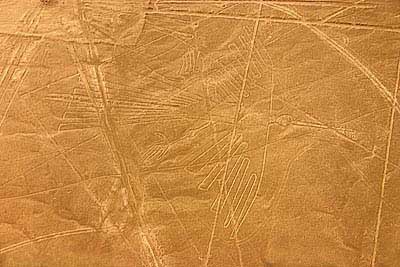
These are just a few of the theories on the Nazca lines that have developed over the decades… but what do the more recent – and less controversial – archaeologists have to say on the matter?
…to be continued…
Want to read more?

Tomorrow: Okay, probably not really Aliens…
By: The Scribe on June, 2007
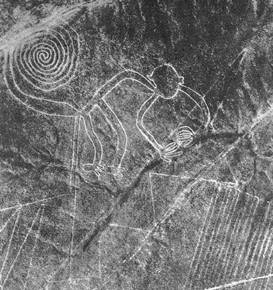 The Nazca desert stretches for about 80 kilometers along the Pampas de Jumana in Peru, and contains some incredible images that can only be clearly seen and identified when viewed from high in the air. These ‘Nazca lines’ cover this area of desert: there are several hundred very simple geometric patterns and lines across the plateau, and over 70 insect, animal, and human figures with curving lines. Some of the largest figures are around 270 meters long… and have spawned some interesting theories as to their purpose and methods of creation.
It appears that the Nazca lines were created by removing the iron-oxide coated pebbles from the desert surface, causing a contrast between the pebbles and the lightly colored ground underneath. The drawings have actually managed to survive throughout the centuries due to the very little rainfall in the region – only about 20 minutes of rain every year – making this one of the driest places on Earth. With little rain to displace the pebbles, and the extremely flat-lying ground to avoid wind displacement, the lines have remained virtually untouched since their original creation.

Possibly the most pressing questions about these drawings are: why did the Nazca make them, and how did they manage to create such elaborate images if they could only be seen from the air? For anyone on the ground, the drawings simply appear to be random lines of light-colored earth, and nothing lower than several hundred feet in their air would allow someone to even begin to see a complete design on the ground, due to their extensive size.
All ‘whys’ aside, the ‘how’ has seems to have reached an acceptable conclusion: using some simple tools and early surveying equipment, the Nazca planned out their designs and then implemented them using wooden stakes and string lines. Some ceramic pieces found on the desert surface nearby suggest that these were used to displace or collect the gravel being moved – ceramic pottery can be quite durable, though also easily disposed of and replaced when broken. With some careful measuring and basic mapping skills, it has been suggested that a small team of people could create one of the larger figures in a matter of days.
That takes care of the ‘how’… but what about the ‘why’?
…to be continued…
Want to read more?
Tomorrow: It was aliens…obviously!
By: The Scribe on June, 2007
 The Nazca culture of ancient Peru is perhaps best known for its legacy of mysterious, giant drawings left behind in the Peruvian deserts. However, before delving into the history and lore of these incredible creations, it’s worthwhile taking a look into who the Nazca people were in the first place, and what may have prompted them to create such fantastic artwork in the middle of the desert.
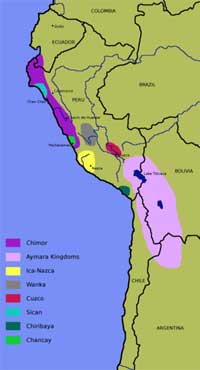
The Nazca people lived in the Nazca region, as shown in yellow on the map above, between 300 BC and 800 AD, and based their culture around a capital city known as Cahuachi. The population of the city was relatively small, however it was quite popular as a religious pilgrimage destination, visited primarily for ceremonial events and celebrations. It was occupied between 1-500 AD, and its situation in the landscape overlooked many of the Nazca desert lines.
Interestingly enough, Cahuachi also contains around 40 mounds with mudbrick or ‘adobe’ structures on top, which have been under excavation for the past few decades – with many more decades of work still to come. Some of the most interesting things learned about the Nazca culture through excavation was their skill at making clothing, as well as their impressive pottery vessels.
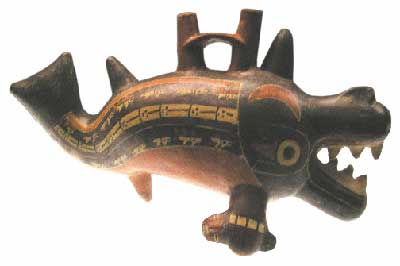
Consider this: one thousand years before any other Peruvian cultures on the north coast, the Nazca learned how to make clothes out of llama and alpaca wool. In fact, most of the designs found on Nazca pottery seem to have originated from textile patterns, suggesting that the Nazca were a highly creative people with vivid imaginations.
There were several distinct artistic phases to Nazca pottery, and the first began with simple designs of fruit, plants, animals and people, as well as some mythical scenes. As time passed, the drawings became more realistic, and the next phase saw an increase in background designs, humans, and bodyless demons. This was followed by phases of militaristic pottery, vessels with elite portraiture, and eventually images of disjointed figures, with the more familiar style of South American iconography that is still very difficult to interpret.
The disembodied heads sometimes shown on Nazca pottery were initially suspected to be renditions of ‘trophy’ heads, and this has since been archaeologically confirmed by several real caches of severed and ritually prepared heads in Cahuachi! Less gruesome animals commonly shown on Nazca pottery were whales, sharks, fish, snakes, hummingbirds, and plants like cacti and Peruvian flowers.
So, if they had such an established ritual culture already – as suggested through the severed heads from their capital city – why did the Nazca create giant drawings in the desert?
…to be continued…
Want to read more?


Tomorrow: More about the Nazca
Previous page | Next page
