Archive for 2007
By: The Scribe on April, 2007
 Son of King Philip II of Spain and Maria Manuela of Portugal, Don Carlos was born in the Spanish city of Valladolid; deformed from birth, his mother died shortly after the delivery. His shoulders and legs were of uneven height, and he was prone to feverish illnesses. It is thought that Don Carlos’ physical and eventual mental deformities were possibly the result of incestuous marriages in the Portuguese Royal Family – he had only 4 great-grandparents instead of the regular 8, and only 6 great-great-grandparents instead of the usual 16.
As he grew, Don Carlos began to show increasing signs of mental disabilities. Even as a boy, Don Carlos was rumored to have bitten the breasts of his wet-nurses, nearly killing three of them from the resulting wound. At the age of 9, he was known to torture other female children, as well as servants and animals. He quite enjoyed roasting small animals alive, particularly rabbits, and once bit off the head of a snake. On another occasion, he entered the royal stables and severely mutilated the horses to the point that twenty horses had to be put down.
In 1562, Don Carlos met with an accident – possibly while chasing women around, though this has never been confirmed – that caused a severe head wound. The wound soon developed a bacterial infection, swelling his head and causing a temporary blindness. Doctors even drilled a hole in his head, a procedure known as trephination, in an attempt to relieve the pressure. In desperation, Philip II called the local Franciscan monks to bring a holy relic to his son’s bedside – so they brought the remains of a holy man who had died one hundred years ago and placed the mummy in bed with the prince. Miraculously, Don Carlos’ health seemingly began to stabilize.
Though the prince regained some of his mobility, his ability to produce heirs was questionable. In fact, the only thing the prince seemed to enjoy doing with women was whipping them; record books detail the money paid to fathers of girls who were “beaten by order of his Highness.” His derangement only seemed to increase with time – on one occasion, a shoemaker presented boots to Don Carlos that he didn’t particularly approve of, so the prince forced the shoemaker to cut up the boots and eat them.
After a failed attempt to incite a plot against his father, Don Carlos was locked in solitary confinement in the tower of Arevalo castle, where his own ancestor Isabel of Portugal – also considered “mad” – had been locked up and died around a century before. In confinement, Don Carlos behaved even more irregularly, pouring ice water on the floor and lying naked it in, vomiting incessantly, or drinking over 10 litres of water with his meals. When given the last sacrament after a particularly violent bout of illness, he even vomited the communal host. On July 24th, 1568, Don Carlos was pronounced dead – rumored to have been poisoned by his own father. The public was told that the prince had “died of his own excesses”.
Want to read more?


Tomorrow: Another week long series: The burnt city!

By: The Scribe on April, 2007
 In the 7th century BC, Greek colonists arrived on the Libyan coast and established the city of Cyrene. The Greek scientist Theophrastus (ca. 370-288 BC) wrote a detailed account of the expedition, explaining how not long after the colonists’ arrival, they discovered a plant called ‘silphium’. The city would soon come to depend on this plant for its high trade value, and its existence was crucial for the Cyrenian economy.
Generally considered to be an extinct “giant fennel”, the plant was valued both for its use in seasoning foods, as well as for its unique ability to affect cures for a number of ailments. Cooking aside, sap from the silphium plant was used to treat everything from coughs, fever, indigestion, to sore throat, aches, warts, and more. What it was most valued for, however, was its use as an herbal contraceptive.
It is thought that the plant may have been active in the prevention or termination of pregnancy. The Roman physician Soranus, also known as the most famous gynecologist of the ancient world, wrote in a medical treatise that women should drink about the size of a chick pea’s worth of silphium juice, mixed with water, once a month. He claimed that this “not only prevents conception, but also destroys anything existing.”
While silphium was eventually harvested to extinction, there were also several other plants in antiquity purported to have prophylactic abilities: Queen Anne’s lace blocked a woman’s internal cycle, while even in modern times, pennyroyal contains a substance that can terminate both human and animal pregnancies.
Although much of the information from antiquity concerning contraceptive herbs and medicinal remedies for pregnancies has been lost, one thing remains clear: women in and around ancient Greece and Rome definitely had a great deal of control over their reproductive decisions.
Want to read more?


Tomorrow: Woman beating prince.
By: The Scribe on April, 2007

The first inhabitants of Malta probably arrived around 5200 BC from Sicily, and originally fished, farmed, and hunted for their survival. As their society progressed, buildings and culture became more and more complex, eventually arriving at the time now known as the ‘Temple Period’ on Malta. Built around 3600 BC, the prehistoric Maltese temples are the oldest free-standing stone structures in the world – older than the Pyramids or Stonehenge.
Although it is not known why the Maltese people built so many large temples, most of the temples share the same form – five semi-circular rooms connected at the centre – and so it appears that they were related in some way. One suggestion has been that these rooms might have represented the head, arms, and legs of a deity, since the most common finds in these temples were “fat lady” statues. Images of large women are often celebrated in ancient cultures as symbols of fertility.

Finds from the temples indicate that the buildings were used for sacrificing animals, mainly goat, sheep, and ram. Several altars were found in temple rooms, though the rooms themselves were only large enough to hold several individuals.
Unfortunately, the people of ancient Malta did not leave behind any writing or inscriptions that may have provided more insight into the culture and its temples. Instead, around 2500 BC, the Temple period came to a sudden and inexplicable end – the entire culture seems to have vanished.

New people such as the Phoenicians would later colonize the island, and ownership disputes would be ongoing until 1964, when Malta was finally granted status as an independent nation.
Want to read more?


Tomorrow: Ancient “Morning-After” pill?
By: The Scribe on April, 2007
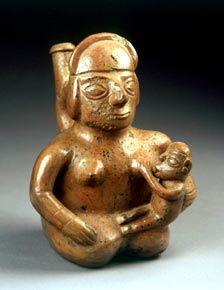 The Moche civilization occupied the coastline northern Peru for around 700 years, building large stepped platforms and creating elaborately painted murals depicting their gruesome traditions of ritual warfare. However, the Moche are best known for their advanced agricultural knowledge and complex ceramics and pottery.
Moche pottery is one of the most diverse types of pottery known from an ancient civilization, and many of their pieces were mass produced in molds. Despite this, there was a great variety in Moche pottery, which depicted everything the culture seemingly found important: vegetables, animals & birds, war, metalworking, weaving, and of course, sex. There were also many “portrait vases”, which were pottery vessels made to resemble a person’s head. The faces also depict a variety of emotions, such as anger, laughter, or deep thought.
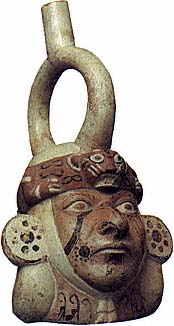
The pottery was made by applying clay figures onto the pottery before it dried (and thus before firing), a technique not frequently used due to the risk of explosion in the kiln – if there were any air pockets left between the pot and figure joints. The color of the pottery was fairly simple as well, mainly black, red, white, and cream.
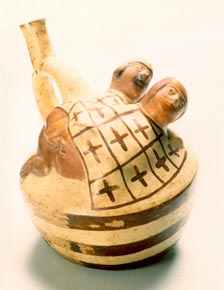
The erotic pottery of the Moche is highly varied, showing a great deal of creativity reminiscent of the Hindu Kama Sutra. What has fascinated scholars is the limited number of depictions of standard procreative copulation on these vessels; this is only ever depicted when the male is shown wearing ceremonial dress, the female’s hair is parted into two braids ending in snake’s heads, and the act is occurring within a ceremonial building with additional figures standing around to watch. While the exact meaning of such a depiction has not yet been established, it is clear that the Moche were not squeamish about their sexuality.

The Museo Larco in Lima, Peru, holds a large number of Moche pottery and artifacts, including a gallery of erotic pottery. Some images from this gallery are available online here.
Tomorrow: The Mega Temples of Malta
Previous page | Next page
