Archive for 2007
By: The Scribe on April, 2007
 In 1584, at the age of 27, Feodor I was crowned Tsar of Russia. Son of Ivan IV “the Terrible”, Feodor looked nothing like his physically imposing father – in fact, he was small, with short arms and a squat neck. Quiet and passive, Feodor was believed to have been mentally retarded at birth, with little intelligence and a dispassion for ruling the country.
His vapid eyes and naïve gaze certainly contributed to this perception, and even his own father did not believe his son capable of ruling. Instead, he organized a small advisory council to assist Feodor I, which included his wife and brother-in law. By the end of the year 1587, his brother-in-law Boris Godunov was the only member of the council that remained due to internal struggles for power; because of this, he took over the position of acting Tsar in place of the disinterested Feodor.
Many Russians believed that “feeble-mindedness” was indicative of religious wisdom, and ascribed Feodor’s mental incapacitation to spiritual superiority. Oddly enough, because of this, the people he refused to rule still loved and respected him greatly.
Feodor spent much of his time in solitary prayer, though he took special interest in traveling across the country to visit churches and ring their bells. This resulted in the nickname “Bellringer”, and was originally intended to be a term of endearment.
The only child of Feodor and his wife died in infancy, and it was this failure to procreate that would bring an end to his family’s dynasty. Feodor did have a half-brother named Dmitri, however this child was considered illegitimate and therefore unfit to rule – the Russian Orthodox Church recognized only a man’s first three marriages, and Dmitri had been the offspring of Ivan IV the Terrible’s eighth wife. Feodor genuinely cared for his half-brother, however he did not make any attempt to change the established laws of the church.
In 1591, Dmitri was found dead at the age of ten. The official verdict was that the child had cut his own throat while having an epileptic seizure, and no one questioned the remarkable nature of such an accusation – except for the child’s mother, who claimed her son was murdered by members of Godunov’s court as an insurance policy against any possible competitors for the throne, even though illegitimate children had no real claim to it. Evidently, Feodor never questioned whether his brother-in-law had any involvement with Dmitri’s death… and in 1598, after a bout of illness, he passed away in his bed.
Want to read more?


Tomorrow: Pottery Porno!

By: The Scribe on April, 2007
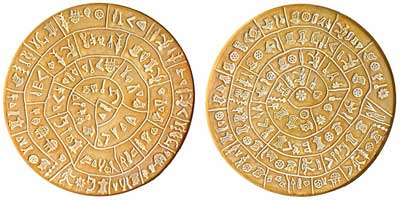
Found in 1908 on the island of Crete, the Phaistos disc remains one of the most disputed – and most mysterious – archaeological artifacts of the 20th century. Its purpose, meaning, and place of manufacture are still under debate, while the disc itself still cannot be translated. It was discovered intact at the site of Phaistos, a Minoan palace that may have collapsed due to an earthquake in the region.
The symbols on the disc bear some resemblance to Linear A and Linear B, causing many amateur archaeologists to attempt to decipher its meaning. However, unless some comparative examples turn up, there simply does not appear to be enough context available to decipher the text. In the past, almost everything has been speculated as potential content: a list of prayers; an epic story; a military announcement; a board game; even a geometric theorem.
The inscription itself was made by pressing seals into the soft clay of the disc, which was then baked in an extremely hot oven – probably a pottery kiln. There are 241 figures on the disc, and the symbols are of a very wide variety: fish, birds, human heads, a shield, a boat, plants, and many more. The inscription probably reads from the outside in, the text starting at the outer edge of the disc and spiraling inward. This is evident from the corrections made by the scribe while composing the text, which are still visible!
Want to read more?


Tomorrow: 4000 year old perfume
By: The Scribe on April, 2007
 Around 1850 BC, a violent earthquake shook the southern site of Pyrgos on Cyprus, blanketing the area in earth and debris and perfectly preserving the remains of the rooms underneath. Archaeologists working at the site discovered what they believe to be a 3,995 square mile factory devoted to perfume production.
The size of this factory suggests that perfume was produced on an industrial scale; at least 60 mixing bowls, perfume bottles, funnels, and other implements were preserved in perfect condition. Residues gathered from the vessels – over 4000 years old – were analyzed, and it is known that the perfumes were scented with lavender, bay, rosemary, pine, or coriander extracts, and kept in small alabaster bottles.
Greek mythological tradition places the island of Cyprus as the birthplace of the love goddess Aphrodite, who often wore perfumes to enhance her desirability.
Want to read more?


Tomorrow: “The Bellringer” of Russia
By: The Scribe on April, 2007
![wall painting, Pompeii, ca. 70 AD]](/images/fruitbasket2.jpg "wall painting, Pompeii, ca. 70 AD]") One of the common “facts” taught about ancient Rome, both by public schools and uninformed historians, is that Roman houses contained a special room called a vomitorium, which was set aside for the purpose of purging one’s insides from a recent meal… in order to make room to eat more. The word itself comes from the Latin word vomere, which means “to vomit”.
One of the common “facts” taught about ancient Rome, both by public schools and uninformed historians, is that Roman houses contained a special room called a vomitorium, which was set aside for the purpose of purging one’s insides from a recent meal… in order to make room to eat more. The word itself comes from the Latin word vomere, which means “to vomit”.
Fortunately for the Romans, this is simply a misconception. Vomiting, for those who have experienced such a phenomenon in the past, is typically not an event that any human wishes to endure any more than absolutely necessary – say, during illness – and thus it would be absolute falsity to claim that the entire Roman upper class was semi-bulimic.
Ancient Rome did have vomitorioums, however, but their purpose was entirely unrelated to the consumption of food! Vomitorium was the proper name for an architectural feature of ancient Roman theatres: it was a wide corridor situated below or behind a tier of seats, through which thousands of spectators could file in and out of quickly (or “spew out of”, to keep the nuance of the Latin word).

The vomitoria of the Colosseum in Rome were reportedly able to allow 50,000 people to enter and be seated within 15 minutes; presumably they would be able to exit in an equally rapid manner, thus earning the passageway its name. The misconception of meaning for this term probably came about in the early 1900s, when historians were writing history texts without a correct understanding of Latin… which meant that they could not read texts of the ancient authors… who, when writing about eating excessively and illness afterward, never once mentioned the existence of special room in which one could throw up.
Want to read more?


Tomorrow: A Minoan mystery!
Previous page | Next page
