Archive for 2007
By: The Scribe on November, 2007

At the Plocnik archaeological site in southern Serbia, several female figurines have been uncovered that point toward a rather extensive history of feminine concern with fashion. The site was once occupied by the Vinca culture, Europe’s largest prehistoric civilization, and it appears that they were somewhat more advanced than previously assumed – finds from the site point to a well-developed and sophisticated metropolis with a flare for art and fashion.
According to the figurines, the young women who lived at this site were dressed similar to the modern young women of today – wearing short, decorative tops, miniskirts, and jewelry like bracelets around their arms. Unlike many early cultures whose figurines were highly similar one to the next, the group of Vinca who lived here created over 60 different styles of pottery and figurines – and surprisingly, they weren’t all made to depict deities! Plenty of the figurines appear to have been created just for fun, for the pure enjoyment of creating art.
The pursuit of beauty isn’t something that has normally been associated with prehistoric cultures, but humans have been occupied with creating beautiful things since, seemingly, time began. The culture here had a rather advanced form of labor division and social organization, with things like stoves, special trash holes in the ground, wool and fur mats to sleep on, and leather, wool or flax clothing. Even a thermal well nearby to the settlement may be evidence of the first European spa!

Plenty of animal toys and clay rattles, as well as awkward clay pots created by children – the equivalent of today’s finger-painting efforts, perhaps – show that children were also a large component in the community. Specialized areas in the homes also point to the keeping of certain kinds of animals as pets.
The discovery of a metal workshop at the site has also been extremely important in potentially pushing back the date of the Chalcolithic period, or Copper Age, in Europe to having begun nearly 500 years earlier than previously thought. The Vinca are now thought to have been the first culture with metalworking capabilities in Europe – and considering their high interest in fashion and art and specific focus on children and community, it seems that the people of prehistory are not so far removed from modern society as some might think.
Want to read more?


Tomorrow: Life is a kelp highway! What?

By: The Scribe on November, 2007
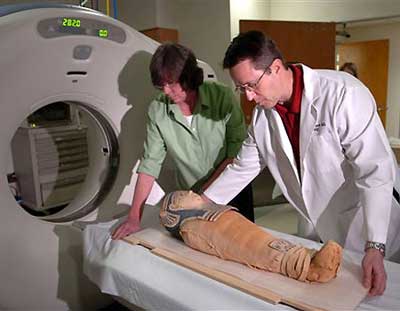
The mummy of a child from ancient Egypt caused scientists to do a bit of a double-take when they performed a CT scan on the body – images revealed that a spear-like object was wedged inside the child’s skull and upper spine!
CT scans are commonly performed on mummies so that not all bodies need to be unwrapped for study – in many cases, the mummies are so fragile that unwrapping them might potentially destroy the remains. Instead, X-rays on the body reveal things like how a person was wrapped and buried, the condition of the skeleton, and whether there are any added items inside the wrappings such as jewelry or ornamentation.
The child with a spear in its head was probably between three and five years old when it was buried, and the scan seemed to show that the child had an unusually large head. While scientists haven’t been able to pinpoint the cause of the abnormality, the bone structure of the head and face may result in a facial recreation sometime over the next several years.
However, the primary question still remains – was the spear in the child’s head a cause of death, or did the embalmers insert the spear in order to keep the head and neck steady during the mummification process. Either explanation is entirely plausible, though the former explanation is far more disturbing to consider.
Want to read more?


Tomorrow: Pre-History’s Next Top Model
By: The Scribe on November, 2007
 A 2,400-year-old shipwreck off the coast of the Greek island of Chios in the Aegean sea contained a rather tasty surprise – DNA testing on the insides of some of the amphorae yielded a recipe for Greek salad dressing! The shipwreck currently lies 70 meters deep, and is located about a kilometer away from Chios.
Scientists were able to obtain samples of the ancient dressing after sending several underwater robots down to the shipwreck to collect two of the jars. Amphorae were used by the ancient Greeks and Romans to transport liquids and other commodities – things like wine, oil, spices, grain, or olives – and are shaped like large cones. Since they’re made out of earthenware pottery, they have an incredible lifespan, preserving for hundreds of thousands of years, even underwater!
Studies on amphorae from shipwrecks often help to reveal the country of origin of the ship and how old it was, and it isn’t unusual for the jars to often still contain remains of their original contents – finds like this have helped to dramatically increase the amount of information available on trade in the ancient Mediterranean.
 The DNA contents of the amphorae from this shipwreck revealed several common yet interesting ingredients: the jars contained olive oil mixed with oregano. This came as a bit of a surprise to archaeologists, since the island the ship had left from was a major exporter of fine wines – it had been assumed that any ship leaving Chios would have held plenty of amphorae full of wine.
While further investigations revealed that another amphora from the ship likely contained wine – which means there was probably plenty aboard – the oregano-flavored oil seems to have been the primary trade item on this vessel, making up at least two-thirds of the 350 amphorae found on the ship.
It’s likely that strong winds developed soon after the ship left port, causing it to capsize without warning. It is fairly common for the area around Chios to develop sudden storms or fluke winds that are exceedingly dangerous for sailing, however since they are unpredictable, sailors couldn’t simply not leave port for sake of potential trouble.

As a result, it turns out that not only did the ancient Greeks like their salad dressing, but the island of Chios was responsible for a more diverse agricultural program than previously assumed. These people certainly knew what they were doing, as well – in the rural areas of modern Greece, the older women are well aware that adding oregano and other spices to oil helps not only to increase the flavor, but also to preserve the life of the oil much longer.
By exporting flavored oil with an intentional longer lifespan, it’s possible that this ancient preservation method accidentally helped to preserve the oil’s DNA for archaeologists to find two thousand years later.
Want to read more?


Tomorrow: Baby Spears – but not the Britney kind.
By: The Scribe on November, 2007
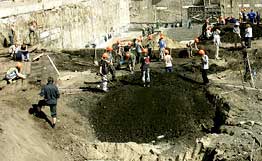 Near Lake Evoron in the Far East of Russia, an ancient camping site has been discovered which was the temporary home of hunters during the Ice Age for their hunting excursions.
The camp dates to approximately 13,000 BC, which is an incredible find – primarily because so little is known about the Ice Age which occurred in that time period. It is a point in history that is poorly studied, primarily because of how little archaeological evidence remains from that era.
The site was found in 2007 while researchers were on an archaeological expedition to Lake Evoron, and it is situated next to the Amur River. It appears to be the largest of four Stone Age sites from the area, and it was the discovery of several artifacts that pointed toward the site’s use as a mammoth hunting camp.
Several stone arrowheads, flint pikes, and a stone scraper were found here, and if the site is excavated, those few pieces could multiply into hundreds of stone tools, likely buried at a moderate depth below the surface.
The discovery of ancient sites in this area of Russia isn’t unusual – in 2006, an Iron Age burial mound was found with a piece of iron dagger, though it dated only to around 500 BC. This Paleolithic campsite is obviously much, much older, and may point toward a better understanding of this little-known time when the world was covered in ice.
Want to read more?


Tomorrow: Ancient Salad Dressing
Previous page | Next page
